World Market for Oncology Imaging AI - Markintel Horizon Report (December 2025)

Individual License: $4,950 | Team and Enterprise License Options Available


Key Takeaways

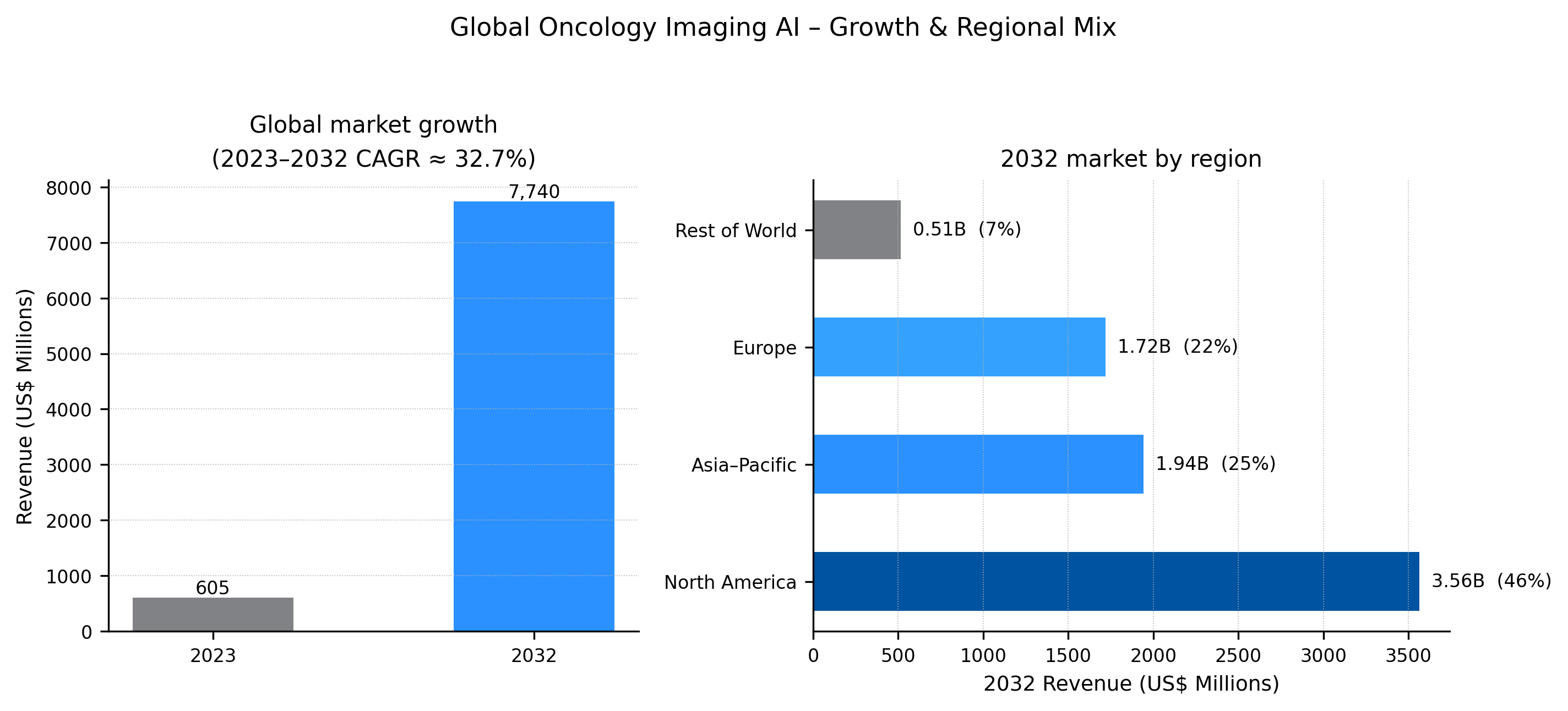
  • Oncology Imaging AI grows from US$604.7M in 2023 to US$7.74B by 2032, a 32.7% CAGR, with spend concentrating in CT, X‑ray/DBT, and MRI and accelerating around screening, treatment planning, and response assessment.
  • The report maps how value pools shift along the oncology pathway—from screening and detection to RT planning, PET dosimetry, and longitudinal response tracking—rather than treating “AI” as a single bucket.
  • A cluster-based competitive architecture (AI Software, Imaging OEMs, RT/Oncology Planning, AI Platforms & Cloud, Providers & Teleradiology, Imaging‑Pharma/CRO & Trials) translates market structure into concrete GTM and partnership moves.
  • The analysis is anchored in Marketstrat’s Markintel™ framework stack—M³, ARC‑Index, GTM Growth–Maturity, and Upgrade & Package Ladders—so findings go beyond “where the money is” to “how to win” in each cluster.


Download Table of Contents


World Market for Oncology Imaging AI – Markintel™ Horizon Report (2023–2032)

This Horizon report is Marketstrat’s dedicated deep dive on how AI is reshaping oncology imaging pathways globally—from breast and lung screening to complex CT/MRI staging, PET-based theranostics, and RT planning. The analysis quantifies the global market for Oncology Imaging AI from 2023 through 2032, then layers in a full competitive and GTM lens tailored to vendors, providers, and investors.


The report measures all imaging-centric AI software and AI‑linked revenue deployed across the oncology pathway (screening, detection, staging, treatment planning, response, and surveillance) across five core modalities—CT, X‑ray/DR (incl. DBT), MRI, PET/Nuclear, and Ultrasound—and a full buyer set spanning cancer centers, IDNs/AMCs, community providers, and teleradiology networks.


Beyond sizing, the study is structured as a practical playbook. Each major stakeholder cluster—AI software vendors, imaging OEMs, RT/TPS players, AI platforms & cloud orchestrators, provider/telerad networks, and imaging‑pharma/CROs—is analyzed through Markintel’s proprietary strategy frameworks, with explicit recommendations on attach‑rate expansion, packaging, evidence building, and partnership models. The goal is not just to explain the market, but to help decision makers sequence investments, shape offers, and defend margins in a fast‑moving but noisy category.
 

Market Snapshot

Oncology Imaging AI has moved from experimental pilots to a fast‑scaling market. The report sizes a global opportunity that expands more than 10x between 2023 and 2032, with a compound annual growth rate in the low‑30s. North America remains the largest revenue pool over the horizon, but Asia–Pacific is the fastest‑growing region, overtaking Europe on momentum as national breast and lung programs, domestic OEMs, and cloud‑first deployments ramp. Europe stays a strong second engine, with adoption paced by MDR, HTA, and national screening strategies.


Most spend concentrates in CT, X‑ray/DBT and MRI oncology workflows, with PET/Nuclear and Ultrasound forming smaller but high‑value niches tied to theranostics, quantification, and interventional oncology. The mix of value pools also shifts along the pathway: Detection & Diagnosis remains foundational, but more spend migrates toward screening, treatment planning, and response assessment, where lesion‑level segmentation, dosimetry, and structured reporting are becoming mandatory for modern cancer programs.


The report quantifies Oncology Imaging AI across regions and countries, modalities, tumor sites, clinical applications, pathway stages, revenue streams, and end‑use settings (cancer centers, IDNs/AMCs, community providers, teleradiology). Detailed numbers are reserved for report buyers; the public snapshot is directional by design.


What’s Covered

  • Global market sizing & forecast (2023–2032) – total Oncology Imaging AI market today and through 2032, with growth outlook, scenario commentary and key inflection points along the decade.

  • Granular segmentation of value pools – analysis by modality, tumor site, clinical application, pathway stage, revenue stream and end-use setting (cancer centers, IDNs/AMCs, community hospitals, imaging centers, teleradiology), aligned with the broader Markintel™ AI-in-Imaging taxonomy.

  • Regional & country perspectives – detailed views for North America, Europe, Asia-Pacific, Latin America and Middle East & Africa, including commentary on leading and fast-growth countries, screening initiatives, and local regulatory/reimbursement dynamics.

  • Clinical & technology trends across the oncology pathway – how AI is being deployed from breast and lung screening through CT/MR staging, RT planning, PET theranostics and longitudinal response assessment, with use-case mapping to Screening, Diagnosis, Staging, Planning, Response and Surveillance stages.

  • Regulatory, reimbursement and evidence landscape (ARC) – assessment of Approvals, Reimbursement and Clinical validation by key use case (e.g., DBT AI, CT-lung, adaptive RT, PET response, radiomics), including where Oncology Imaging AI is deployment-ready vs where it remains pilot-only.

  • Competitive landscape by cluster – analysis of six major competitive clusters (AI Software, Imaging OEMs, RT/TPS vendors, AI Platforms & Cloud, Providers & Teleradiology, Imaging-Pharma/CRO & Trials), with GTM Growth–Maturity positioning and qualitative company spotlights.

  • GTM & packaging strategies – Markintel Upgrade & Package Ladders for each cluster (Foundation / Advanced / Elite), recommended commercial and pricing rules, channel and partnership strategies, and implications for attach-rate expansion and suite-based selling.

  • Strategic implications & scenarios – cross-cutting insights on where Oncology Imaging AI is likely to become “workflow-critical infrastructure,” how APAC’s faster growth changes global competition, and what boards, product leaders and investors should prioritize over the next 3–5 years.


Key Market Drivers & Restraints

The report ranks and explains growth drivers and structural restraints, helping leaders separate hype from durable momentum.


Primary growth drivers

  • Rising oncology burden & tighter guidelines
    Aging and urbanizing populations, coupled with stricter breast, lung, colorectal, and prostate screening guidelines, are driving higher imaging volumes and raising the bar for consistency, speed, and quantitative rigor. Oncology Imaging AI directly targets this complexity for radiologists, oncologists, RT teams, and tumor boards.
  • National screening and early‑detection programs
    Large‑scale breast DBT and LDCT lung programs across North America, Europe, China, Japan, and select middle‑income markets increasingly embed AI into their standard operating models—triage, second reads, QA, and centralized reading. AI becomes a budgeted program line item, not a pilot.
  • Theranostics, PET quantification, and RT planning
    The rise of PSMA/SSTR theranostics, advanced PET/CT, and more sophisticated RT planning demands multi‑timepoint, lesion‑level measurements and dosimetry that are difficult to deliver consistently without AI. Oncology Imaging AI becomes a natural component of theranostic and RT ecosystems.
  • Productivity and workforce constraints
    Chronic shortages of radiologists and RT staff—combined with the complexity of oncology cases—create structural demand for tools that save time, standardize contours, and reduce rework, even where explicit reimbursement is limited.
  • Platformization and cloud delivery
    PACS‑integrated marketplaces, orchestrators, and cloud‑based AI platforms are reducing integration friction, enabling multi‑vendor oncology AI portfolios under a single contract and governance framework.
  • Regulatory and evidence velocity
    Multi‑region clearances and multi‑site RWE for leading oncology AI solutions improve ARC (Approvals, Reimbursement, Clinical Validation) scores and encourage health systems to move from pilots to scaled deployment.


Key restraints

  • Fragmented reimbursement and slow payer signals, outside a few headline use cases.
  • Evidence heterogeneity and generalizability concerns (hardware, population, workflow variability).
  • Data‑governance and localization constraints across GDPR, HIPAA, and country‑specific rules.
  • IT fragmentation and ongoing integration burden within complex hospital environments.


The report articulates strategic implications for each driver/restraint pair—for example, how to design attach‑ready bundles in high‑volume screening programs, or how to prioritize RWE and ARC improvements where reimbursement is not yet explicit.


Competitive Landscape

Marketstrat organizes Oncology Imaging AI into a cluster-based competitive architecture, making it easier to see where different types of vendors sit and how they interact:

  • AI Software – pure‑play and platform vendors building oncology algorithms (DBT, CT‑lung, radiomics, response analytics, auto‑contouring).
  • Imaging OEMs – modality vendors embedding oncology AI into CT, MR, X‑ray/DBT, PET, and ultrasound fleets as part of scanner packages and oncology “rails.”
  • RT & Oncology Planning – TPS and planning vendors for contouring, QA, adaptive RT, and response‑linked planning.
  • AI Platforms & Cloud – orchestration, marketplaces, and AI‑ops stacks integrating multi‑vendor oncology AI into enterprise imaging environments.
  • Providers & Teleradiology – health systems and telerad networks turning oncology AI into frontline services (screening, tumor‑boards, response services).
  • Imaging‑Pharma & CRO / Trials – iCROs and imaging‑pharma firms using AI for quantitative endpoints, response analytics, and theranostic programs.


Within each cluster, the report provides:

  • A Markintel GTM Growth–Maturity Matrix, positioning companies in quadrants based on evidence‑weighted growth and GTM maturity scores.
  • A Competitive Dataset by quadrant, standardizing fields such as oncology focus, channels, evidence posture, geographic strength, and key partnerships.
  • Company spotlights in the highest‑relevance clusters (e.g., leading AI software vendors and OEMs), each with a concise view of core oncology offerings, platform leverage, regulatory posture, and Marketstrat’s strategic take.


Together, the cluster architecture and frameworks help readers answer concrete questions:

  • Which clusters are best positioned to monetize specific oncology value pools (e.g., PET dosimetry vs DBT screening vs MRI quant)?
  • Which vendors have credible paths to multi‑region oncology programs—and which are structurally constrained?
  • Where should OEMs, platforms, or providers look for partners versus build/buy options?

Companies Covered

5C Network; Accuray; Aidoc; AIQ Solutions; Bracco; Brainlab; Canon Medical; CARPL.ai; deepc (deepcOS); DocPanel; Elekta; Everlight Radiology; Ferrum Health; Fujifilm Healthcare; GE HealthCare; Guerbet; Hologic; Incepto; Koios Medical; Lantheus / EXINI (aPROMISE / PYLARIFY AI); Limbus AI; Lunit; Median Technologies; MIM Software; Mirada Medical; MVision AI; Nuance Precision Imaging Network (PIN); Philips Healthcare; Quibim;
QView Medical; RadNet / DeepHealth; RaySearch Laboratories; Riverain Technologies; Samsung Healthcare; ScreenPoint Medical (Transpara); Siemens Healthineers; Teleradiology Solutions; Tempus (Arterys); Therapixel (MammoScreen); Unilabs / Telemedicine Clinic (TMC); United Imaging; Vara; vRad.


The list is cluster‑balanced—it includes AI software specialists, modality OEMs, RT/TPS vendors, platform players, provider/telerad networks, and imaging‑pharma/iCROs that feature in the oncology analysis.

Methodology & Frameworks

The Oncology Imaging AI Horizon report is built on the same Markintel™ methodology, taxonomy, and QA rules used in Marketstrat’s global AI in Medical Imaging program, adapted specifically to oncology.

Scope & segmentation

  • Full country‑level model rolled up to five regions (North America, Europe, APAC, LATAM, MEA).

  • Segmentation by Modality, Tumor Site, Clinical Application, Pathway Stage, Revenue Stream, and End‑Use/Bayer Type, with oncology‑specific taxonomies (e.g., PSMA/SSTR PET, PIRADS prostate MRI, RT planning & contouring).


Dual‑lens architecture

  • Top‑down market funnel – anchors the oncology slice within the broader AI in medical imaging market, ensuring consistency with other Markintel Horizon reports.

  • Bottom‑up attach‑rate flow – models how oncology AI revenue actually accrues, via attach‑rates to modality fleets, oncology programs, RT/TPS workflows, and cloud/PPU services by country and segment.


Framework stack

The report leverages a stacked framework approach to translate numbers into action:

  • Markintel M³ – Market Momentum Matrix
    Maps oncology sub‑segments (e.g., DBT suites, CT‑lung packs, PET response analytics, auto‑contouring libraries) into Prime Drivers, Emerging Gems, Stable Giants, and Niche/Declining, based on 2023–2032 revenue and CAGR.

  • Markintel ARC‑Index (Approvals, Reimbursement, Clinical Validation)
    Scores key oncology use cases and attach segments on a composite ARC scale and links them explicitly to GTM packages and cluster recommendations.

  • Markintel GTM Growth–Maturity Matrix
    Uses 0–100 Growth and Maturity scores to place companies into quadrants at the cluster level, with clear criteria and Evidence Confidence tags (Strong, Moderate, Emerging). Leaders are only recognized where evidence depth and reliability meet defined thresholds.

  • Upgrade & Package Ladders (Foundation → Advanced → Elite)
    A proprietary GTM framework that organizes oncology AI capabilities into tiered packages with recommended commercial rules (e.g., minimum bundle configurations, pricing/discount logic, and when to unlock higher tiers). This addresses a common vendor problem: selling oncology AI as a bag of parts instead of coherent, value‑anchored offers.


Evidence Confidence and QA

The report documents an Evidence Confidence rating for company and segment placements based on density, recency, and independence of sources (regulatory filings, audited financials, multi‑center trials, RWE, documented programs). “Emerging” confidence is reserved for earlier‑stage vendors/use cases and is explicitly kept out of the Leader quadrants.

Intended Audience

This report is designed for decision‑makers with P&L, product, or capital at stake in Oncology Imaging AI, including:

  • Vendors & OEMs

    • AI software companies building oncology imaging applications.
    • Imaging OEMs (CT, MR, X‑ray/DBT, PET/Nuclear, Ultrasound) shaping oncology attach strategies.
    • RT/TPS vendors, AI platforms, and cloud marketplaces integrating oncology AI into enterprise stacks.
  • Healthcare providers & networks

    • Cancer centers, IDNs/AMCs, and community providers designing AI‑enabled oncology pathways and tumor‑board workflows.
    • Teleradiology networks and screening programs looking to industrialize breast, lung, and other oncology services with AI.
  • Pharma, biotech & CROs

    • Clinical development and medical affairs teams using imaging AI for trial endpoints, response quantification, and theranostic programs.

  • Investors & boards

    • Private equity, growth equity, and strategic corporate investors assessing where Oncology Imaging AI is truly scalable—and which clusters and companies are best positioned to capture value over the next 3–5 years.


For all of these audiences, the core promise is consistent with Marketstrat’s Markintel philosophy: not just an accurate market model, but an Insights → Action roadmap—showing where oncology imaging AI is ready to scale, which segments and clusters matter most, and how to translate opportunity into disciplined, repeatable growth.

Report Details

Title World Market for Oncology Imaging AI
Type Markintel Horizon (Flagship, In-Depth)
Estimated Publication December 2025
Number of Pages ~643 (141 Market Data Tables, 344 Figures – Charts, Strategic Frameworks, and Heatmaps)
Format PDF (digital download, direct purchase)
Geographical Coverage
  • North America (US, Canada)
  • Europe (Germany, France, UK, Italy, Rest of Europe)
  • Asia Pacific (China, Japan, India, Rest of Asia-Pacific)
  • Latin America
  • Middle East & Africa
Market Segmentation
  • By Modality (CT, X-ray/DR. MRI, PET/Nuclear, Ultrasound) 
  • By Geographic Region (see above for Geographic Coverage)
  • By Tumor Site (Breast, Lung/Chest, Prostate, Colorectal, Liver, Neuro-Onc, Gyn, H&N, Other) 
  • By Clinical Application (Detection/Triage, Seg/Quant, Reporting/NLP, Recon/Dose, Workflow Orchestration) 
  • By Pathway Stage (Screening, Diagnosis, Staging, Planning (RT), Therapy Response, Surveillance
  • By End-Use Org (Cancer Centers, IDNs/AMCs, Community Hospitals, Imaging Centers, Teleradiology)
  • By Revenue Stream (Hardware Uplift, Software Licenses, Services, Cloud/PPU)
  • By AI Technology (Detection, Seg/Quant, Radiomics, NLP/LLM, Governance)
Key Topics Covered
  • Global market sizing & forecast (2023–2032)
  • Granular segmentation of value pools
  • Regional & country perspectives
  • Clinical & technology trends across the oncology pathway
  • Regulatory, reimbursement and evidence landscape (ARC)
  • Competitive landscape by cluster
  • GTM & packaging strategies
  • Strategic implications & scenarios
Methodology Markintel Horizon Research Program – Medical Imaging & AI
Price & Licensing Individual ($4,950), Team ($5,450), Enterprise ($8,950) license options


By submitting this form, you agree to our Privacy Policy