Middle East & Africa (MEA) - Oncology Imaging AI Pulse 2023–2032 Screening Hubs & Next‑Gen Oncology Programs - Markintel™ Pulse Report - January 2026

Individual License: $2,950 | Team and Enterprise License Options Available


The Middle East & Africa (MEA) Oncology Imaging AI market is forecast to grow from US$19.6M in 2023 to US$177.5M by 2032 (27.7% CAGR)—a fast-compounding region where adoption often concentrates in hub systems, cancer centers, and multi-site programs that prioritize standardization, throughput, and clinical governance.


Overview

Middle East & Africa Oncology Imaging AI Pulse 2025–2032 is Marketstrat’s focused regional market sizing and forecasting report on AI in cancer imaging across MEA. It quantifies market growth and identifies where demand concentrates across the oncology imaging pathway—especially in workflows that scale across sites and support constrained specialist capacity.


Coverage includes segmentation and forecasts by:

  • Modality: CT; X‑ray/DR (including mammography/DBT); MRI; PET/Nuclear; ultrasound
  • Tumor site: breast, lung/chest, prostate, colorectal, liver, neuro-oncology, gynecologic, head & neck, other/rare
  • Care pathway stage: screening/risk; detection/diagnosis; staging; treatment planning (including RT); response assessment; surveillance/follow-up
  • Clinical application: detection/diagnosis; quantification/analytics; workflow/orchestration; reporting/communication; reconstruction/acquisition
  • Revenue streams: hardware; software; services; cloud/usage-based (PPU)
  • End-use settings: academic/IDN environments, cancer centers, community providers, and teleradiology networks


This Pulse is designed for commercial teams, platform partners, OEMs, investors, and health systems looking for a clear MEA market baseline and a segmentation-consistent view of opportunity.
 

Market Snapshot
  • Market size (MEA): US$19.6M (2023) → US$177.5M (2032)
  • Growth rate: 27.7% CAGR (2023–2032)
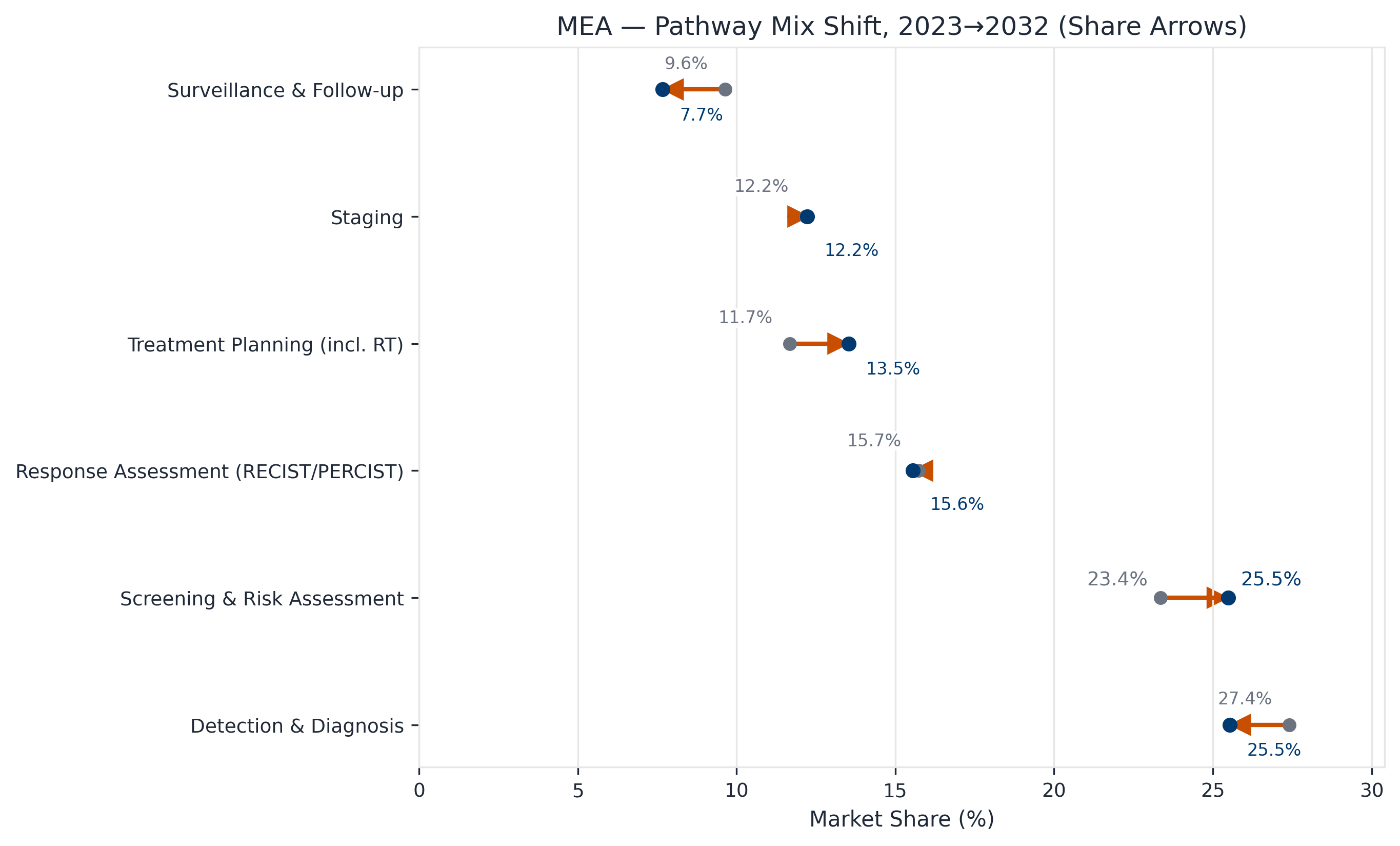
  • Where the market concentrates: Adoption is often hub-led, with a meaningful share of dollars concentrated in screening and diagnostic workflows where AI supports standardization, QA, and throughput.
  • Modality dynamics: CT and X‑ray/DR (including mammography/DBT) typically anchor volume; MRI expands as a premium workflow for staging and quantification; PET/Nuclear grows as a high-value niche as advanced oncology programs scale.
  • Monetization: Software leads, but services and cloud/usage models become increasingly important as deployment complexity, governance expectations, and multi-site rollouts increase.

Key Market Trends (MEA)
  1. Hub-led adoption and “program economics”
    AI adoption in MEA frequently scales through flagship cancer centers and multi-site programs, where protocol standardization and operational control drive purchasing decisions.
  2. Screening and early-pathway workflows remain the near-term engine
    Breast and lung pathways define large volumes and make a compelling ROI case for workflow-native AI (triage, QA, structured reporting).
  3. Services are structurally important
    Deployment, training, monitoring, and workflow redesign frequently determine whether implementations scale beyond pilots—creating a durable services layer alongside software.
  4. Cloud/usage models expand, but deployment flexibility remains essential
    As multi-site networks grow and governance requirements rise, cloud and usage-based models gain share; however, hybrid delivery remains important for varied infrastructure and data policies.
  5. Teleradiology and centralized reading expand access
    Teleradiology is a smaller market segment today but grows quickly, acting as a distribution corridor for AI in regions with limited specialist coverage.


Commercial Snapshot

This Pulse emphasizes commercial rails and adoption economics rather than vendor market shares. Key dynamics include:

  • Tender-driven procurement and enterprise program deployments in high-capability systems
  • High value placed on integration, governance, and implementation certainty
  • Increasing adoption of platform-enabled distribution for multi-vendor AI portfolios
  • Growing relevance of usage-based pricing in centralized reading and network models


Sample Insights & Figures

Readers commonly use this Pulse to answer:

  • What are the largest pools vs fastest-growing pools in MEA by modality and pathway stage?
  • Which tumor sites concentrate the majority of opportunity (typically breast and lung/chest, with prostate as a rising growth lane)?
  • How does cloud/PPU monetization evolve across the decade, and what does that imply for GTM and packaging?
  • Where do end-use settings (IDNs/cancer centers/community/telerad) shape the commercial strategy?


What’s Inside
  • MEA-focused Executive Summary with key market headlines
  • Condensed methodology aligned to this Pulse’s scope
  • MEA market sizing and forecasts (2023–2032) segmented by modality, tumor site, pathway stage, clinical application, end-use, and revenue stream
  • Mix-and-momentum exhibits highlighting where spend concentrates and where incremental dollars accrue


Why This Report

MEA is not a uniform market—and that is exactly why regional forecasting and segmentation matter. This Pulse supports:

  • Market entry and partnership strategy for OEMs, AI vendors, and platforms
  • Portfolio prioritization across high-throughput anchors and premium oncology workflows
  • Commercial planning around procurement patterns, integration requirements, and monetization models
  • Investor diligence by grounding narratives in segmentation-consistent forecasts


Report Stats
  • No. of Pages: 35
  • No. of Figures: 14
  • No. of Tables: 7
  • Price: Individual License: $2,950 | Team License: $3,450 | Enterprise License $3,950
  • SKU: MINTP-M01119-7


By submitting this form, you agree to our Privacy Policy