Global MRI Horizon: Market Structure, Forecasts, and AI Monetization Architecture (2024A–2035E) - February 2026

Individual License: $4,950 | Team and Enterprise License Options Available
 

Key Takeaways
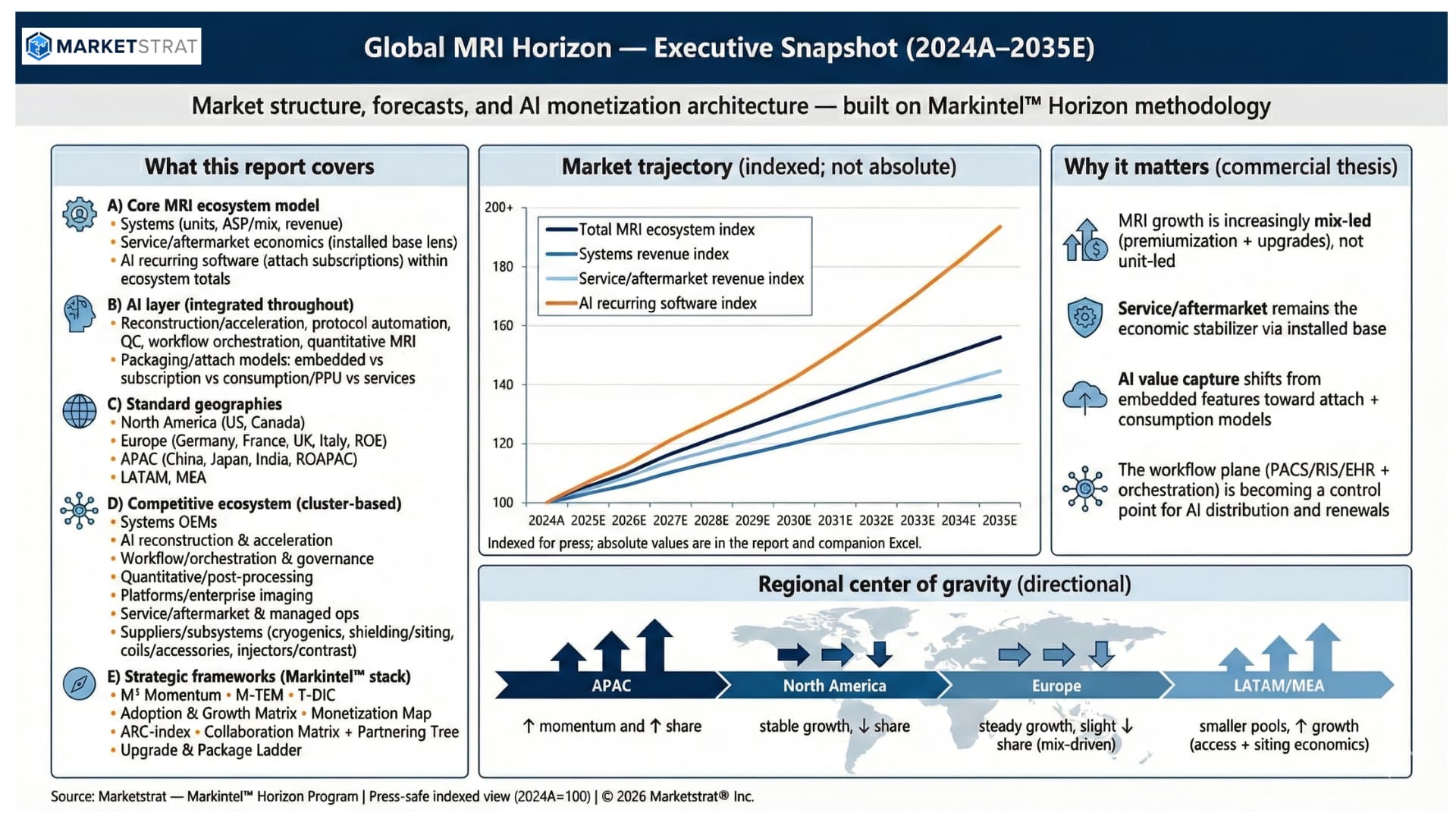
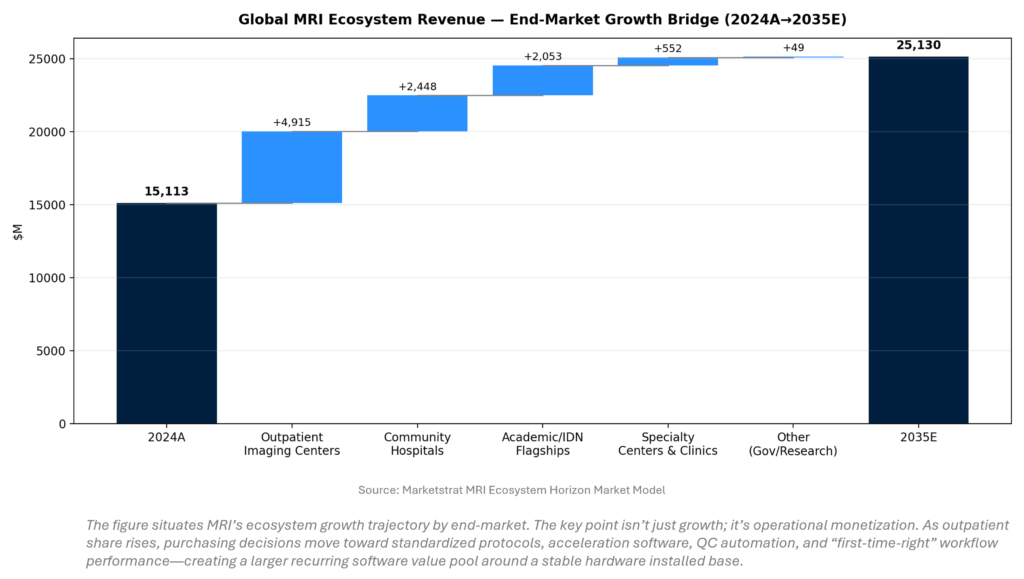
  • The global MRI ecosystem (systems + service/aftermarket + AI recurring software) expands from ~$15.1B (2024A) to ~$25.1B (2035E), with growth increasingly driven by mix, upgrades, and commercialization architecture, not unit volume alone.
  • MRI is entering a structural mix transition: premiumization (3T adoption and upgrade cycles) accelerates while low‑field expands in access‑driven settings, reshaping “what wins” by end‑market and geography.
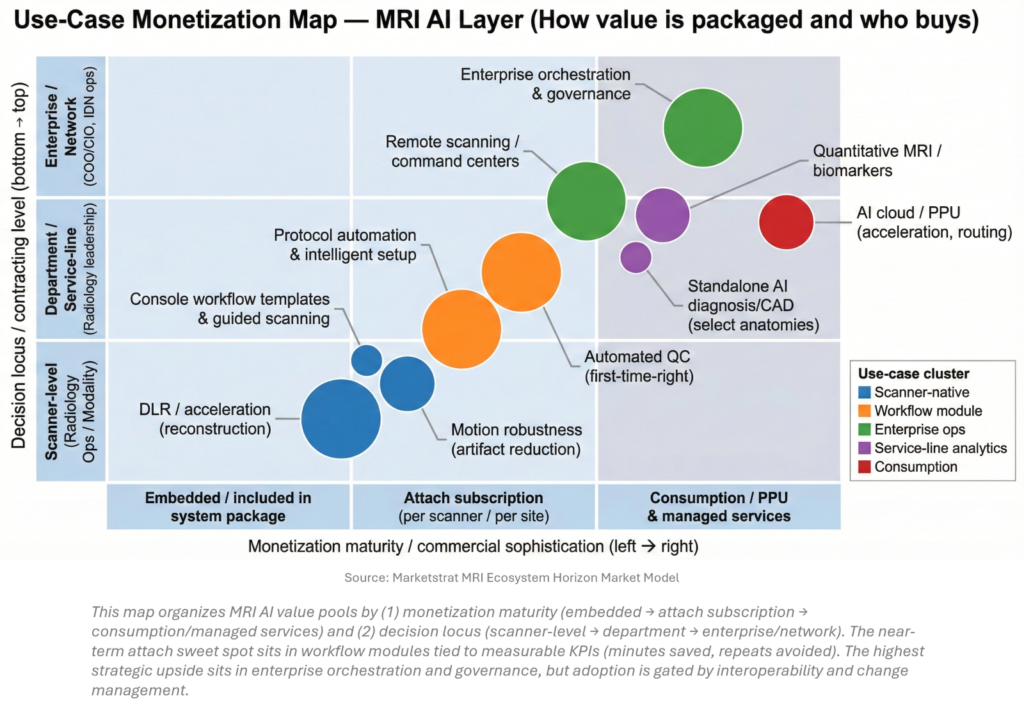
  • The AI layer is not a feature checklist—it is a monetization shift: what starts as console‑native differentiation increasingly moves toward attach subscriptions, enterprise standardization, and consumption economics (cloud/PPU + managed services) as workflow orchestration becomes the control point.
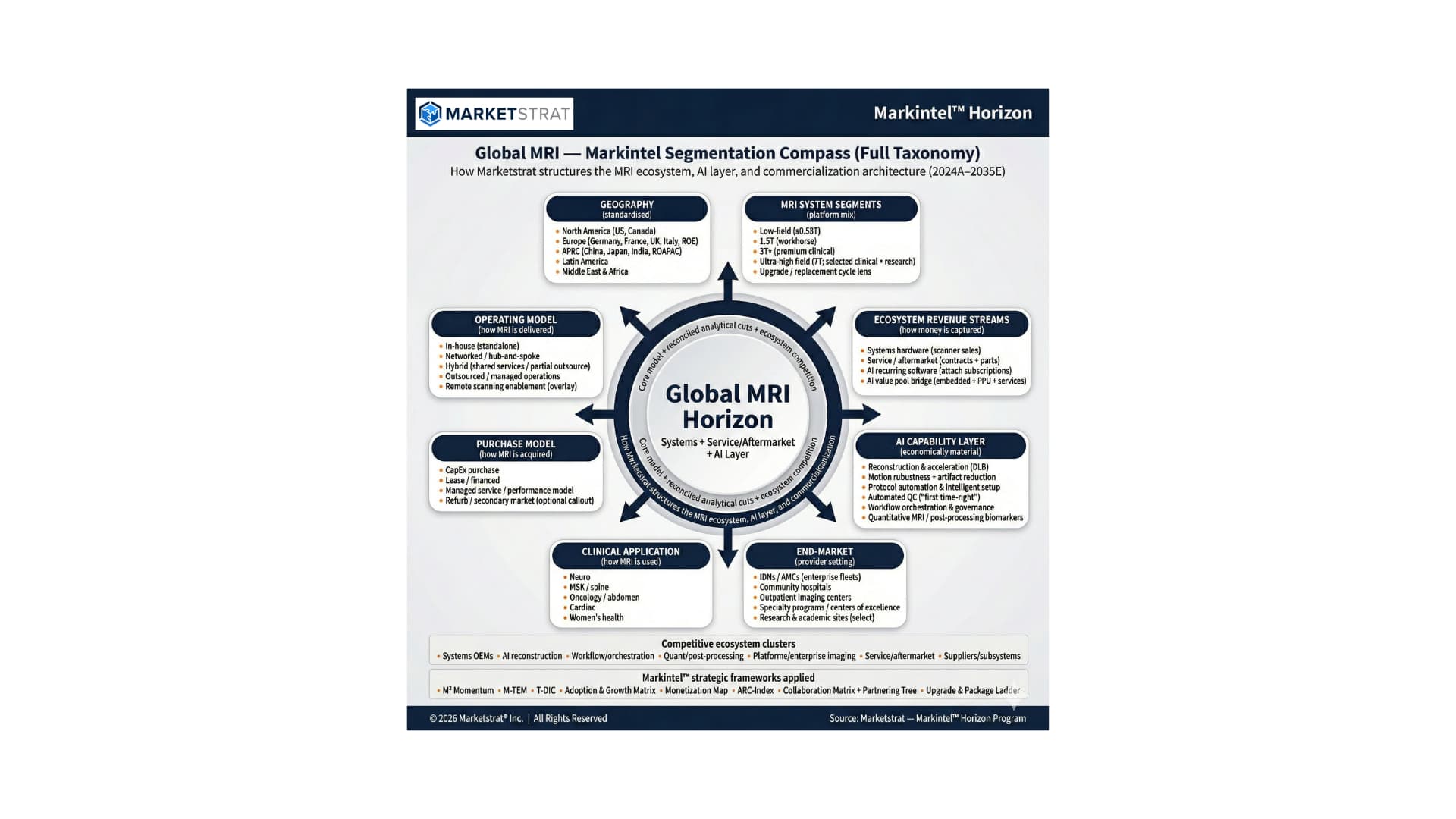
  • Marketstrat organizes the MRI landscape into a cluster-based ecosystem architecture and applies the full Markintel™ framework stack (M³, M‑TEM, T‑DIC, Adoption & Growth Matrix, Use‑Case Monetization Map, ARC‑Index, Collaboration Matrix + Partnering Decision Tree, Upgrade & Package Ladder) to translate sizing into actionable GTM and partnership moves.


Report Overview

This Horizon report is Marketstrat’s in‑depth global analysis of the MRI market—built for MRI OEM executives, strategy and corporate development teams, services/aftermarket leaders, investors, provider procurement/operations, and AI/platform vendors adjacent to MRI.


Unlike conventional MRI market reports that treat AI as an add‑on chapter, this report integrates AI as a first‑class economic and commercialization layer across system mix, upgrades, service/aftermarket economics, workflow, and enterprise contracting.


The goal is not just to describe the market—it is to explain where value is forming, how it is being monetized, and what commercial plays will matter most over the next decade.
Market Snapshot

MRI remains one of the most strategically important imaging modalities because it sits at the intersection of high clinical value, complex operations, and long‑lived installed base economics. Over the horizon, MRI growth is increasingly mix‑led: premium tiers, upgrade cycles, software/AI packaging, and service lifecycle monetization drive value capture more than unit shipment growth.


A second structural shift is underway: MRI economics are becoming more explicitly tied to workflow plane control—protocol standardization, automation/QC (“first‑time‑right”), routing, and remote scanning enablement—rather than scanner performance alone. This is also where AI monetization shifts from embedded value to attach + enterprise + consumption models.


The report quantifies MRI across standardized geographies (North America, Europe, APAC, LATAM, MEA) with consistent country-level rollups and region narratives. Public content on this page is intentionally directional; detailed market tables, country views, and segment sizing are contained in the report and companion Excel deliverables.
Key Market Trends (What is structurally changing)

  • Premiumization and upgrade cycles increasingly determine market winners: attach economics and upgrade ladders shape realized ASP and lifetime value more than feature parity.
  • Low‑field expansion is not “backward”—it is a siting/access play: infrastructure-light deployment, targeted clinical workflows, and cost‑per‑scan economics expand MRI’s reachable footprint.
  • Installed base economics remain central: service contracts and fleet lifecycle decisions (refresh, uptime guarantees, parts availability) shape competitive durability.
  • AI monetization shifts from embedded to operational: reconstruction and automation start as “included” differentiators, but durable monetization increasingly concentrates in enterprise governance, workflow orchestration, and consumption rails.
  • Workflow plane control is becoming a strategic bottleneck: integration surfaces and enterprise standards (PACS/RIS/EHR, scheduling/routing, QC governance) increasingly determine distribution and renewals.
  • Remote scanning enablement moves from niche to operational lever: a workforce and throughput response that reshapes hub‑and‑spoke models and staffing assumptions.
  • Supply chain and siting dependencies (cryogenics, shielding, siting constraints, tariff dynamics) increasingly influence procurement timing, project feasibility, and total delivered cost.
  • Evidence posture matters for scalable AI: economic value is increasingly gated by enterprise adoption requirements (IT security, governance, clinical validation, workflow integration), not algorithm performance alone.


Competitive Landscape (Cluster-Based Ecosystem Architecture)


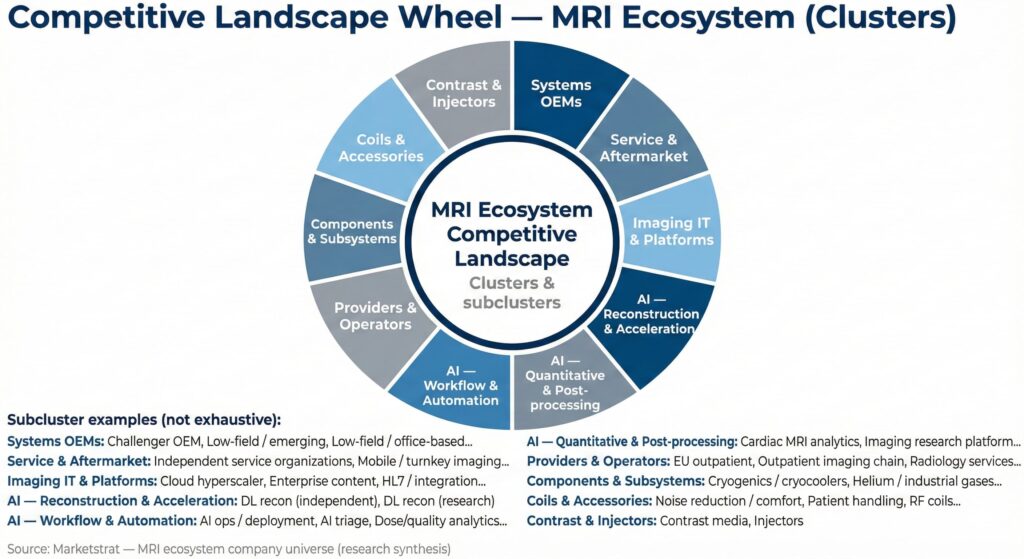
Marketstrat structures MRI competition into clusters to clarify where value is captured and who controls distribution:

  • Systems OEMs (MRI hardware platforms + upgrades + installed base leverage)
  • AI reconstruction & acceleration (scanner-native + OEM-partnered layers)
  • Workflow, automation & orchestration (protocol automation, QC, routing, governance, AIOps)
  • Quantitative MRI & post‑processing (biomarkers, longitudinal analytics, service-line enablement)
  • Platforms & enterprise imaging layers (PACS/VNA/workflow planes)
  • Service & aftermarket (ISOs, managed operations, uptime + lifecycle monetization)
  • Suppliers & subsystems (cryogenics, shielding/siting, coils/accessories, injectors/contrast ecosystem)


Within clusters, the report applies Markintel frameworks and evidence‑weighted competitive datasets, plus concise company spotlights that explain:

  • where the moat sits (distribution vs tech vs workflow lock‑in)
  • how revenue is captured (bundle vs attach vs consumption vs services)
  • what signals to watch over the next 12–24 months.


Company Spotlights

Affidea; AGFA HealthCare; Aidoc; Air Liquide; Air Products; AIRS Medical; Alliance Medical; Amazon Web Services (AWS); Amuneal; Analog Devices; Avante Health Solutions; Bayer; Blackford Analysis; Block Imaging; Bracco; Bruker; Canon Medical Systems; Circle Cardiovascular Imaging; Cortechs.ai; Cryomech; EnvoyAI; Epic; Esaote; ETS-Lindgren; Flywheel; Fujifilm (Synapse); Fujifilm Healthcare (incl. Hitachi legacy); Furukawa Electric; GE HealthCare; Google Cloud; Guerbet; Hyland; Hyperfine; Icometrix; InHealth; Integrity Imaging; Intelerad; Japan Superconductor Technology (JASTEC); Kopp Development; LeanTaaS; Linde; Mach7 Technologies; MediGlobe; Medis Medical Imaging; Metrasens; Microsoft (Azure); Nemoto Kyorindo; Neusoft Medical; NORAS MRI products; Nuance (Microsoft); Oracle Cerner; Paramed Medical Systems; PartsSource; Perspectum; Philips; Philips (IntelliSpace); Pneumacoustics (Serene Sound); Pro Medicus (Visage); Promaxo; Quibim; Qure.ai; Qynapse; Radiology Partners; RadNet; RadNet (DeepHealth); RAPID Biomedical; Sectra; Shared Medical Services (SMS); Siemens Healthineers; Soma Tech Intl; Subtle Medical; Sumitomo Electric Industries; Sumitomo Heavy Industries (SHI); SyntheticMR; Texas Instruments; Time Medical; ulrich medical; United Imaging Healthcare; Vista.ai (Formerly HeartVista); Viz.ai; vRad (Virtual Radiologic); Wandong Medical.
Methodology & Frameworks

The report is built on Marketstrat’s Markintel™ Horizon program, combining:

  • a reconciled core market model (systems, installed base, service, AI recurring),
  • an AI Bridge View that clarifies embedded vs attach vs consumption economics, and
  • publishable analytical cuts that allocate and reconcile back to the same totals (checksums).


The framework stack is applied as an “insight-to-action engine,” including:

  • M³ Market Momentum Matrix (segment/revenue-stream momentum)
  • M‑TEM (technology maturity scoring)
  • T‑DIC (diffusion curve: stage + time-to-mainstream + impact)
  • Solution Adoption & Growth Matrix and Use‑Case Monetization Map
  • ARC‑Index (Approvals / Reimbursement / Clinical validation) for economically material AI capabilities
  • Ecosystem Collaboration Matrix + Partnering Decision Tree
  • Upgrade & Package Ladder (systems + AI + service sequencing)

What’s Covered

  • Core global market model (2024A–2035E)
    MRI systems (units, ASP/mix logic, revenue), installed base, and service/aftermarket economics—built as a reconciled ecosystem view.
  • AI layer integrated throughout
    Reconstruction/acceleration, motion/QC, protocol automation, workflow orchestration/governance, and quantitative post‑processing—analyzed as economic value pools with packaging/attach logic.
  • Standardized country and regional views
    • North America: US, Canada
    • Europe: Germany, France, UK, Italy, Rest of Europe
    • APAC: China, Japan, India, Rest of APAC
    • Latin America, Middle East & Africa
  • Publishable analytical cuts reconciled back to the model
    End‑market mix, clinical application mix, purchase model mix, operating model mix, and AI capability mix—explicitly reconciled to the same totals (checksums).
  • Competitive landscape organized by ecosystem clusters
    A practical competitive architecture that shows how OEMs, software/AI vendors, platforms, service providers, and suppliers interact—and where moats sit.
  • Commercial architecture and “how to win” frameworks
    Upgrade & Package Ladder, ARC‑Index for economically material AI capabilities, partnering decision logic, and explicit “Insights‑to‑Action” recommendations.

Intended Audience

This report is designed for decision-makers with product, commercial, operational, or capital exposure to MRI, including:

  • Imaging OEM executives (strategy, product, services, corporate development)
  • AI reconstruction, workflow/orchestration, and quantitative MRI vendors
  • Enterprise imaging platform vendors and cloud/marketplace players
  • Provider procurement, radiology operations, and IDN leadership
  • Investors, banks, and private equity evaluating consolidation and value capture paths
  • Suppliers and ecosystem partners exposed to MRI siting, cryogenics, shielding, coils, accessories, and contrast/injectors.

Report Details

  • Title: Global MRI Horizon: Market Structure, Forecasts, and AI Monetization Architecture (2024A–2035E)
  • Type: Markintel™ Horizon (Flagship, In‑Depth)
  • Publication: February 2026
  • Report ID: MINTH‑M02102
  • Length: ~296 pages (111 market data tables, 86 figures including strategic frameworks)
  • Format: PDF (digital delivery) + companion Excel deliverables (model + data tables)
  • Geographical Coverage:
    North America (US, Canada) | Europe (Germany, France, UK, Italy, ROE) | APAC (China, Japan, India, ROAPAC) | LATAM | MEA
  • Market Segmentation (core + analytical cuts):
    • Systems segmentation (field-strength tiers)
    • Ecosystem revenue streams (systems, service/aftermarket, AI recurring; AI bridge value pools)
    • End-market, clinical application, purchase model, operating model
    • AI capability layer (recon/accel, motion/QC, protocol automation, orchestration, quantitative MRI)
  • Price & Licensing Options: Individual ($4,950), Team ($5,450), Enterprise ($8,950)


About Marketstrat

Marketstrat® is a market intelligence and GTM enablement firm focused on medtech, healthcare, and life sciences. Under the Markintel™ brand, Marketstrat delivers robust market intelligence and proprietary frameworks; through GrowthEngine advisory and tools, it helps clients turn insights into execution. Together, these capabilities support clients in converting evidence‑weighted insight into practical action across strategy, product, and commercial execution.


Marketstrat® and Markintel™ are trademarks of Marketstrat Inc. All other trademarks are the property of their respective owners.


Check out free Research and InsightsStrategic Frameworks & Market Signals and Analysis of Industry Events


Check out our collection of Markintel Horizon and Markintel Pulse research.


Check out details on our reports, World Market for AI in Medical Imaging and World Market for Oncology Imaging AI and other Pulse Reports in the Imaging space.

By submitting this form, you agree to our Privacy Policy