Global Ultrasound Horizon: Market Structure, Forecasts, and AI Monetization Architecture (2024A–2035E) - April 2026

Individual License: $4,950 | Team and Enterprise License Options Available
 

Key Takeaways
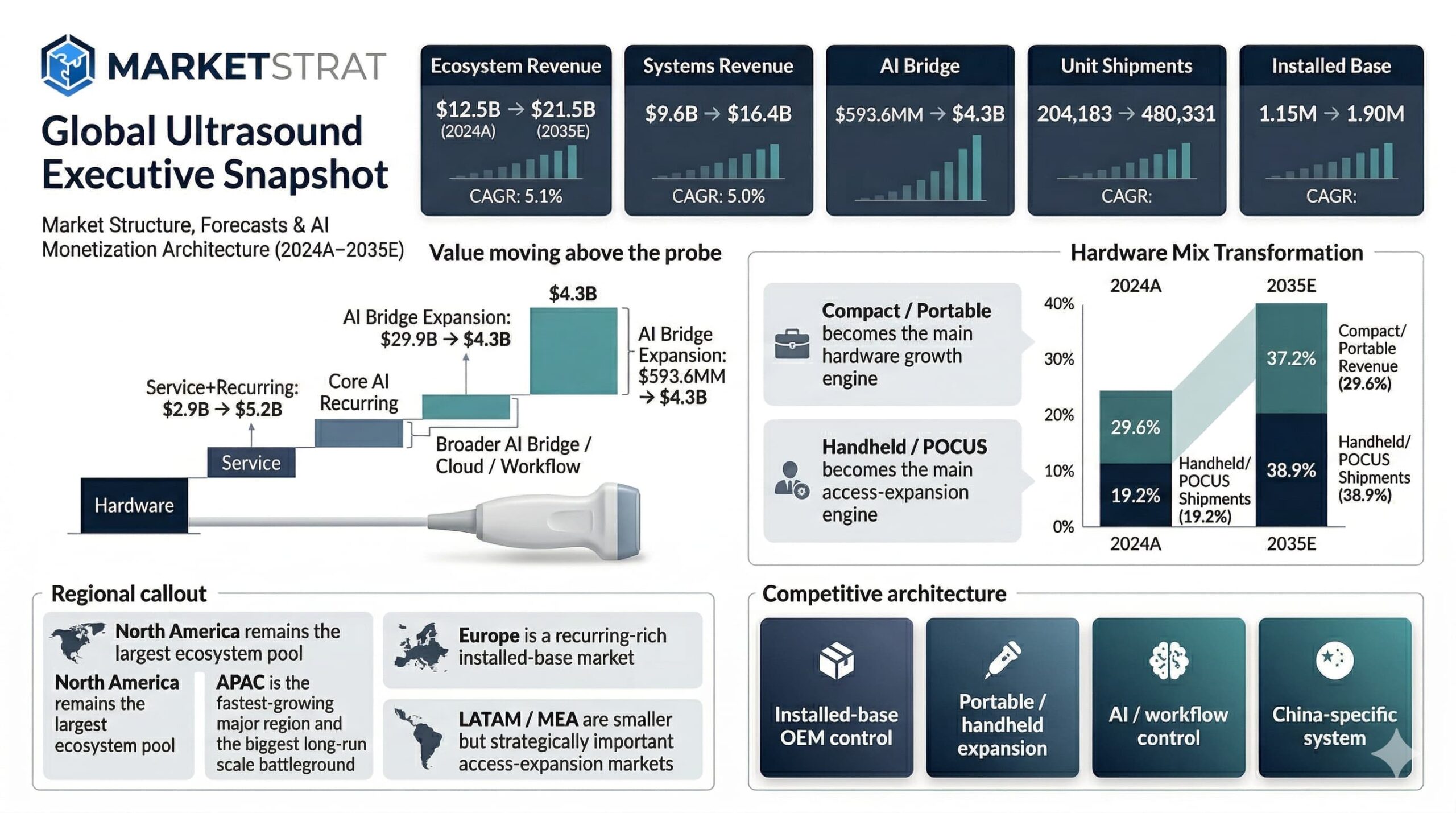
  • The global ultrasound ecosystem expands from $12.5B (2024A) to $21.5B (2035E), as the market broadens beyond hardware into service, workflow, and AI-linked monetization.
  • Ultrasound is entering a structural two-speed transition: premium and midrange carts remain the value core, while compact / portable and handheld / POCUS expand the addressable user base and site-of-care footprint.
  • The AI layer is not a feature checklist — it is a monetization architecture shift. The broader AI bridge grows from $593.6MM to $4.3B, with increasing value moving toward software, cloud / PPU, services, workflow, and governance.
  • Marketstrat structures ultrasound competition through a cluster-based ecosystem architecture and applies the full Markintel™ framework stack to translate sizing into actionable GTM, packaging, and partnership priorities

Report Overview

This Horizon report is Marketstrat’s in-depth global analysis of the ultrasound market and broader ultrasound ecosystem — built for ultrasound OEM executives, strategy and corporate development teams, services / aftermarket leaders, providers, investors, and AI/workflow vendors adjacent to imaging. The report integrates ultrasound hardware, installed-base economics, service / aftermarket revenue, core AI recurring revenue, the broader AI bridge, market-structure views, competitive architecture, and strategic frameworks into one reconciled decision model.


Unlike conventional ultrasound reports that treat AI as an add-on chapter, this report treats AI as a first-class commercialization layer across acquisition guidance, reporting, quantification, cloud orchestration, enterprise governance, and recurring monetization. The goal is not just to describe the market — it is to explain where value is forming, how it is being monetized, how competition is reorganizing, and which commercial moves matter most over the next decade.

Market Snapshot

Ultrasound is broadening faster than it is premiumizing. World systems revenue rises from $9.6B in 2024A to $16.4B in 2035E, while annual shipments increase from 204,183 to 480,331 units and installed base expands from 1.15M to 1.90M units. That means the market is adding many more devices into many more settings than a simple topline revenue view suggests.


The more important structural shift sits above hardware. Total ecosystem revenue grows from $12.5B to $21.5B, while service + core AI recurring rises from $2.9B to $5.2B and the broader AI bridge expands from $593.6MM to $4.3B. In other words, the next value pool is increasingly tied to workflow, reporting, governance, cloud review, and software-linked operating leverage rather than to hardware ASP alone.
 

Key Market Trends (What is Structurally Changing)

  • Compact / Portable becomes the main hardware growth engine. It rises from 29.6% of systems revenue in 2024A to 37.2% in 2035E and becomes the largest single hardware segment.
  • Handheld / POCUS becomes the main access-expansion engine. It remains smaller in revenue than carts, but its shipment share expands from 19.2% to 38.9%, signaling a major shift in where and by whom ultrasound is used.
  • The market is becoming more software-defined. The report’s central thesis is that value is migrating above the probe into acquisition guidance, structured reporting, QA, governance, cloud review, and enterprise workflow insertion.
  • Regional growth and monetization are diverging. North America remains the largest revenue pool, Europe remains an installed-base and recurring-rich market, APAC is the fastest-growing major region and biggest long-run scale reservoir, while LATAM and MEA remain smaller but strategically important for portability, value-tier positioning, and service-network execution.
  • China now requires a separate strategy. The report treats China as a distinct competitive system shaped by procurement, domestic substitution, local AI, value-tier scale, and export ambition rather than as just another regional sub-market.

Competitive Landscape (Cluster-Based Ecosystem Architecture)

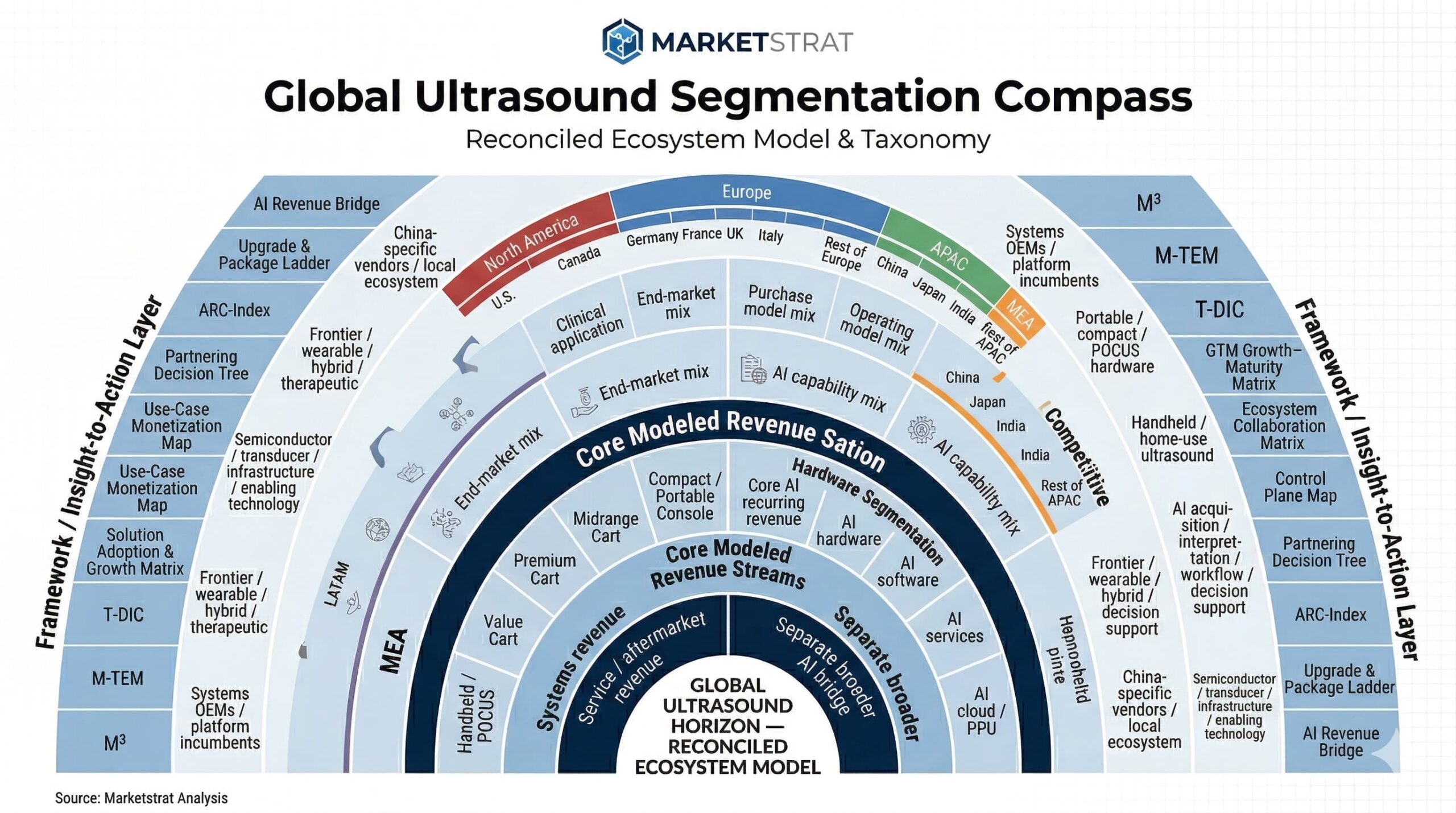
Marketstrat structures the ultrasound ecosystem into clusters to clarify where value is captured and who controls distribution, workflow, and monetization. The report organizes the market into:

  • Systems OEMs / platform incumbents
  • Portable / compact / POCUS hardware
  • Handheld / home-use ultrasound
  • AI acquisition / interpretation / workflow / decision support
  • Frontier / wearable / hybrid / therapeutic
  • Semiconductor / transducer / infrastructure / enabling technology
  • China-specific vendors / local ecosystem


Within and across those clusters, the report explains:

  • where the moat sits (distribution vs workflow vs platform control),
  • how revenue is captured (bundle vs attach vs enterprise subscription vs cloud / PPU vs services),
  • and what to watch over the next 12–24 months. The report specifically identifies GE HealthCare, Philips, Mindray, Samsung Medison, Siemens Healthineers, Canon Medical, FUJIFILM Sonosite, Butterfly Network, Clarius, Exo, UltraSight, BrightHeart, Sonio, Us2.ai, AS Software, SonoScape, and more than 60 additional ecosystem participants.


Companies Discussed

AISAP, AS Software, ASUS LU800, Biotics AI, Boston Scientific, Brainsonix, BrightHeart, Butterfly Network, Canon Medical Systems, Caption Health, Carthera, Chison, Clarius Mobile Health, DeepHealth / See-Mode, DeepSight Technology, DiA Imaging Analysis, Diagnoly, DolphinSonic, EchoNous, EndoSound, Esaote, ESI, Evident Vascular, EXACT Therapeutics, Exo, Fiyano, Flosonics Medical, FUJIFILM / FUJIFILM Sonosite, GE HealthCare, Gestalta, Healcerion, HeartFocus / DESKi, HeartLab, HistoSonics, Hitachi, Huasheng Medical, iCAD, imec, Infineon Technologies, Intelerad Medical Systems, Intelligent Ultrasound / Surgical Science, iSono Health, Koios Medical, Konica Minolta, Laza Medical, MAUI Imaging, MediReport, Merge Labs, MicroPort Lifesciences, Mindray, MyCardium AI, NerveBlox, NICAMED, NVIDIA, Openwater, Oxailis, OxSonics Therapeutics, Petal Surgical, Philips, PIUR Imaging, Pulsenmore, Qure.ai, RadNet / DeepHealth, Resolve Stroke, Rivanna Medical, Samsung Medison, Sanmai Technologies, SecondWave Systems, Seno Medical, Shantou Ultrasound / SIUI, Siemens Healthineers, Softsonics, SonALAsense, Sonic Incytes, Sonio, SonoScape, Sonus Microsystems, SuperSonic Imagine, ThinkSono, TodoPocus, TRS Technologies, TSMC, TTP, UltraSight, Ultrasound AI, Ultromics, United Imaging Healthcare, Us2.ai, Vave Health, Ventripoint Diagnostics, Verasonics, Vermon, Wandong Medical

Methodology & Frameworks

The report is built on Marketstrat’s Markintel™ Horizon methodology, combining:

  • a reconciled core market model,
  • an AI bridge that clarifies embedded vs recurring vs cloud/consumption economics,
  • and publishable market-structure views that reconcile back to the same totals.


The full Horizon framework stack is applied as an insight-to-action engine, including:

  • M³ Market Momentum Matrix
  • M‑TEM
  • T‑DIC
  • Solution Adoption & Growth Matrix
  • Use-Case Monetization Map
  • ARC-Index
  • Ecosystem Collaboration Matrix
  • Partnering Decision Tree
  • Upgrade & Package Ladder
  • AI Revenue Bridge

What's Covered

  • Core global model (2024A–2035E): systems revenue, service / aftermarket, core AI recurring, installed base, unit shipments, and AI bridge value pools.
  • Hardware segmentation: premium cart, midrange cart, value cart, compact / portable console, handheld / POCUS.
  • Standardized geography model: North America (U.S., Canada), Europe (Germany, France, UK, Italy, ROE), APAC (China, Japan, India, ROAPAC), LATAM, MEA.
  • Market Structure Views: end-market mix, clinical application mix, purchase model mix, operating model mix, AI capability mix.
  • Competitive landscape: cluster-based architecture plus company spotlights.
  • Commercial architecture: packaging logic, partnership motion, AI monetization architecture, and report-facing implications-to-action.


Market Segmentation

Core Ultrasound Segmentation Schema (2024A, 2035E, CAGR)

  • Ultrasound Systems (Units, Revenue, Installed Base): Premium Cart; Midrange Cart; Value Cart; Compact / Portable Console; Handheld / POCUS
  • Service / aftermarket Revenue
  • Core AI Recurring Revenue
  • AI Bridge Revenue

Market Structure Segmentation (2024A, 2035E, CAGR)
  • End-market Mix (revenue)
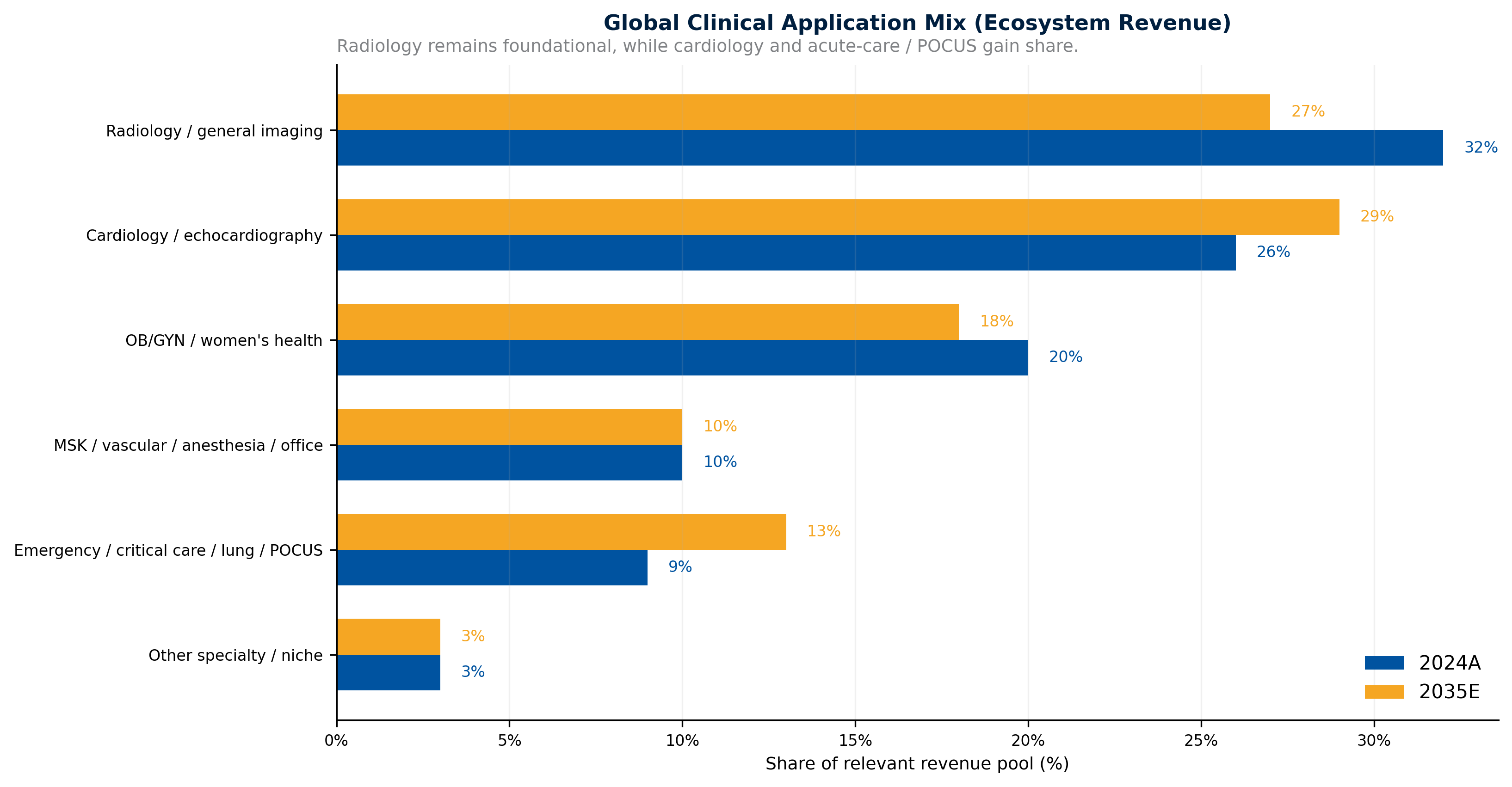
  • Clinical Application Mix (revenue)
  • Purchase Model Mix (revenue)
  • Operating Model Mix (revenue)
  • Ai Capability Mix (revenue)

Intended Audience

This report is designed for decision-makers with product, commercial, operational, or capital exposure to ultrasound, including:

  • ultrasound OEM executives across strategy, product, services, and corporate development,
  • AI acquisition / workflow / reporting / cloud vendors,
  • enterprise imaging and interoperability platform vendors,
  • provider procurement and imaging operations leaders,
  • investors, banks, and private equity,
  • and ecosystem partners exposed to probes, components, workflow infrastructure, and service monetization.

Report Details

  • Title: Global Ultrasound Horizon: Market Structure, Forecasts, and AI Monetization Architecture (2024A–2035E)
  • Type: Markintel™ Horizon Report
  • Publication: April 2026
  • Report ID: MINTH-M02105
  • Length: 280 pages (178 market data tables, 70 figures including strategic frameworks
  • Format: PDF (digital delivery) + companion Excel deliverables (model + data tables)
  • Geographical Coverage: North America (US, Canada) | Europe (Germany, France, UK, Italy, ROE) | APAC (China, Japan, India, ROAPAC) | LATAM | MEA
  • Price & Licensing Options: Individual ($4,950), Team ($5,450), Enterprise ($8,950)
By submitting this form, you agree to our Privacy Policy