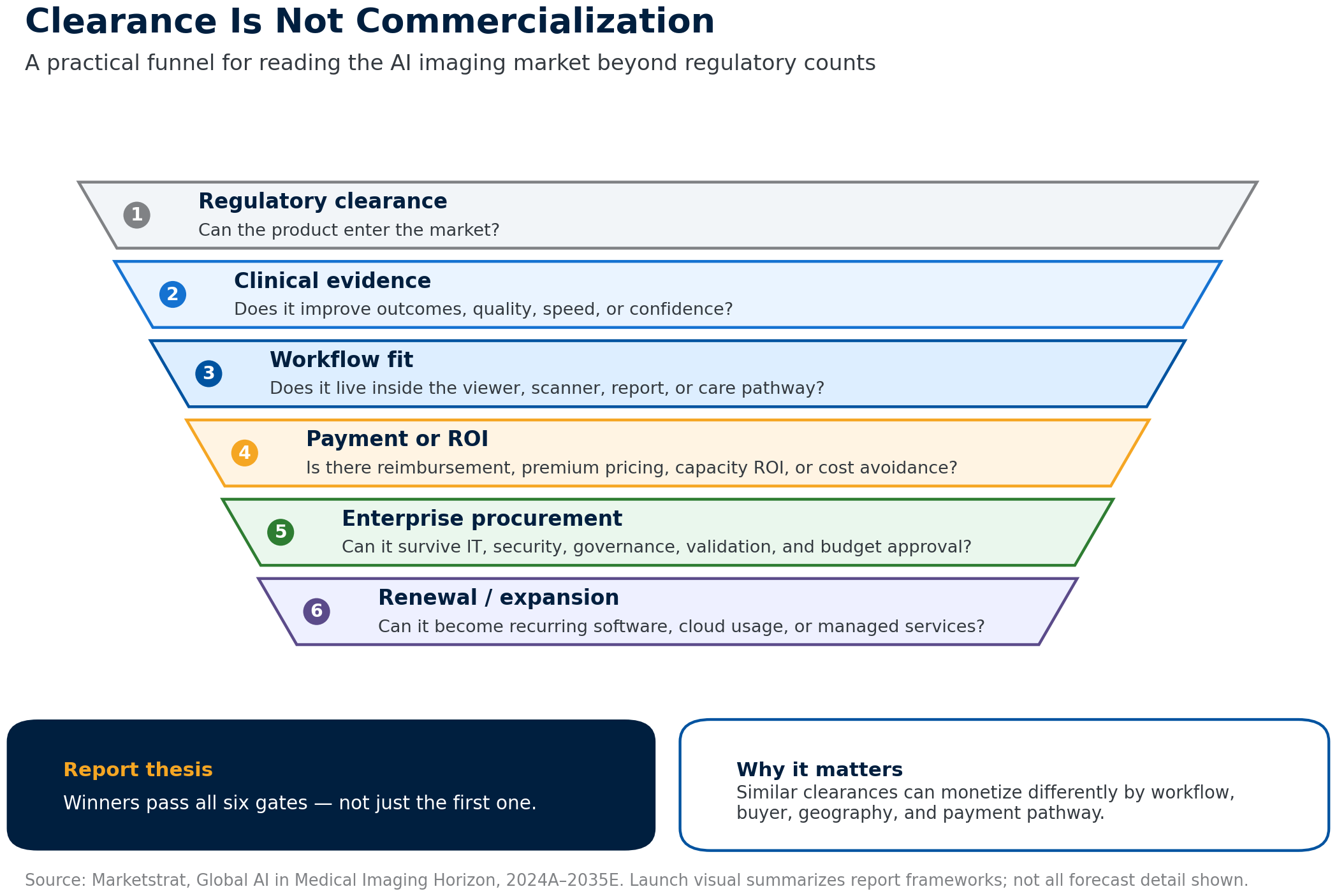
Artificial intelligence is no longer a side theme in medical imaging. It is becoming a monetization layer across scanners, PACS, enterprise imaging, reporting, quantitative analytics, teleradiology, outpatient imaging networks, and cloud-based clinical workflow. The question is no longer simply which AI tools have regulatory clearance. The more important questions are: which tools get paid, which tools fit into clinical workflow, which vendors control distribution, and which business models can scale beyond pilots.
Marketstrat’s Global AI in Medical Imaging Horizon provides a 2024A–2035E view of this transition. The report sizes the global AI medical imaging market, segments it by modality, clinical area, application, technology layer, revenue stream, end-user group, geography, and reimbursement maturity, and explains how competitive advantage is shifting from narrow algorithms toward workflow, evidence, reimbursement documentation, enterprise deployment, and recurring software economics.
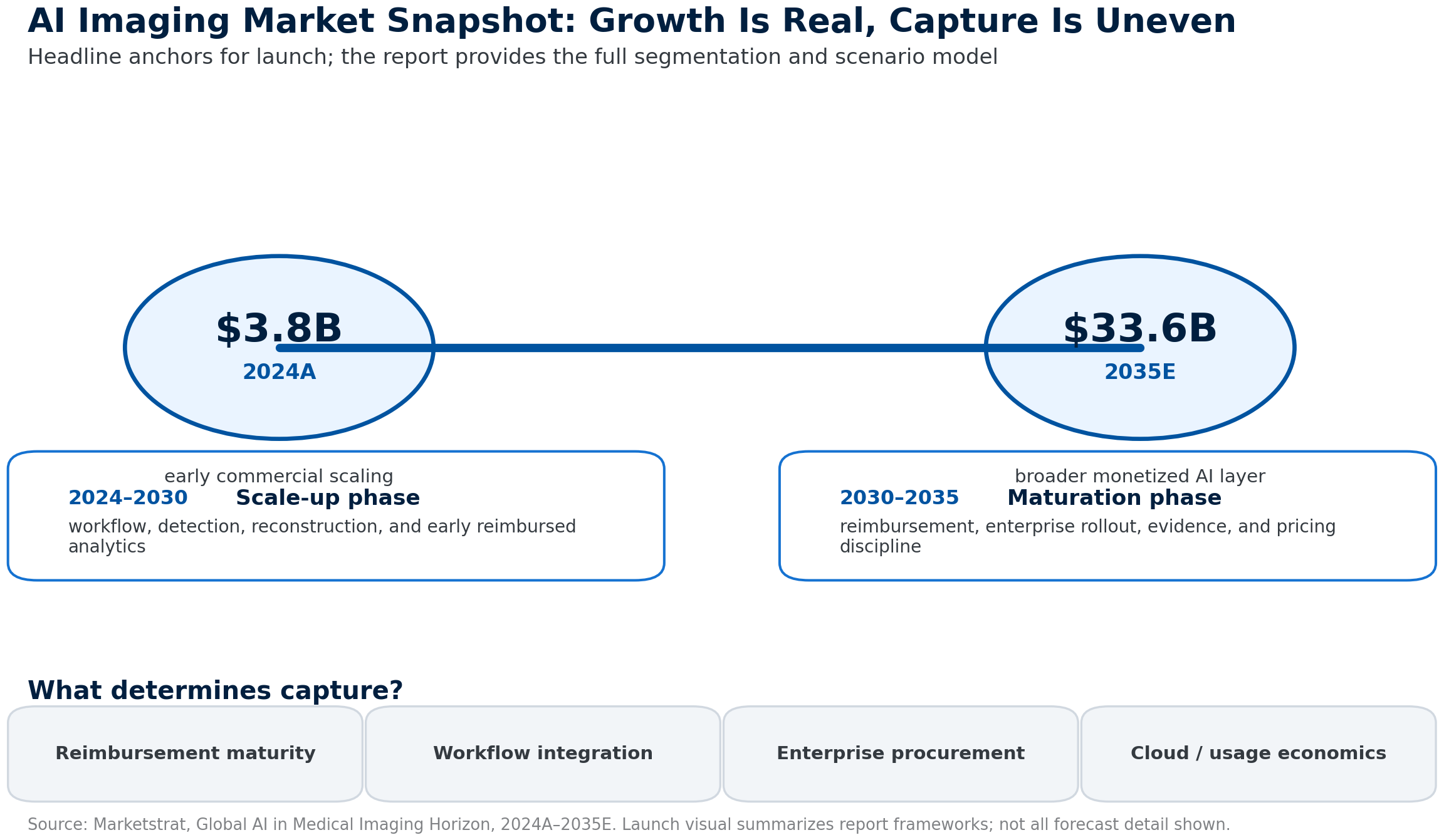
The base-case model places the global AI medical imaging market at approximately $3.8B in 2024A and $33.6B by 2035E, but the report is not just a sizing exercise. It is a market-structure, monetization, and competitive-architecture report built to help executives, investors, strategists, and commercial teams understand where AI imaging value is forming — and where it is likely to be captured. The report’s scope boundary is AI-attributable revenue across detection, workflow, reconstruction, quantification, and reporting, with hardware-embedded AI, cloud/pay-per-use, and services treated as distinct revenue streams.
The report is built around a reconciled 2024A–2035E market model and covers the major commercial dimensions of medical imaging AI: modality, clinical area, clinical application, technology layer, revenue stream, end-user organization, geography, and reimbursement tier. The base-case forecast places the global AI medical imaging market at approximately $3.8B in 2024A and approximately $33.6B by 2035E, with growth shaped by reimbursement expansion, enterprise platform adoption, AI-enabled productivity, cloud deployment, and disease-specific quantitative analytics.
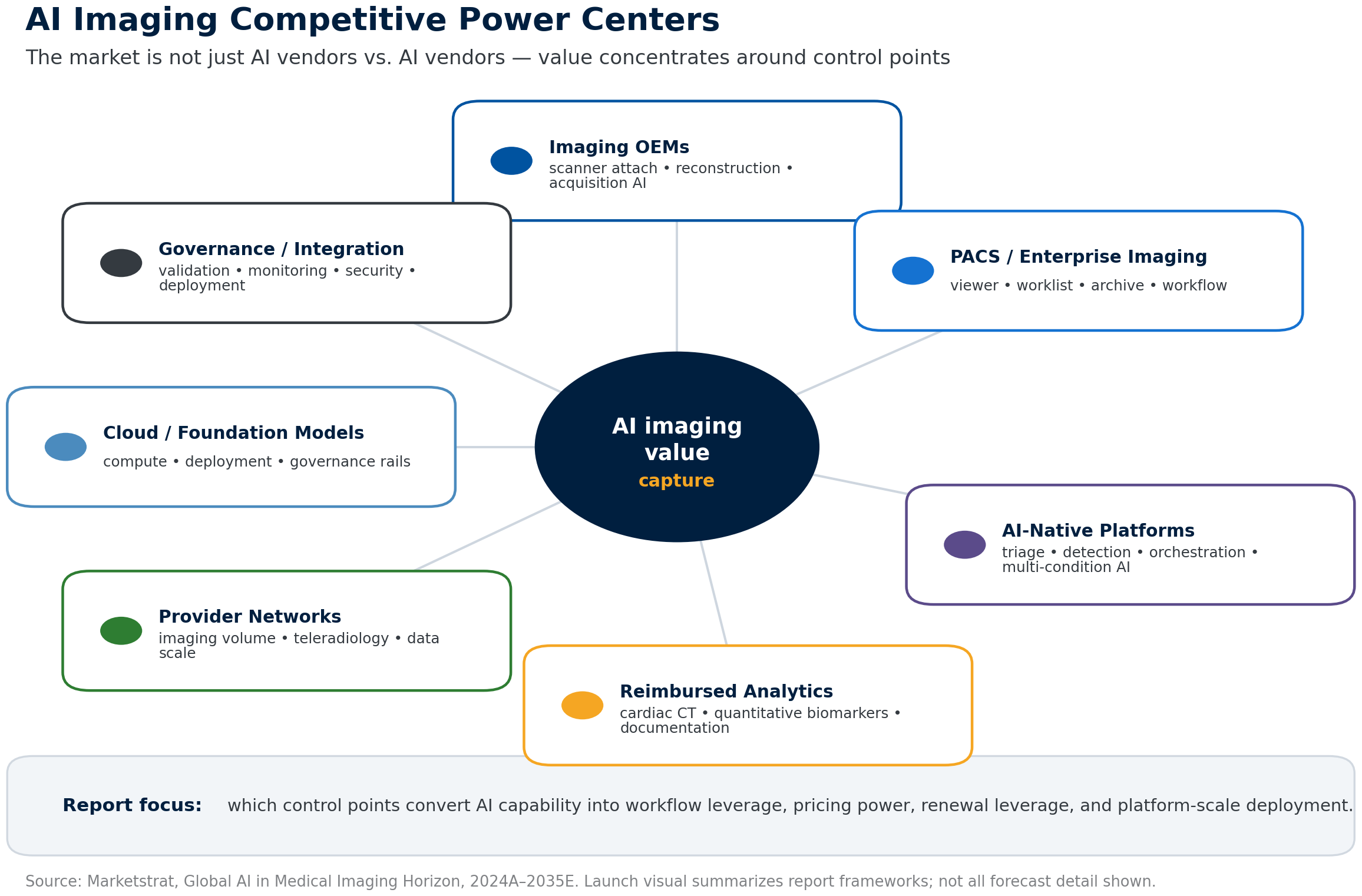
The AI medical imaging competitive landscape is consolidating around workflow control, enterprise integration, reimbursement leverage, and platform-scale distribution. The market is no longer best described as a fragmented population of algorithm developers. It is becoming a layered competitive system in which OEMs, enterprise imaging vendors, AI-native platforms, specialty analytics companies, cloud providers, and provider networks are all competing to control the deployment surface.
The report analyzes the competitive landscape across the major AI imaging control points, including imaging OEMs, enterprise imaging vendors, PACS / RIS / VNA platforms, AI-native clinical platforms, reimbursed quantitative analytics companies, breast and oncology AI vendors, reconstruction and acquisition AI companies, reporting and workflow automation vendors, AI orchestration / governance platforms, cloud infrastructure providers, and provider-network AI platforms.
Companies discussed include GE HealthCare, Siemens Healthineers, Philips, Canon Medical, Fujifilm, United Imaging, Pro Medicus, Sectra, Intelerad, AGFA HealthCare, Aidoc, Viz.ai, RapidAI, Qure.ai, Annalise.ai, DeepHealth / RadNet, HeartFlow, Cleerly, Elucid, Circle Cardiovascular Imaging, Lunit, iCAD, ScreenPoint, Hologic, Vara, Rad AI, Microsoft / Nuance, deepc, CARPL.ai, Ferrum Health, Blackford, Incepto, AWS, Microsoft Azure, Google Cloud, NVIDIA, and others.
Market size and forecast architecture
Monetization and business model
Clinical and modality opportunity
Competitive architecture
The report covers the global market for AI-attributable revenue across medical imaging, including:
The AI imaging market has entered a new phase. Between 2020 and 2024, much of the market narrative focused on FDA clearance counts, stand-alone detection algorithms, and radiology productivity. By 2026, the commercial conversation has changed.
Five changes now define the market:
Intended audience
This report is designed for decision-makers with exposure to medical imaging AI, including:
Driving healthcare innovation through actionable intelligence, strategic execution, and transformative solutions for global impact and growth.