Global Mammography Horizon Report: Market Structure, Forecasts, Competitive Dynamics, and AI Monetization Architecture, 2024A–2035F - July 2026

Individual License: $4,950 | Team and Enterprise License Options Available


Mammography remains one of the most established screening infrastructure markets in medical imaging, but it is no longer best understood as a simple equipment replacement category. Dedicated mammography systems, DBT, CEM-capable gantries, service contracts, mammography-specific workflow software, AI, breast biopsy, mobile screening, and supplemental imaging pathways are increasingly connected through the same commercial decision chain.


This Marketstrat® Horizon report analyzes the global mammography market and the broader breast imaging ecosystem from 2024A to 2035F. It separates the Core Mammography Market from the Interventional Breast Pathway and the broader Breast Imaging Ecosystem Opportunity, allowing readers to distinguish the headline system-and-service denominator from adjacent procedure, ultrasound, MRI, access, and workflow value pools.


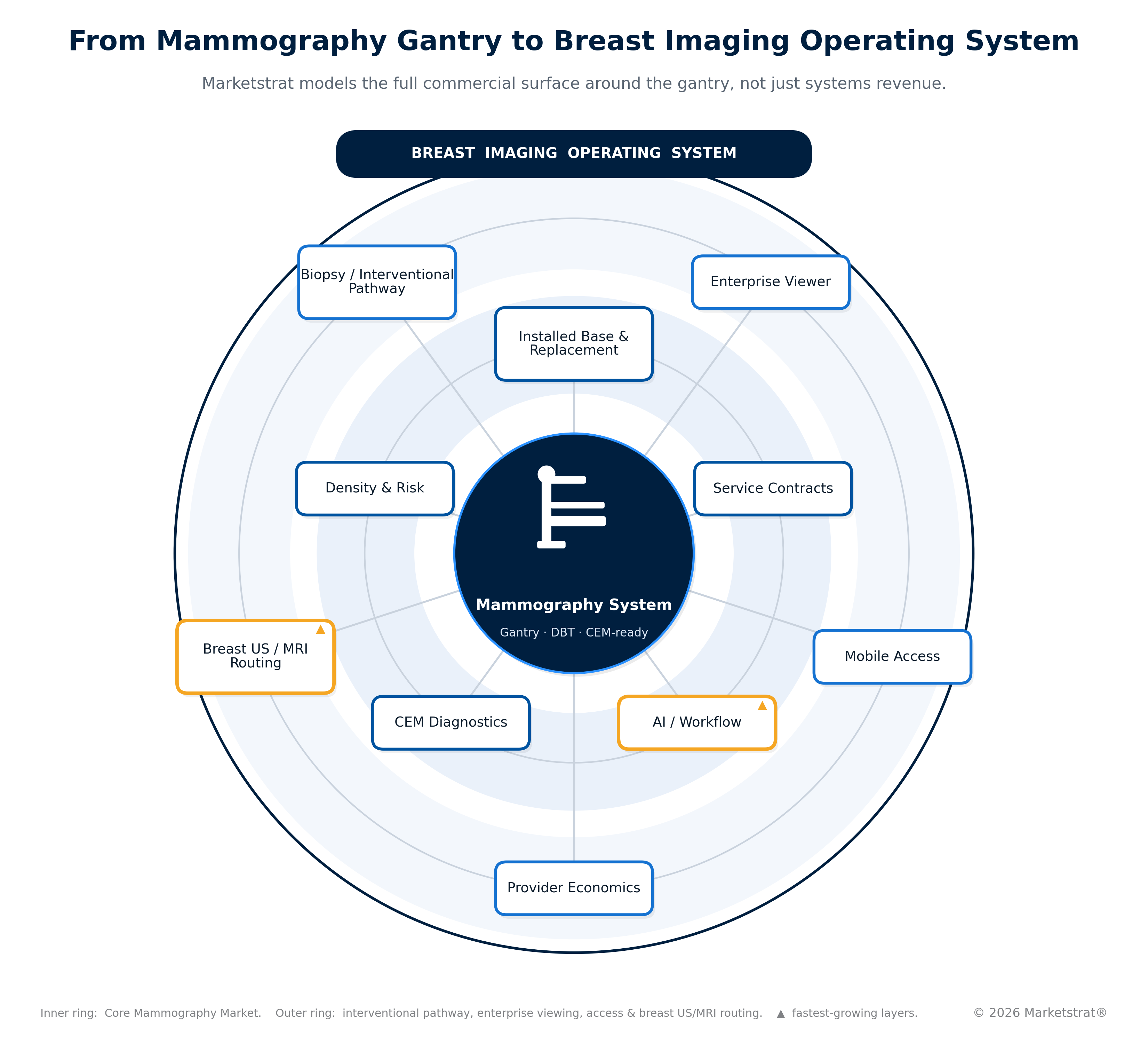
The central commercial question is no longer only “who sells the mammography gantry?” It is: who controls the breast imaging operating system around the gantry — replacement timing, service, AI, CEM, biopsy, enterprise workflow, provider economics, mobile access, and supplemental imaging routing? The report’s competitive thesis is that durable advantage is shifting from share of gantries toward share of control planes.


This Horizon report is Marketstrat’s in-depth global analysis of mammography and breast imaging market structure. It is built for medical imaging OEM executives, breast health strategy teams, AI and workflow vendors, enterprise imaging platforms, interventional breast technology companies, investors, private equity, distributors, provider networks, and public-sector imaging leaders.


The report covers screening and diagnostic mammography, FFDM, DBT, contrast-enhanced mammography, mammography-specific software and workstations, breast AI, density and risk tools, service contracts, mobile screening, image-guided breast intervention, and supplemental breast imaging pathways. It also evaluates how value migrates across mature replacement markets, access-expansion markets, screening-program markets, China’s two-channel procurement structure, and premium private-network breast imaging pathways.


The report is designed to answer practical commercial questions:

  • Where does mammography still grow when gantry hardware is mature?
  • Which value pools sit inside the Core Mammography Market, and which sit in adjacent breast imaging pathways?
  • How should vendors think about AI monetization when provider-gross value can be larger than vendor-booked software revenue?
  • Where is CEM most commercially relevant?
  • Which companies control the installed base, service, biopsy pathway, enterprise workflow, AI layer, provider volume, and China/value-tier channels?
  • How do regional strategies differ across the U.S., Europe, China, Japan, India, LATAM, and MEA?


Market Snapshot

The global mammography market is structurally mature but strategically active. The gantry pool remains the anchor, yet the most important growth and competitive movement is occurring around the gantry: AI/workflow software, CEM-enabled diagnostic pathways, service retention, interventional breast procedures, breast ultrasound, breast MRI, mobile access infrastructure, and risk-based screening.


The report’s market architecture separates three layers:

Core Mammography Market
Dedicated mammography systems, mammography-specific service, mammography-specific software/workstations, and mammography AI/workflow.


Interventional Breast Pathway
Biopsy systems, localization, image-guided intervention, and related downstream procedure economics.


Breast Imaging Ecosystem Opportunity
The Core Mammography Market plus the Interventional Breast Pathway and breast ultrasound/MRI adjacencies.


This matters because a flat or modestly growing gantry market can still control a larger and faster-moving ecosystem. The report’s framework analysis shows equipment and service as stable, installed-base-heavy pools, while AI/workflow, CEM, breast ultrasound, breast MRI, and biopsy/intervention drive a broader strategic opportunity.
Key Market Trends

1. Mammography is shifting from hardware replacement to ecosystem control

The strongest competitors are not simply those with the most installed gantries. They are the companies that can defend replacement accounts, attach service, integrate AI and workflow, enable CEM, support biopsy pathways, and keep the breast imaging study inside their operating environment.


2. DBT is becoming baseline in developed markets

DBT remains strategically important, but in many developed markets it is increasingly a replacement-cycle and premium-standard feature rather than a greenfield growth story. Future differentiation shifts toward workflow, patient experience, AI integration, CEM readiness, dose, acquisition speed, service, and fleet economics.


3. CEM is the most important near-term premium technology overlay

Contrast-enhanced mammography is not yet a broad screening standard, but it is strategically important for dense-breast workup, diagnostic problem-solving, selected MRI-substitution use cases, CEM-guided biopsy, and premium breast-center positioning. The report treats CEM as a practical near-term overlay rather than a distant frontier technology.


4. AI monetization must be separated from provider economics

The report distinguishes vendor-net AI/workflow revenue from provider-gross economics. Vendor revenue includes software, OEM-bundled AI, SaaS, enterprise subscriptions, and per-study fees. Provider-gross value includes patient-pay add-ons, workflow productivity, recall management, reimbursement, and downstream throughput. This separation avoids double counting and clarifies who captures value.


5. Breast ultrasound and breast MRI are not inside the core denominator, but they matter commercially

Supplemental imaging is central to the broader breast imaging pathway. Breast ultrasound and breast MRI are treated as adjacencies rather than core mammography revenue, but they materially shape diagnostic follow-up, dense-breast workflows, high-risk pathways, provider economics, and vendor ecosystem strategy.


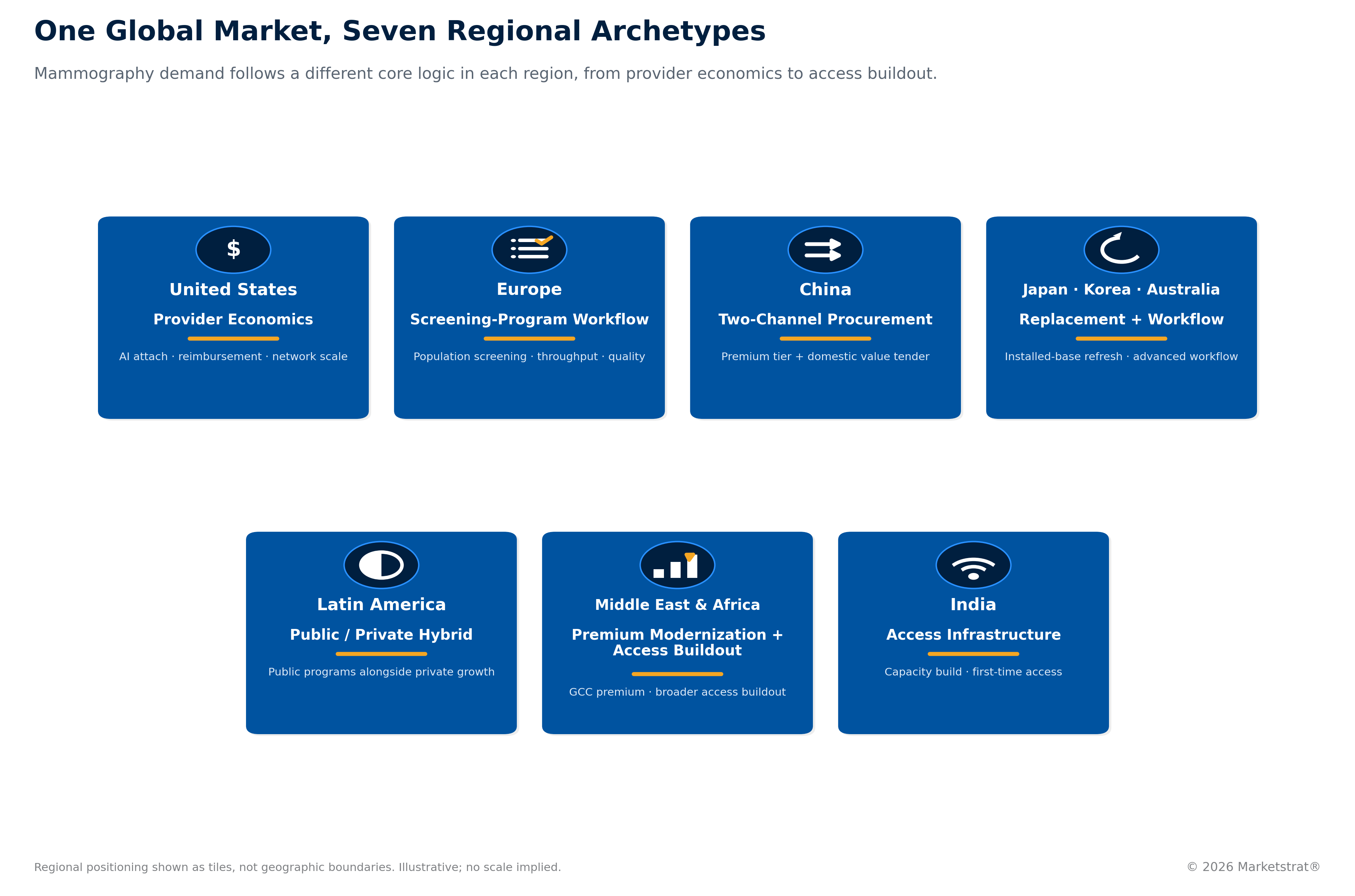
6. Regional strategy is not one global adoption curve

The report frames mammography as a local policy and procurement market with global platform economics. Adoption is shaped by screening age bands, public-program design, insurance coverage, procurement systems, workforce constraints, provider-network structure, and local service capacity.
 

Competitive Landscape

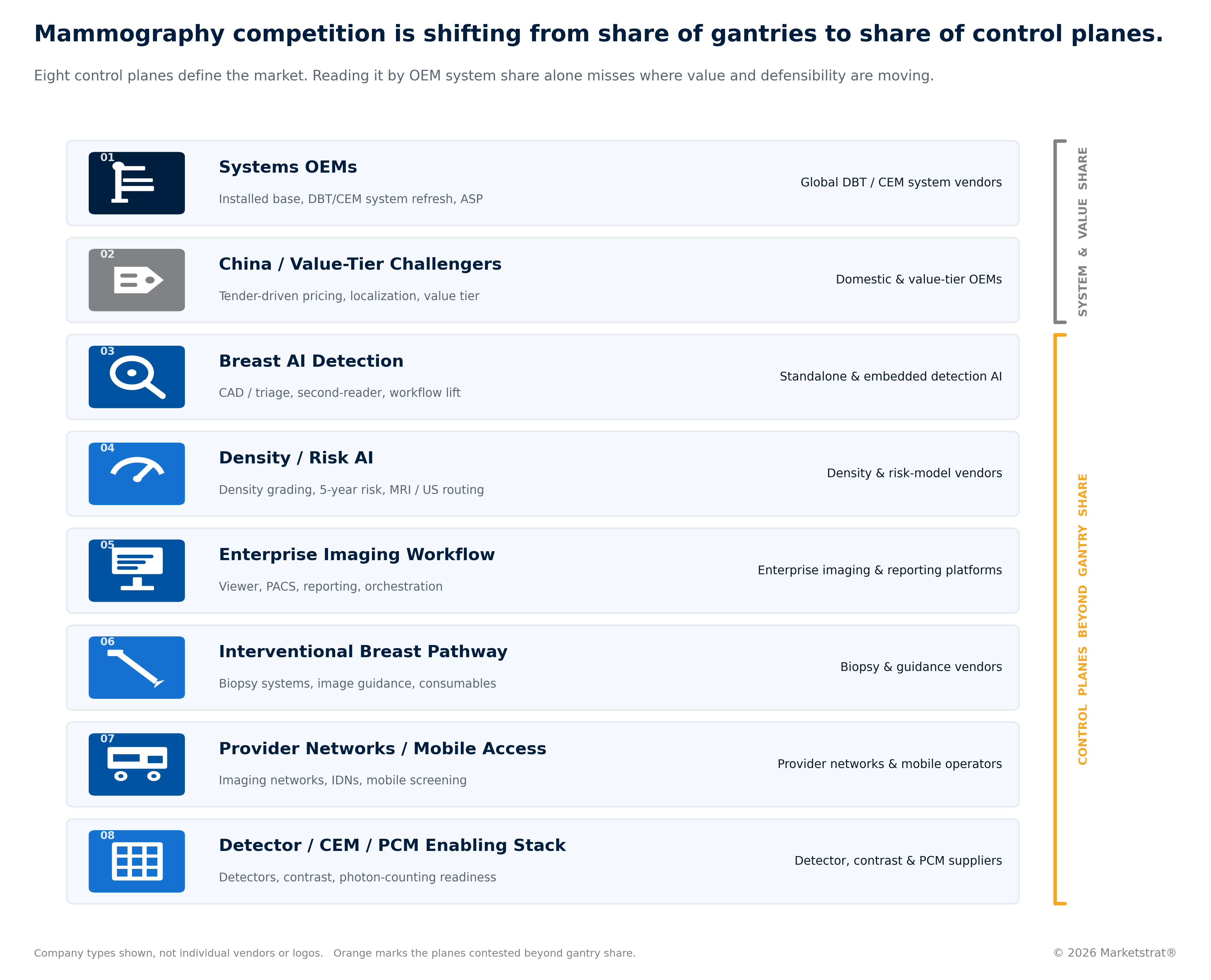
Marketstrat structures the mammography market into eight competitive clusters because the market is increasingly shaped by control planes rather than a flat OEM ranking.


The report analyzes:

  • Systems OEMs / breast health platform incumbents: Hologic, GE HealthCare, Siemens Healthineers, Fujifilm, Canon Medical, Planmed, IMS/Giotto, and selected regional specialists.
  • China and value-tier challengers: United Imaging, Wandong, Mindray, Neusoft, Inkon, and regional distributors.
  • Breast AI detection and second-reader vendors: ScreenPoint, Lunit, DeepHealth/iCAD, Hologic Genius AI, Vara, Therapixel, CureMetrix, and related screening-AI assets.
  • Density, risk, and population-health AI platforms: Lunit/Volpara, Clairity, Densitas, b-rayZ, ScreenPoint/Biomediq, and DeepHealth.
  • Enterprise imaging, breast workflow, and AI orchestration platforms: Visage/Pro Medicus, Sectra, Fujifilm Synapse, Intelerad, GE, Siemens, Philips, Mach7, Agfa, Hyland, and related platforms.
  • Interventional breast pathway and biopsy ecosystem: Hologic, Mammotome, BD, Merit Medical, Leica/Danaher, GE, Siemens, and related procedure assets.
  • Provider networks, mobile access, and telemammography operators: RadNet/DeepHealth, Solis, SimonMed, Mamotest-like models, Krsnaa-like PPP models, and public mobile screening programs.
  • Detector, CEM, and photon-counting enabling stack: Siemens, Canon/Redlen, Varex, GE, Hologic, detector suppliers, contrast suppliers, and selected enabling-technology owners.


The report’s competitive conclusion is that no single company controls every layer. Hologic remains the strongest vertical breast-health incumbent, GE and Siemens are credible enterprise and CEM/premium-technology challengers, software and AI platforms increasingly influence reading workflow, and China/value-tier players create a different unit-versus-value competitive tension.
What's Inside

Core model: 2024A–2035F

  • Procedure volume
  • Installed base
  • Annual shipments
  • Equipment / gantry revenue
  • Service contracts
  • Mammography-specific software and workstations
  • AI / workflow software
  • Core Mammography Market
  • Interventional Breast Pathway
  • Breast Ultrasound Adjacency
  • Breast MRI Adjacency
  • Breast Imaging Ecosystem Opportunity


Technology and workflow coverage

  • 2D FFDM
  • DBT / 3D mammography
  • Contrast-enhanced mammography
  • Mammography AI detection and second-reader workflows
  • Density and risk AI
  • Enterprise breast workflow and viewers
  • Mobile mammography and telemammography
  • Breast ultrasound and breast MRI adjacencies
  • Biopsy and interventional breast workflow
  • Photon-counting mammography as a scenario/watchlist technology, not a base-case revenue pool


Market-structure views

  • Core vs pathway vs ecosystem denominator
  • Regional and country market archetypes
  • Replacement-cycle dynamics
  • Screening-policy and utilization context
  • Procurement and tender evidence
  • Service and installed-base economics
  • CEM and premium overlay strategy
  • AI monetization and provider-gross value bridge
  • Competitive control-plane analysis


Strategic frameworks

The report applies Marketstrat’s Markintel® framework stack, including M³ Market Momentum Matrix, M-TEM, T-DIC, Solution Adoption & Growth Matrix, ARC-Index, Ecosystem Collaboration Matrix, and Upgrade & Package Ladder. These frameworks translate model outputs into strategic interpretation: which segments deserve investment, where pricing risk is highest, where AI can be monetized, and which technologies are commercially ready versus evidence- or reimbursement-gated.


Geographic coverage

Global, North America, Europe, Asia-Pacific, Latin America, Middle East and Africa, plus major countries and named clusters analyzed in the report. The regional model distinguishes mature replacement markets, access-expansion markets, screening-program markets, premium private-network markets, public/value procurement markets, and China’s two-channel structure.

Why This Report?

This report is designed for decision-makers with commercial, product, operational, investment, or strategic exposure to mammography and breast imaging, including:

  • Mammography OEM strategy, product, commercial, and corporate development teams
  • Breast health platform companies
  • AI detection, density/risk, workflow, and orchestration vendors
  • Enterprise imaging, PACS, viewer, and reporting platforms
  • Breast biopsy, localization, and interventional pathway companies
  • Detector, CEM, contrast, and enabling-technology suppliers
  • Provider networks, imaging centers, mobile screening operators, and teleradiology platforms
  • Investors, banks, private equity, and strategic acquirers
  • Distributors and regional channel partners
  • Public-sector screening, procurement, and access-infrastructure stakeholders


The report is not only a market-sizing document. It is a strategic map of how value is shifting around mammography: from hardware placement toward service, workflow, AI, CEM, biopsy, enterprise viewing, provider-volume economics, mobile access, and supplemental imaging routing.

Report Details

Title: Global Mammography Horizon: Market Structure, Forecasts, Competitive Dynamics, and AI Monetization Architecture, 2024A–2035F
Type: Marketstrat® Horizon Report
Report ID: MINTH-M02137
Publication: July 2026
Forecast Horizon: 2024A–2035F
Format: PDF digital delivery
Core Coverage: Mammography systems, FFDM, DBT, CEM, mammography AI/workflow, service and aftermarket, mobile mammography, interventional breast pathway, breast ultrasound, and breast MRI adjacencies
Geographic Coverage: Global, North America, Europe, Asia-Pacific, Latin America, Middle East and Africa, plus major countries and named regional clusters
License Options: Individual ($4,950), Team ($5,450), Enterprise ($8,950)

By submitting this form, you agree to our Privacy Policy