
Marketstrat analyzes how CMS, GE HealthCare, Sectra and Provect AI are shifting imaging value toward capacity, workflow control and governance.
🎧 Listen to this week’s Marketstrat Pulse Insight:
CMS, GE HealthCare, Sectra and Provect AI Signal a New Imaging Capacity-Control Market
Medical imaging has traditionally evaluated value at the level of the asset or algorithm. The scanner delivered capacity. The software delivered accuracy. Commercial adoption was expected to follow from technical performance, authorization and a large addressable market.
The latest Marketstrat Pulse analysis points to a more demanding model.
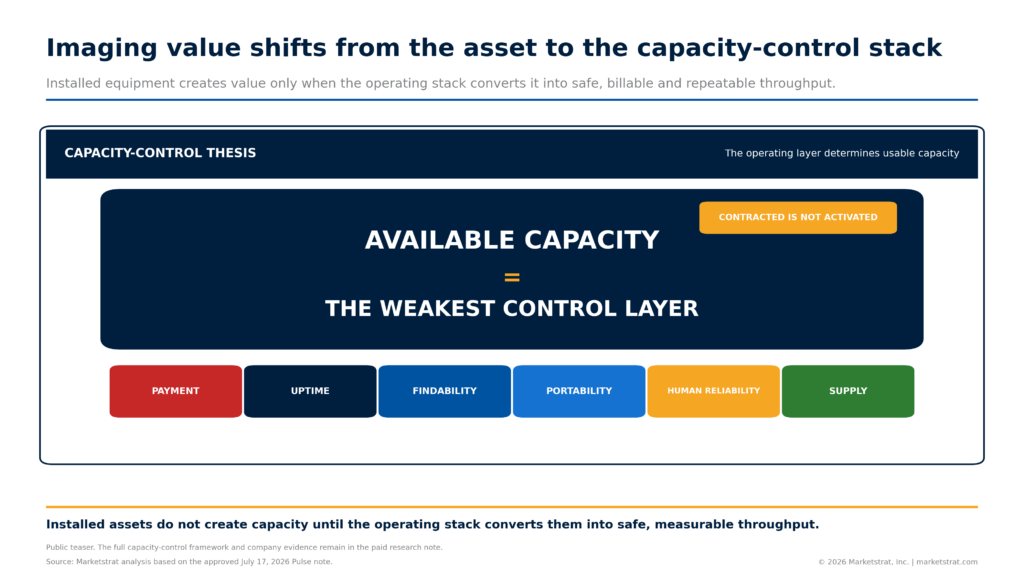
Across policy, enterprise imaging, lifecycle services, software-defined procedures and clinical governance, the market is shifting toward control of the operating stack. The central question is no longer only whether an imaging capability exists. It is whether that capability can be activated, measured, governed and converted into safe, billable and repeatable throughput.
The week’s signals came from CMS, GE HealthCare (Nasdaq: GEHC), Sectra (Nasdaq Stockholm: SECT B), Provect AI and peer-reviewed evidence on automation bias. They converge on one commercial issue: installed capacity is only as productive as the weakest operating layer around it.
Policy is moving from payment after the scan to control before the scan
The immediate reimbursement debate remains important, but the more durable signal is CMS’s attention to duplicate imaging, result sharing and interoperability. Proposed changes to Medicare’s Appropriate Use Criteria program reinforce the same direction.
This moves part of the utilization question upstream. Before another study is acquired, the system increasingly needs to answer three questions: Was the examination appropriate? Was a prior result available? Is the repeat study clinically justified?
That raises the strategic value of image exchange, patient matching, order support and auditable access to prior studies. These functions could become more directly connected to utilization management and revenue protection.
The risk is clear. Poorly designed controls can confuse duplicate imaging with necessary follow-up, changed symptoms, inadequate image quality or unavailable outside studies. The winning architecture must reduce avoidable repetition without creating another blunt denial layer.
Long-duration agreements are shifting operating responsibility to strategic vendors
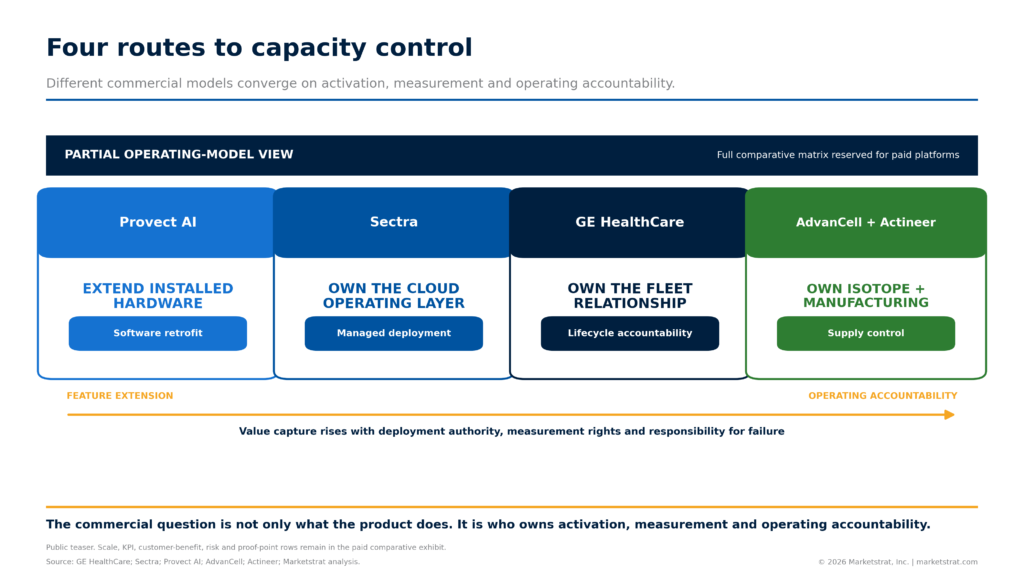
GE HealthCare’s approximately $500 million, 10-year relationship with Catholic Health combines equipment additions, multivendor service, cloud operations, lifecycle management and training. Sectra’s managed-cloud agreement at Hennick Humber Hospital places monitoring, optimization and continuous upgrades around an environment supporting more than 250,000 annual exams.
These are not simply larger product orders. They move vendors closer to the layer where uptime, modernization cadence, software activation and workflow standardization are managed.
For providers, the test is whether that accountability translates into better appointment access, lower downtime, faster deployment and a lower cost per completed study. The trade-off is dependency. As more of the operating model sits with one OEM or enterprise platform, providers need clear rights around data access, application choice, portability, service levels and exit terms.
Software-defined imaging is extending the installed base
Provect AI represents a different route to capacity. Its FDA-cleared software reconstructs intraoperative 3D images from standard 2D C-arm acquisitions. The proposition is to add higher-value procedural capability without requiring another dedicated imaging system.
That matters for hospitals and ambulatory settings where room space, case volume or capital budgets may not support intraoperative CT. Software can potentially release value from existing hardware and broaden access to image-guided procedures.
Clearance, however, is only the first gate. Commercial proof depends on compatibility, consistent image quality, procedure-time effects, workflow exceptions, training requirements and the amount of capital actually avoided.
“Works with the installed base” is an addressable-market claim. “Activated across defined systems and used in routine cases with measurable operating benefit” is an adoption claim.
Human-system performance sets the safe capacity ceiling
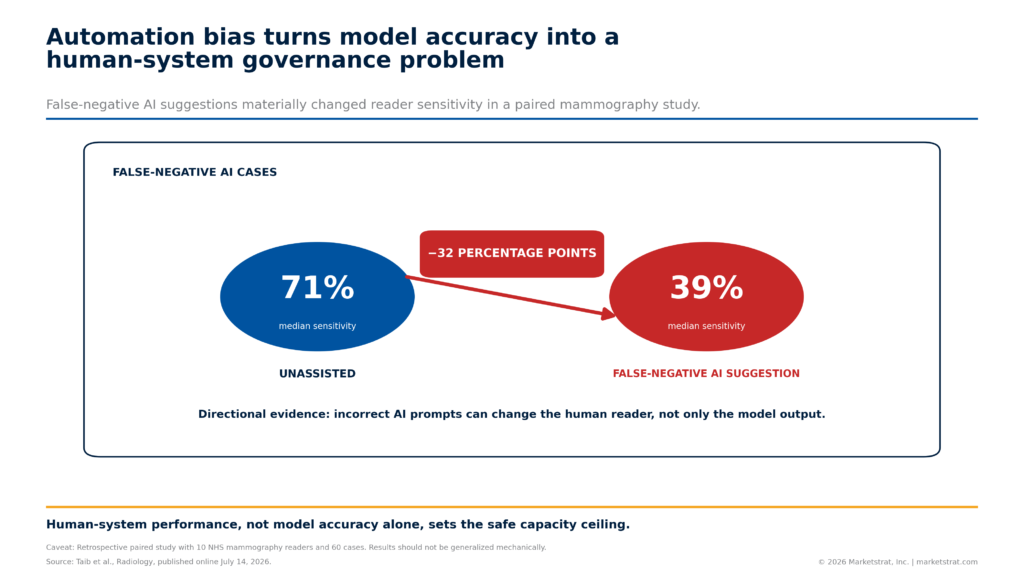
A peer-reviewed mammography study in Radiology found that incorrect AI suggestions materially changed reader sensitivity and visual-search behavior. More visible prompts could also increase reading time.
The implication extends beyond mammography. An AI system can change attention, confidence and review behavior even when the clinician retains formal responsibility for the final interpretation. Model performance and workflow performance are therefore not separate commercial questions.
Providers need deployment baselines, prompt-level monitoring, override review, escalation rules and reassessment after software updates. Vendors need evidence on how readers respond to false negatives, false positives and different prompt densities. Payers and regulators should avoid treating standalone technical accuracy as equivalent to net clinical benefit.
The same logic is appearing in theranostics
AdvanCell and Actineer show that the capacity-control thesis is not limited to diagnostic imaging. Targeted alpha therapy depends on isotope availability, manufacturing repeatability, dose logistics and treatment-site readiness, in addition to the therapeutic asset.
A clinically promising therapy cannot scale when the isotope or manufacturing chain is unreliable. Capital is therefore moving toward infrastructure that can support repeatable production and delivery.
For imaging providers, higher theranostics volume also creates demand for patient selection, treatment planning, response assessment, hot-lab operations and coordinated scheduling. Scanner availability is only one constraint in a broader clinical production system.
What changes for providers, vendors and investors
Providers should measure capacity by episode, not by installed asset. Order quality, prior-image access, uptime, room cycle, interpretation, repeat rate and downstream completion should be viewed as one chain.
Imaging-AI vendors need a commercial dossier beside the regulatory dossier. Buyers need to know who can authorize deployment, how long implementation takes, which systems are compatible, how eligible volume is measured and who is responsible when the workflow fails.
OEMs and enterprise platforms have an opportunity to become the operating layer. They must prove that governance, integration and lifecycle accountability improve performance while preserving enough openness for customers.
Investors and strategic acquirers should treat contracted footprint and clearance counts as intermediate indicators. Stronger evidence includes activated sites, case volume, renewal behavior, implementation capacity, usage rights and a measurable change in an operating KPI.
Imaging capacity is not the theoretical output of the fleet. It is the number of appropriate studies and procedures that can be completed, interpreted safely and converted into clinical action under real operating constraints.
Marketstrat’s view is that the next phase of imaging competition will be decided less by isolated technical novelty and more by control of activation, measurement and operating accountability.
Access the Full Research
The full Marketstrat Pulse research note includes the complete event analysis, stakeholder implications, deep dives, source appendix and proprietary visual exhibits. Request direct access to the full Pulse Insights research series, discuss subscription licensing or arrange an analyst briefing with Marketstrat at research@marketstrat.com
Selected Marketstrat research may also be available to entitled users through AlphaSense and LSEG Workspace.
Related research themes
- Imaging reimbursement and utilization management
- Enterprise imaging cloud and platform control
- Installed-base software and capacity economics
- Human-AI governance and clinical evidence
- Image-guided procedures and ambulatory capacity
- Theranostics manufacturing and isotope supply
About Marketstrat
Marketstrat® is an independent market intelligence firm focused on MedTech, medical imaging, imaging AI, enterprise imaging, PACS, and adjacent healthcare technology markets. Through its Markintel® research methodology and publishing system, Marketstrat produces Horizon Reports, Pulse Reports, Company Research, Market Signals, and weekly Pulse Insights. The firm’s research combines market sizing, forecasting, segmentation, competitive mapping, company intelligence, and event-driven analysis to help corporate strategy, product, commercial, investment, consulting, and industry media professionals interpret fast-moving healthcare markets with greater clarity.
Marketstrat® and Markintel® are registered service marks of Marketstrat, Inc.
Our Research
- Horizon Reports — Comprehensive market landscape assessments with sizing, segmentation, forecasting, and competitive mapping across multi-year time horizons.
- Focus Reports — Targeted market intelligence reports on specific segments, technologies, or competitive dynamics drawn from Marketstrat’s broader Horizon research program.
- Company Research — Decision-grade company intelligence covering strategy, competitive positioning, product portfolio, business model, financial structure, partnerships, and stakeholder impact.
- Market Signals — Event-driven analysis tied to specific catalysts, including regulatory actions, M&A, product launches, policy shifts, reimbursement changes, and earnings. Each signal is structured around strategic implications, not just news.
- Pulse Insights — Weekly market intelligence digest covering what moved, what it means, and what to watch across healthcare, MedTech, medical imaging, imaging AI, and adjacent life sciences markets.
