Individual License: $4,950 | Team and Enterprise License Options Available
This Marketstrat® Horizon report provides an in-depth global analysis of the computed tomography market and the broader CT ecosystem. It is built for medical imaging OEM executives, corporate strategy and development teams, service and aftermarket leaders, component suppliers, clinical AI companies, enterprise imaging platforms, investors, provider organizations, and commercial teams with exposure to CT.
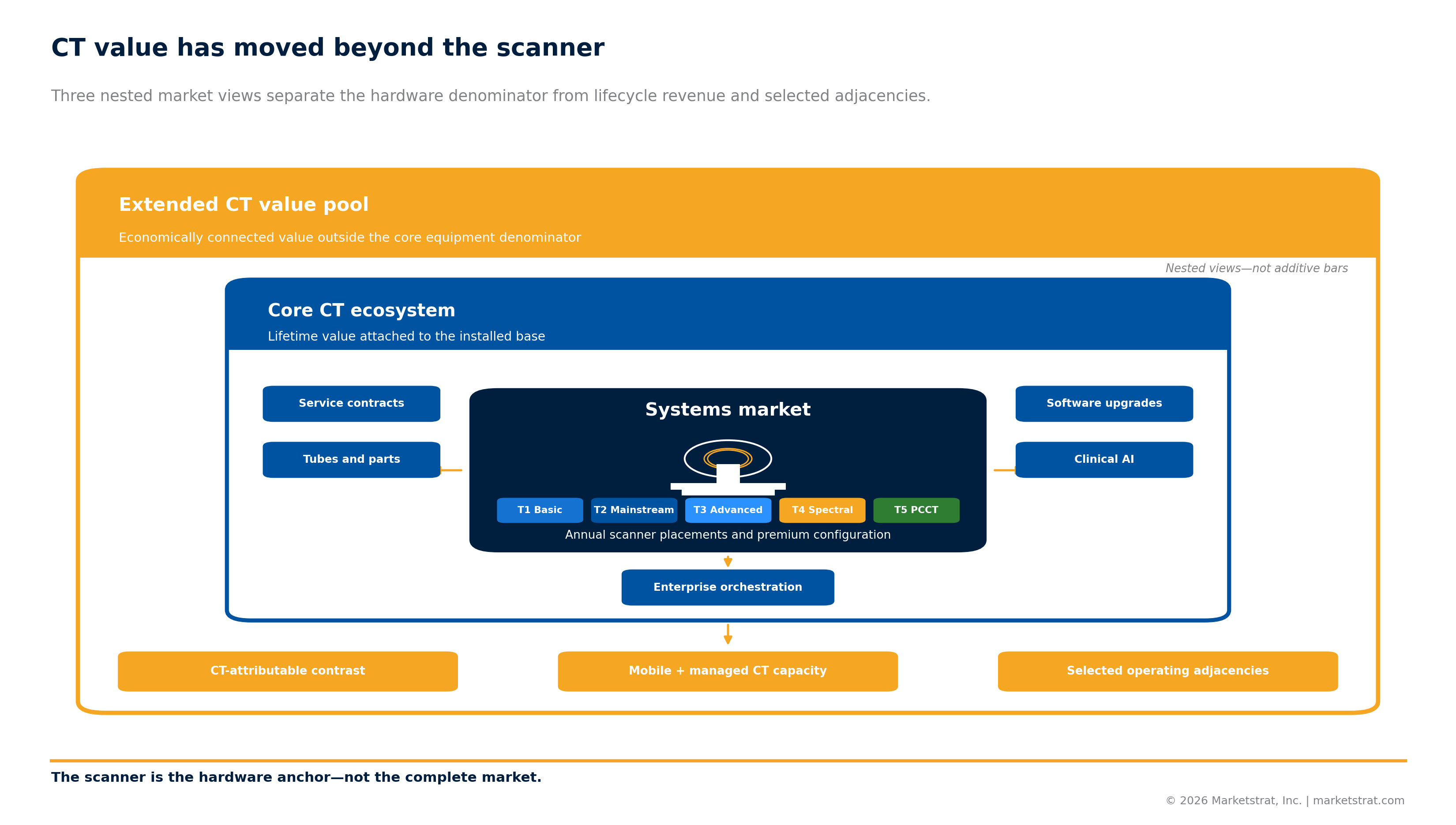
The report integrates CT systems, installed-base economics, procedure demand, replacement and expansion shipments, realized ASPs, service contracts, X-ray tubes and parts, software upgrades, clinical AI, enterprise AI orchestration, financing, and selected adjacencies into one reconciled decision model.
Unlike conventional CT market reports that focus primarily on scanner shipments, slice counts, or top-line equipment revenue, this report examines where value is moving across the complete CT lifecycle.
The central question is not only how many scanners will be sold. It is:
Who will control the premium configuration, service relationship, software upgrade path, clinical AI workflow, enterprise platform, and financing architecture around the installed scanner?
The report was developed through Markintel®, Marketstrat’s proprietary research methodology, strategic framework stack, and evidence-to-insight workflow system. The analysis combines public and proprietary evidence with a bottom-up global market model and publishable analytical cuts that reconcile to the same governing totals.
CT remains one of the most clinically essential and operationally resilient medical imaging modalities. It supports emergency medicine, trauma, stroke, oncology, cardiovascular imaging, pulmonary disease, vascular assessment, abdominal diagnosis, interventional procedures, and population screening.
Global CT procedure volume increases from approximately 564 million examinations in 2024A to 874 million in 2035E. The active installed base expands from approximately 97,600 to 151,600 scanners, while annual new-system shipments increase from approximately 12,900 to 21,200 units.
Those figures do not describe one homogeneous growth cycle.
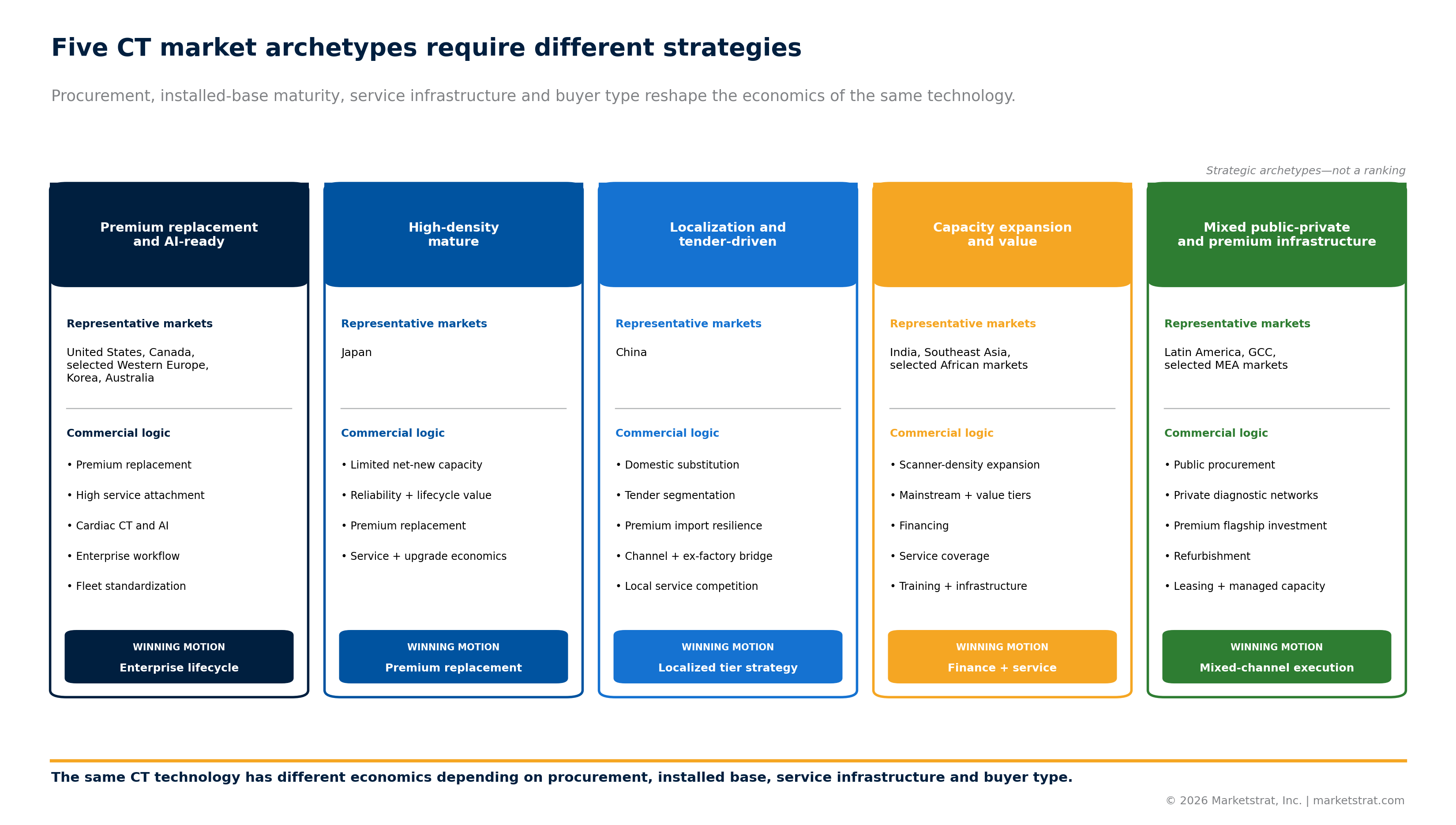
Mature markets are primarily replacement-led. Their economics depend on fleet age, utilization, premium configuration, service attachment, software upgrades, AI adoption, and enterprise contracting.
Lower-density markets remain more expansion-led. Their conversion from clinical need into scanner placements depends on capital availability, public procurement, financing, service coverage, workforce, parts availability, and realized system pricing.
The broader value migration is equally important. Systems revenue grows steadily, but service, tubes and parts, software, clinical AI, and orchestration expand the economic value of the installed base.
Under the final scenario architecture, the 2035E extended CT value pool ranges from approximately US$24.3 billion in the Bear case to US$31.8 billion in the Bull case, compared with US$27.6 billion in the Base case.