
Teledyne, RadNet, Heartflow and Aidoc show how imaging value is shifting toward component control, workflow, payment and repeat paid use.
🎧 Listen to this week’s Marketstrat Pulse Insight:
Medical imaging companies have historically been judged by the assets they sell, the technologies they clear and the number of sites they reach. The stronger signals from the week ending August 14 point to a different source of advantage: control of the commercial path between authorization and repeat paid use.
Teledyne, RadNet, Heartflow and Aidoc are approaching that path from different positions. Teledyne is moving upstream into critical imaging components. RadNet is combining an owned provider network with an external digital-health business. Heartflow is demonstrating case-volume economics in coronary CTA. Aidoc is building both institutional governance and a defined, though limited, inpatient payment route.
The common thread is that product availability is only the first commercial gate.
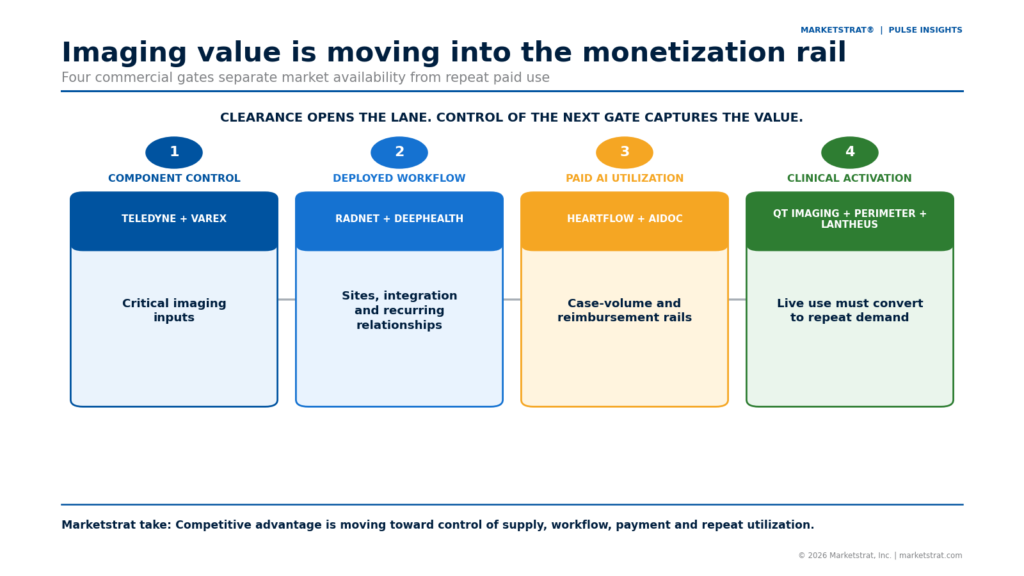
The week’s central signal
The strategic question is shifting from whether a technology can enter the market to who controls what happens after entry.
A cleared device can remain lightly used. A signed enterprise contract can remain unimplemented. A shipped system can generate little recurring volume. A reimbursable service can still fail to produce payment if eligibility, documentation and coding are not operationalized.
That distinction matters because each stage requires a different capability. Supply ownership requires manufacturing scale and customer trust. Enterprise deployment requires integration, implementation and support. Case-level monetization requires active workflow and sufficient demand. Reimbursement requires claims infrastructure and evidence that the technology creates clinical or operating value.
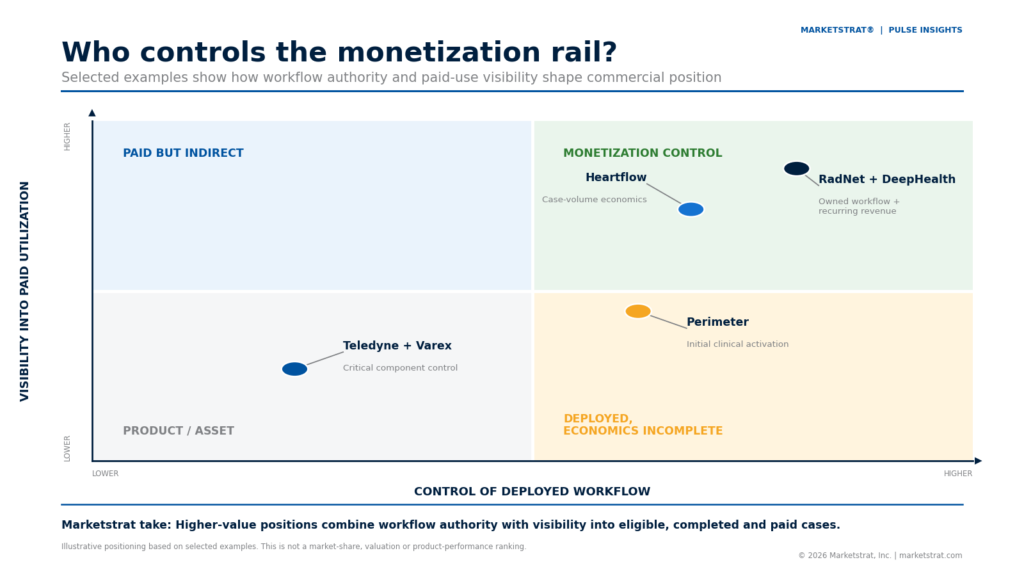
Companies that control two or more adjacent stages are building stronger positions than companies that stop at technical capability.
Teledyne moves upstream into component control
Teledyne’s agreement to acquire Varex for approximately $1.1 billion expands its position across X-ray tubes, detectors, high-voltage interconnects and imaging software. The transaction brings complementary component capabilities under one owner and places upstream supply control more clearly on the strategic agenda.
The value is not limited to product breadth. Critical components shape scanner performance, manufacturing schedules, service continuity and future platform development. Ownership can support coordinated investment and broader OEM relationships.
The principal risk is customer neutrality. Varex serves system manufacturers that compete with one another and may also compete with parts of Teledyne’s portfolio. The acquired business will remain valuable only if OEM customers continue to view it as a dependable, neutral supplier. Transaction close, customer retention and supply assurances therefore matter as much as the announced purchase price.
RadNet turns an operating network into a digital-health platform
RadNet offers a different form of control. Its outpatient imaging network provides a live environment in which DeepHealth products can be developed, deployed and supported. The company can observe the implementation burden inside its own operations before selling to external health systems.
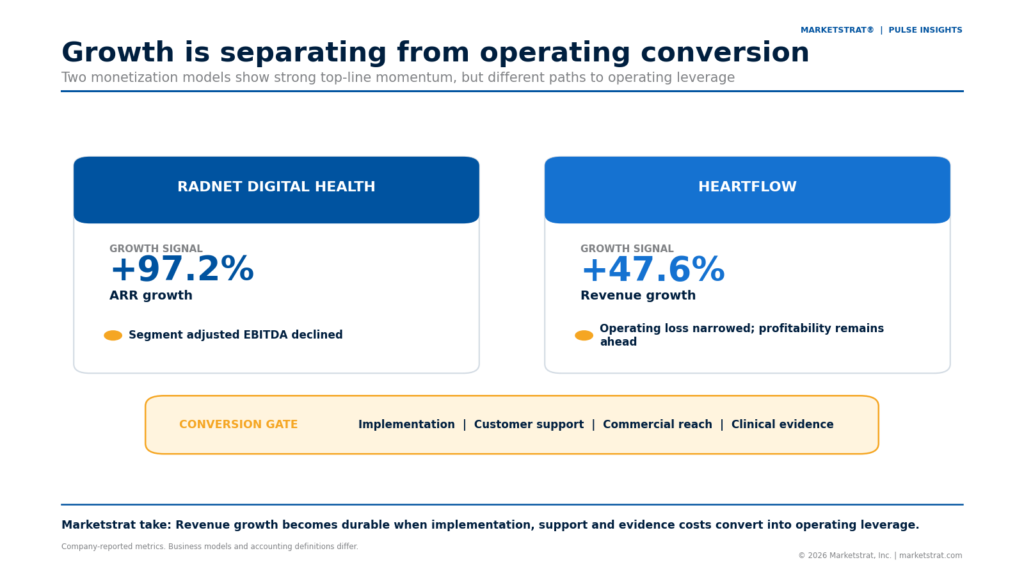
That operating base is now supporting rapid growth in recurring digital-health revenue, with external customers representing a majority of segment revenue. The model links product development, workflow access, reference sites and enterprise commercialization.
The financial counterweight is that growth still requires substantial implementation and service capacity. Digital Health adjusted EBITDA declined as RadNet expanded commercial and customer-support infrastructure. The signal is therefore positive but incomplete: external recurring revenue is scaling, while operating conversion remains a work in progress.
Heartflow shows the value of paid case volume
Heartflow provides the clearest example of why completed paid use is a stronger commercial denominator than installed footprint.
Quarterly revenue increased 48%, driven primarily by higher U.S. FFRCT and Plaque case volume, while gross margin reached 83.0%. Those figures indicate that more analyses are being completed and that additional volume can improve production economics.
The remaining issue is the total cost of scale. Heartflow continues to invest in sales, technology and clinical research. Gross-margin improvement shows that the case-level model can become more efficient, but full operating conversion depends on whether the cost to create, support and retain that volume declines over time.
For investors and strategic buyers, this distinction is important. High gross margin does not automatically mean a mature earnings model. The relevant questions are how quickly active account utilization grows, how much commercial spending is required, and whether new product attachment increases revenue per customer.
Aidoc combines governance and payment, with limits
Aidoc is addressing two barriers that often slow enterprise imaging AI adoption.
First, 12 U.S. health systems formed a Diagnostic AI Consortium with Aidoc to develop shared workflows, governance practices and measurement approaches. A multi-system structure can reduce duplicated evaluation effort and create more comparable evidence across sites.
Second, qualifying Medicare fee-for-service inpatient use of CARE Multi-Triage CT Body will become eligible for a New Technology Add-on Payment beginning October 1.
The two developments are commercially relevant, but neither is equivalent to broad adoption. Consortium participation does not establish purchase scope, activated applications or outcomes. The payment is limited to qualifying inpatient cases and will create value only when hospitals identify eligible use, document it correctly and capture the payment.
The near-term test is operational execution: live workflow, claim capture, measurable impact and evidence that the payment changes procurement economics.
The activation gap remains
QT Imaging, Perimeter Medical Imaging AI and Lantheus illustrate three additional stages of commercialization.
QT Imaging reported shipment and revenue growth, but lower gross margin and higher operating expense show that commercial expansion can remain capital-intensive. Perimeter moved its Claire system into routine commercial use at two Intermountain Health hospitals, an important activation step, while procedure volume and economic impact remain undisclosed. Lantheus received FDA approval for TAUKLARIFY, but broader commercial availability is still under assessment.
These are meaningful milestones. They are not interchangeable. Shipment, live clinical use and regulatory approval represent different levels of market evidence.
Why it matters for strategy teams
The week points to several practical implications.
Providers should distinguish contracted, implemented, active, paid and renewed scope when evaluating imaging technology. Procurement committees need utilization and payment telemetry, not only product specifications.
Vendors should identify the next commercial gate their roadmap must unlock. A stronger algorithm may matter less than better implementation, claims capture, service capacity or account-level utilization.
OEMs and component suppliers should treat customer neutrality, supply continuity and roadmap access as core commercial requirements.
Investors should separate revenue growth from the implementation, support, evidence and sales spending required to produce it. The most durable models will show improving conversion from signed demand to live use, paid activity and recurring contribution.
Marketstrat view
Medical imaging competition is moving toward monetization control. Authorization remains necessary, but it is no longer sufficient evidence of market position. The stronger strategic advantage belongs to companies that can connect product capability to deployed workflow, payment and repeat utilization, then prove that conversion with operating data.
To request direct access or discuss subscriptions, visit marketstrat.com or contact research@marketstrat.com. Entitled institutional users may also access Marketstrat research through their existing research platforms.
About Marketstrat
Marketstrat® is an independent market intelligence firm focused on MedTech, medical imaging, imaging AI, enterprise imaging, PACS, and adjacent healthcare technology markets. Through its Markintel® research methodology and publishing system, Marketstrat produces Horizon Reports, Pulse Reports, Company Research, Market Signals, and weekly Pulse Insights. The firm’s research combines market sizing, forecasting, segmentation, competitive mapping, company intelligence, and event-driven analysis to help corporate strategy, product, commercial, investment, consulting, and industry media professionals interpret fast-moving healthcare markets with greater clarity.
Marketstrat® and Markintel® are registered service marks of Marketstrat, Inc.
Our Research
- Horizon Reports — Comprehensive market landscape assessments with sizing, segmentation, forecasting, and competitive mapping across multi-year time horizons.
- Focus Reports — Targeted market intelligence reports on specific segments, technologies, or competitive dynamics drawn from Marketstrat’s broader Horizon research program.
- Company Research — Decision-grade company intelligence covering strategy, competitive positioning, product portfolio, business model, financial structure, partnerships, and stakeholder impact.
- Market Signals — Event-driven analysis tied to specific catalysts, including regulatory actions, M&A, product launches, policy shifts, reimbursement changes, and earnings. Each signal is structured around strategic implications, not just news.
- Pulse Insights — Weekly market intelligence digest covering what moved, what it means, and what to watch across healthcare, MedTech, medical imaging, imaging AI, and adjacent life sciences markets.
