
The most consequential imaging developments of the week did not share a modality, product category or business model. They shared a control point.
Radiology Partners moved to acquire international case flow. 4DMedical introduced a contract tied to minimum utilization. ImExHS tested workflow agents inside its own radiology-services operation. PanTera connected qualified actinium-225 supply to recurring customers and positive operating performance. Philips and Imricor packaged imaging, navigation and consumables into a procedure environment, while new safety actions underscored the need for post-market telemetry.
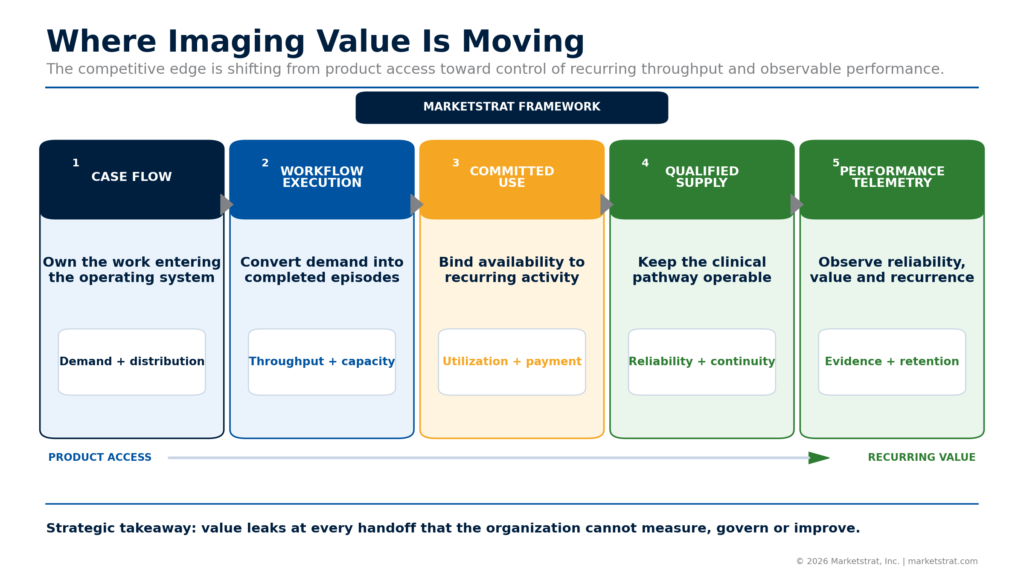
Together, these developments support a broader conclusion: imaging value is moving toward control of the operating denominator behind each episode of care.
The Operating Denominator Is the New Strategic Layer
Clearance, installed footprint and product availability remain necessary. They do not establish recurring value on their own.
The operating denominator is the measurable base through which a product or service converts into routine activity. For teleradiology, it is studies routed, accepted, reported and quality-reviewed. For imaging software, it is eligible studies, activated workflows, completed uses and paid volume. For radiopharmaceuticals, it is qualified weekly output and doses delivered. For procedural platforms, it is completed cases, room utilization and recurring consumables. For safety, it is incidents relative to total uses, followed by remediation and recurrence.
Companies that control these denominators can shape workflow, collect evidence and capture a larger share of the economics.
Radiology Partners and Everlight Put Case Flow at the Center
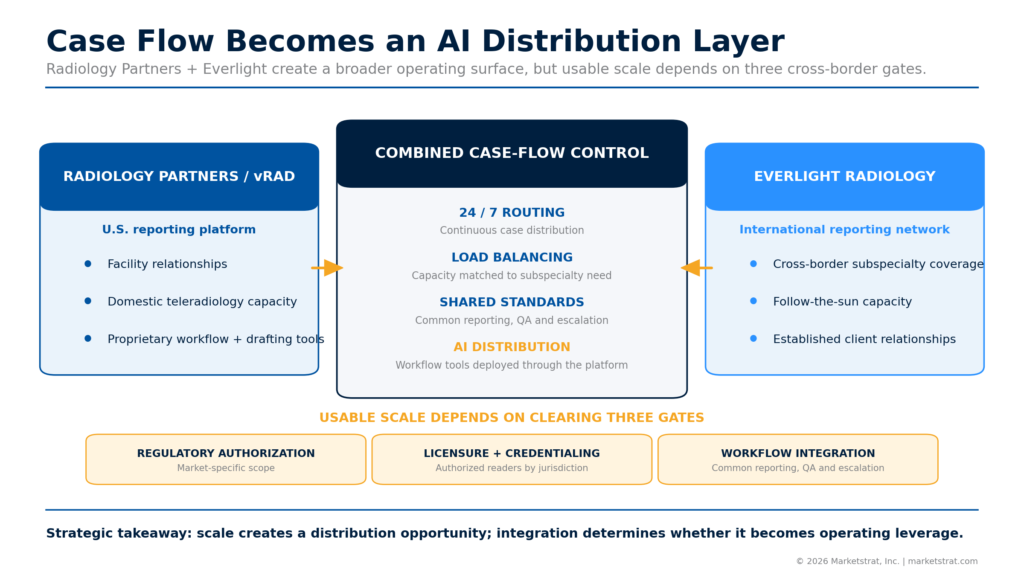
Radiology Partners’ planned acquisition of Everlight Radiology is best understood as a case-flow and capacity transaction.
Everlight processes approximately 2.5 million annual exams through an international radiologist network. Radiology Partners brings a large U.S. facility base, vRad’s teleradiology capacity and proprietary workflow technology. The combination creates a broader surface across which studies can be routed, subspecialty coverage balanced and common tools deployed.
The non-obvious implication is that AI distribution may increasingly follow ownership of the reporting workflow. A platform that manages study intake, reader assignment, report generation and quality review is structurally better positioned than a standalone algorithm vendor to determine when a model is used and how its value is measured.
The constraint is integration. Local regulatory authorization, professional licensing, credentialing, data governance and liability requirements may limit how quickly one operating model can extend across markets. Network scale creates the opportunity. Productivity, turnaround and quality determine whether it becomes economic value.
4DMedical Begins to Bind Access to Use
4DMedical’s first CT:VQ contract with committed minimum utilization marks a different transition.
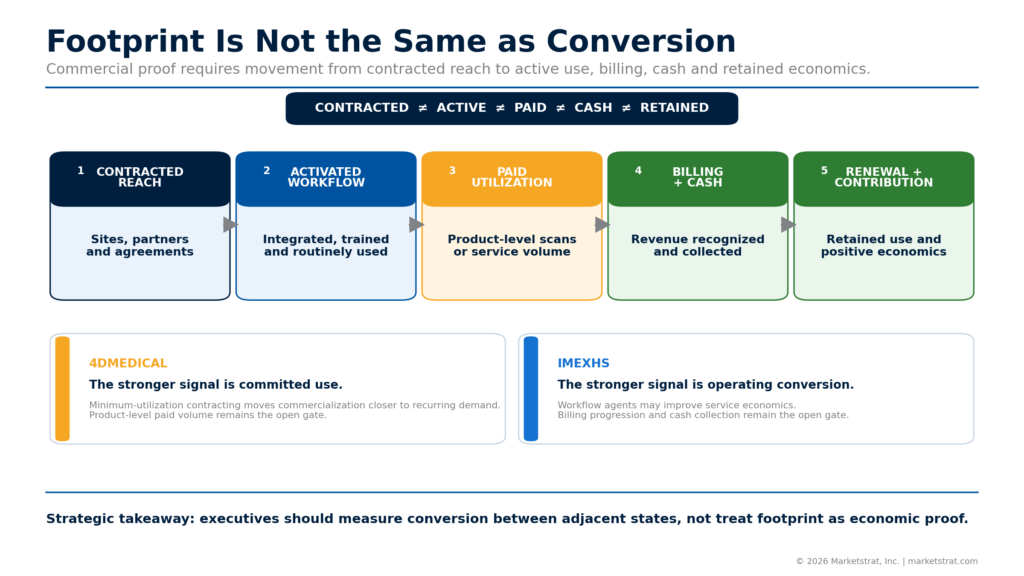
The three-year Cleveland Clinic agreement goes beyond product availability by establishing a recurring-use obligation. That can improve revenue visibility and align vendor support with an expected volume base. It also creates a clearer test of whether reimbursement, clinical demand and workflow integration are sufficient to support routine use.
The limitation matters. 4DMedical’s broader site and scan disclosures cover its SaaS portfolio, not CT:VQ alone. The company also indicated that established products remained the primary source of scan growth. CT:VQ-specific paid volume, minimum attainment and renewal economics were not disclosed.
For commercial teams, the lesson is not that every imaging-AI contract should require a volume commitment. It is that site counts should be separated from eligible studies, active sites, paid scans and renewed use.
ImExHS Tests AI Inside the Service Cost Base
ImExHS is pursuing operating control from another direction. It has deployed eight proprietary workflow agents across its Aquila+ platform and uses the technology within its RIMAB radiology-services business.
That model can be economically attractive because the company acts as its own initial customer. It does not need to persuade a third-party provider to share productivity gains. It can potentially capture lower handling cost, faster coordination and improved case throughput directly through service margins.
The reported improvement is still an early signal. Pricing changes and other cost actions occurred alongside automation. Some contracted software revenue had not yet begun billing, and cash collections lagged recognized revenue. The next evidence should isolate agent-supported cases, exception rates, time saved and cost per completed read, then connect those operating gains to cash conversion.
PanTera Turns Scarce Isotope Capacity Into Qualified Supply
PanTera’s actinium-225 progress shows why production capacity and usable supply are different assets.
The company secured c-GMP recognition, supported regulatory submissions, supplied more than 25 active customers and reported positive first-half EBITDA. These milestones indicate that PanTera is operating beyond the announcement stage. Customers are using qualified material in clinical development and compassionate-use programs.
The strategic advantage is not isotope scarcity alone. Pharmaceutical sponsors require documented quality, repeatable output, release testing, regulatory references and reliable logistics. Once a supplier is embedded in clinical-development documentation, switching can require additional quality and regulatory work.
The boundary condition is execution. Planned capacity expansion must still deliver reliable weekly output, on-time shipment and repeat customer demand.
Procedure Environments and Telemetry Extend the Thesis
Philips and Imricor introduced a commercially available cardiac interventional MR configuration that combines imaging, workflow, mapping, recording and catheter technologies. The commercial model shifts from selling compatible components toward supplying an executable procedure environment.
Availability does not establish adoption. Orders, installed laboratories, trained operators, procedures per room and recurring catheter use remain the relevant denominators.
Safety developments reinforce the same logic. ECRI expanded its pathway for reporting AI errors and near misses, while Boston Scientific’s Imager II catheter removal showed how a manufacturing deviation can interrupt image-guided care. Scaled deployment requires visibility into product version, affected uses, incident frequency, remediation time and recurrence.
What Executives and Investors Should Evaluate Differently
The practical implication is to track conversion between adjacent operating states.
Corporate strategy teams should test whether a platform controls case flow, workflow data and customer renewal, or relies on another organization’s infrastructure. Product leaders should define the next commercial gate alongside the next technical feature. Providers should require access to site-level utilization, exceptions, downtime and corrective-action data. Investors should separate contracted reach from active use, billing, cash and contribution.
M&A diligence should also become more operational. In a teleradiology transaction, the key questions include credentialing, market-specific authorization, workflow standardization and quality governance. In radiopharmaceutical supply, diligence should focus on qualified output, logistics and customer concentration. In software, it should examine implementation burden, telemetry rights and cash conversion.
Marketstrat POV
The market may be overvaluing access metrics and undervaluing operating control.
A large network is valuable when it can improve routing, productivity and quality. A minimum-use contract is valuable when it generates paid product volume. Workflow agents matter when they lower cost without creating new exceptions. Qualified isotope capacity matters when it produces reliable, repeat demand. Telemetry matters when it enables faster detection and remediation.
The thesis weakens if those conversions fail. That is the central test for the next phase of imaging competition.
Explore the latest Marketstrat Pulse analysis and related Horizon research, subscribe to Marketstrat’s LinkedIn newsletter, or contact Marketstrat (research@marketstrat.com) for research access and custom analysis.
Research process: Marketstrat uses a human-led, AI-enabled workflow. AI systems materially support evidence synthesis, modeling, drafting, coding, and quality control. Marketstrat sets the methodology, evaluates the evidence, determines the conclusions, and approves all published content.
About Marketstrat
Marketstrat® is an independent market intelligence firm focused on MedTech, medical imaging, imaging AI, enterprise imaging, PACS, and adjacent healthcare technology markets. Through its Markintel® research methodology and publishing system, Marketstrat produces Horizon Reports, Focus Reports, Company Research, Market Signals, and weekly Pulse Insights. The firm’s research combines market sizing, forecasting, segmentation, competitive mapping, company intelligence, and event-driven analysis to help corporate strategy, product, commercial, investment, consulting, and industry media professionals interpret fast-moving healthcare markets with greater clarity.
Marketstrat® and Markintel® are registered service marks of Marketstrat, Inc.
Our Research
- Horizon Reports — Comprehensive market landscape assessments with sizing, segmentation, forecasting, and competitive mapping across multi-year time horizons.
- Focus Reports — Targeted market intelligence reports on specific segments, technologies, or competitive dynamics drawn from Marketstrat’s broader Horizon research program.
- Company Research — Decision-grade company intelligence covering strategy, competitive positioning, product portfolio, business model, financial structure, partnerships, and stakeholder impact.
- Market Signals — Event-driven analysis tied to specific catalysts, including regulatory actions, M&A, product launches, policy shifts, reimbursement changes, and earnings. Each signal is structured around strategic implications, not just news.
- Pulse Insights — Weekly market intelligence digest covering what moved, what it means, and what to watch across healthcare, MedTech, medical imaging, imaging AI, and adjacent life sciences markets.
