
The cost of making a platform productive belongs inside its commercial strategy. It cannot be left as an assumption between market access and the expected return.
Developments from August 29 through September 4 expose that cost at different stages. Sectra reports revenue from deployed cloud services. Medtronic is expanding robotics distribution options. Enovis proposes acquiring engineering capabilities for future products. GE HealthCare has expanded market access for photon-counting CT. Each development creates opportunity, but the remaining work and funding requirements differ.
Marketstrat’s central judgment is that implementation capability merits greater strategic weight when it becomes repeatable. Scale that continues to require intensive customization, support or unpriced provider effort does not establish the same economic advantage.
Robotics investment buys different obligations
Medtronic announced an investment in Cornerstone Robotics that includes rights to distribute Sentire in selected markets outside the United States where the system is approved. The company positions it alongside Hugo, creating the possibility of broader customer coverage.
That opportunity requires commercial choices. Training, service, sales incentives and platform positioning must support incremental activity. A larger portfolio could instead introduce complexity or shift demand between systems without enough additional procedures to justify the effort.
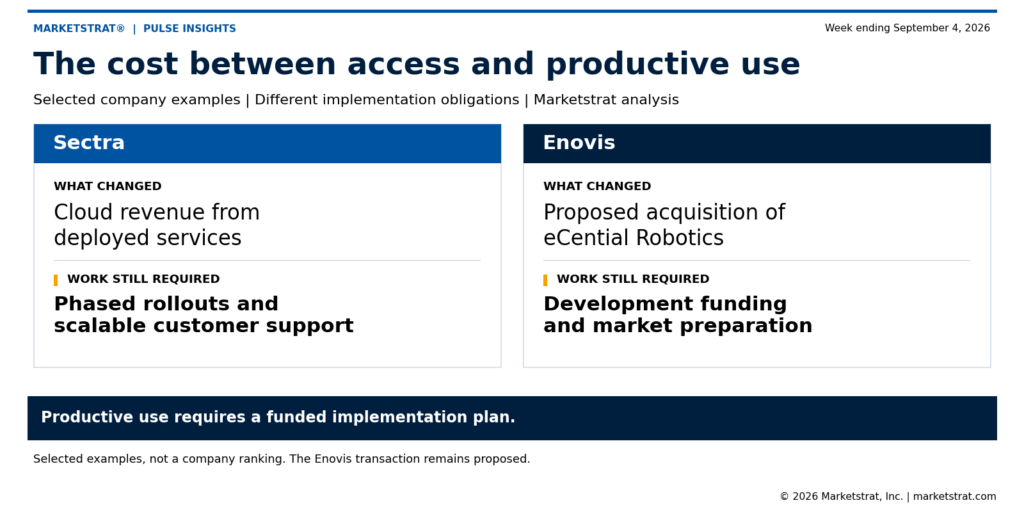
Enovis is pursuing a different form of control. Its binding offer for eCential Robotics would add engineering and automation capabilities. The transaction is not completed, and the development roadmap requires funding before its planned products can generate routine commercial activity.
Management’s projected near-term margin burden makes part of that requirement visible. It does not establish that the expenditure will earn an attractive return, nor that the spending is inherently inefficient.
Marketstrat’s distinction is between the asset acquired and the work still required. Distribution rights and engineering ownership should not be assessed as interchangeable exposures. Their commercial tests begin at different points.
Sectra moves the argument beyond announced opportunity
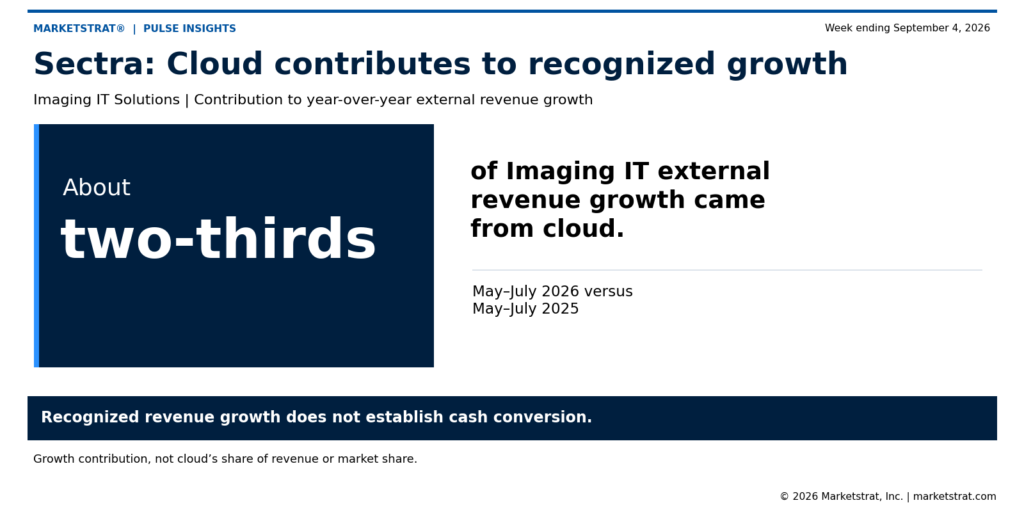
Sectra’s May–July 2026 results carry particular analytical weight because they show cloud services contributing to recognized Imaging IT revenue. Marketstrat calculates that cloud accounted for about two-thirds of the year-over-year increase in the segment’s external revenue.
This is evidence of commercialization, not a measure of enterprise-imaging market share. Management’s description of additional support resources ahead of corresponding revenue also shows why delivery capacity belongs inside the recurring-revenue model.
The cash distinction matters. Weaker group operating cash flow cannot be used as a direct measure of cloud profitability. Equally, a rising cloud-revenue contribution does not prove immediate cash conversion or an indefinitely scalable support model.
The stronger competitive signal would be a sequence of deployments that becomes more predictable while sustaining customer activity and acceptable service requirements. That is a more demanding standard than accumulating contracts or reporting a favorable revenue mix.
Photon-counting CT requires a specific value proposition
GE HealthCare’s CE-mark announcement for Photonova Spectra broadens the system’s commercial access. The next question is how the technology performs in the clinical applications and operating environments that buyers intend to support.
The company’s technical comparison concerns additional data generated, not a proportional increase in scan speed or processing productivity. Procurement should therefore distinguish potential diagnostic benefit from changes in examination throughput, interpretation workload and the complete room cycle.
A provider might value better characterization without completing more scans per hour. Another might prioritize a particular workflow improvement. Both require a defined application and a credible account of installation, protocol development, training and service.
Marketstrat sees expanded access as the beginning of a more practical evaluation. It is insufficient on its own to establish routine use, economic contribution or a realized market-share gain.
AI operating evidence narrows the commercial claim
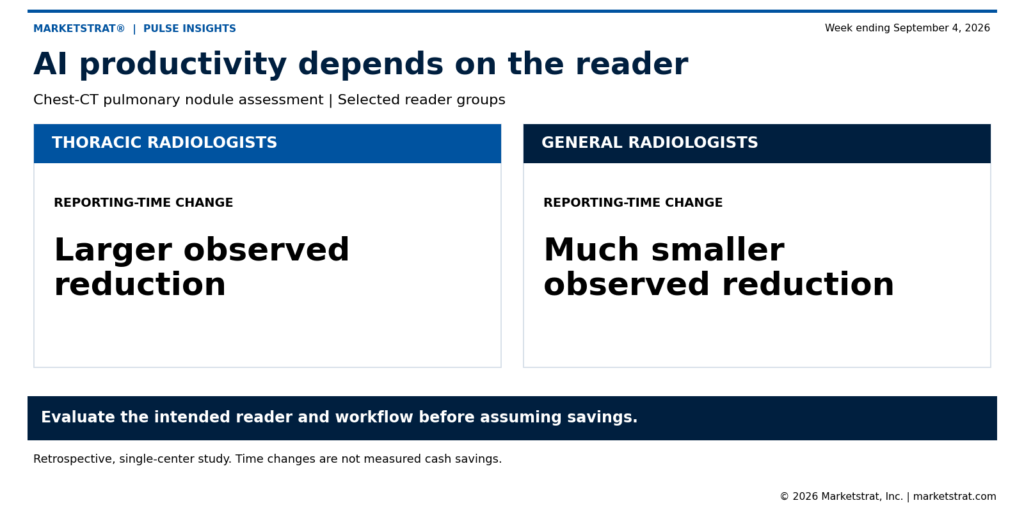
New chest-CT evidence adds an important qualification to the capacity argument. Reporting-time changes differed materially across reader groups, with a substantially larger reduction among thoracic radiologists than general radiologists.
The study does not establish a universal advantage for specialist users. It is retrospective, comes from a single center and relies on modeled, PACS-derived timing measures. Its financial extrapolation is not measured cash savings.
For product leaders, the implication is to define the reader, task and workflow supported by the economic proposition. For providers, it is to avoid distributing a headline average across departments that do different work.
Even a genuine time benefit needs an identifiable use. Additional examinations, avoided overtime and better service are distinct sources of value. The same released capacity should not be counted twice, and a service improvement should not be relabeled as cash savings merely to strengthen an approval case.
What the market may be underestimating
The implementation burden is shared across suppliers, providers and channels. Development and support sit with the supplier; validation and workflow changes can consume provider resources; local market development and technical coverage may fall to a distribution partner.
Marketstrat’s concern is the gap between those responsibilities. A supplier can have an available product while the provider lacks protected staff time. A provider can approve capital without resolving the support required to reach routine use. Neither problem is solved by repeating the potential benefit.
For executives, the useful change is to examine the funding and operating plan alongside the technology decision. The return depends on whether the necessary work is resourced and whether useful activity persists after intensive launch support ends.
Where the implementation thesis can fail
Implementation is not automatically a source of defensibility. It can remain an expanding services burden if successive customers require similar levels of customization and intervention.
The thesis also weakens when broader portfolios mainly redistribute demand or when measured productivity gains disappear after implementation effort and quality review are included. These are material limits to the argument, not reasons to disregard constructive operating evidence.
Marketstrat POV
The most credible platform strategy connects its commercial rights with a funded, repeatable route to useful activity. Sectra provides evidence of revenue conversion; robotics investment and photon-counting CT expose different unfinished obligations; reader-level AI evidence shows why the benefit must fit the deployment.
For corporate strategy, product, commercial and investment teams, the question is what becomes easier as the business expands. Improving predictability and lower intervention can strengthen the case. Persistent dependence on customization or customer effort should temper it.
Explore the latest Marketstrat Pulse analysis and related Horizon research, subscribe to Marketstrat’s LinkedIn newsletter, or contact Marketstrat (research@marketstrat.com) for research access and custom analysis.
Research process: Marketstrat uses a human-led, AI-enabled workflow. AI systems materially support evidence synthesis, modeling, drafting, coding, and quality control. Marketstrat sets the methodology, evaluates the evidence, determines the conclusions, and approves all published content.
About Marketstrat
Marketstrat® is an independent market intelligence firm focused on MedTech, medical imaging, imaging AI, enterprise imaging, PACS, and adjacent healthcare technology markets. Through its Markintel® research methodology and publishing system, Marketstrat produces Horizon Reports, Focus Reports, Company Research, Market Signals, and weekly Pulse Insights. The firm’s research combines market sizing, forecasting, segmentation, competitive mapping, company intelligence, and event-driven analysis to help corporate strategy, product, commercial, investment, consulting, and industry media professionals interpret fast-moving healthcare markets with greater clarity.
Marketstrat® and Markintel® are registered service marks of Marketstrat, Inc.
Our Research
- Horizon Reports — Comprehensive market landscape assessments with sizing, segmentation, forecasting, and competitive mapping across multi-year time horizons.
- Focus Reports — Targeted market intelligence reports on specific segments, technologies, or competitive dynamics drawn from Marketstrat’s broader Horizon research program.
- Company Research — Decision-grade company intelligence covering strategy, competitive positioning, product portfolio, business model, financial structure, partnerships, and stakeholder impact.
- Market Signals — Event-driven analysis tied to specific catalysts, including regulatory actions, M&A, product launches, policy shifts, reimbursement changes, and earnings. Each signal is structured around strategic implications, not just news.
- Pulse Insights — Weekly market intelligence digest covering what moved, what it means, and what to watch across healthcare, MedTech, medical imaging, imaging AI, and adjacent life sciences markets.
