Individual License: $4,950 | Team and Enterprise License Options Available
This Marketstrat® Horizon report provides an in-depth global analysis of Nuclear Medicine imaging and the broader PET, SPECT, radiopharmaceutical, theranostics, isotope, software, and provider-capacity ecosystem.
It is built for molecular-imaging OEM executives, radiopharmaceutical companies, isotope and manufacturing suppliers, nuclear-pharmacy and distribution organizations, software and dosimetry platforms, corporate strategy and development teams, investors, providers, and commercial leaders with exposure to Nuclear Medicine.
The report integrates equipment systems, active installed base, replacement and expansion shipments, realized ASPs, service and aftermarket, diagnostic radiopharmaceuticals, therapeutic product curves, medical-isotope and manufacturing readiness, reimbursement, productive treatment-site capacity, and separately monetized AI and workflow into one reconciled decision model.
Many market studies separate equipment demand from radiopharmaceutical products or treat clinical opportunity as though it converts directly into revenue. This report analyzes the two principal economic pillars of Nuclear Medicine, equipment and radiopharmaceuticals, while preserving the distinct economics of service, software, isotope supply, distribution, reimbursement, and provider operations.
The central question is:
Where will value accumulate as Nuclear Medicine shifts from a scanner-centered modality to an integrated diagnostic, therapeutic, supply, workflow, and provider-capacity operating system?
The report was developed through Markintel®, Marketstrat’s proprietary research methodology, strategic framework stack, and evidence-to-insight workflow. The analysis combines a bottom-up global market model with regulatory, clinical, reimbursement, company, procurement, manufacturing, infrastructure, and provider-operating evidence.
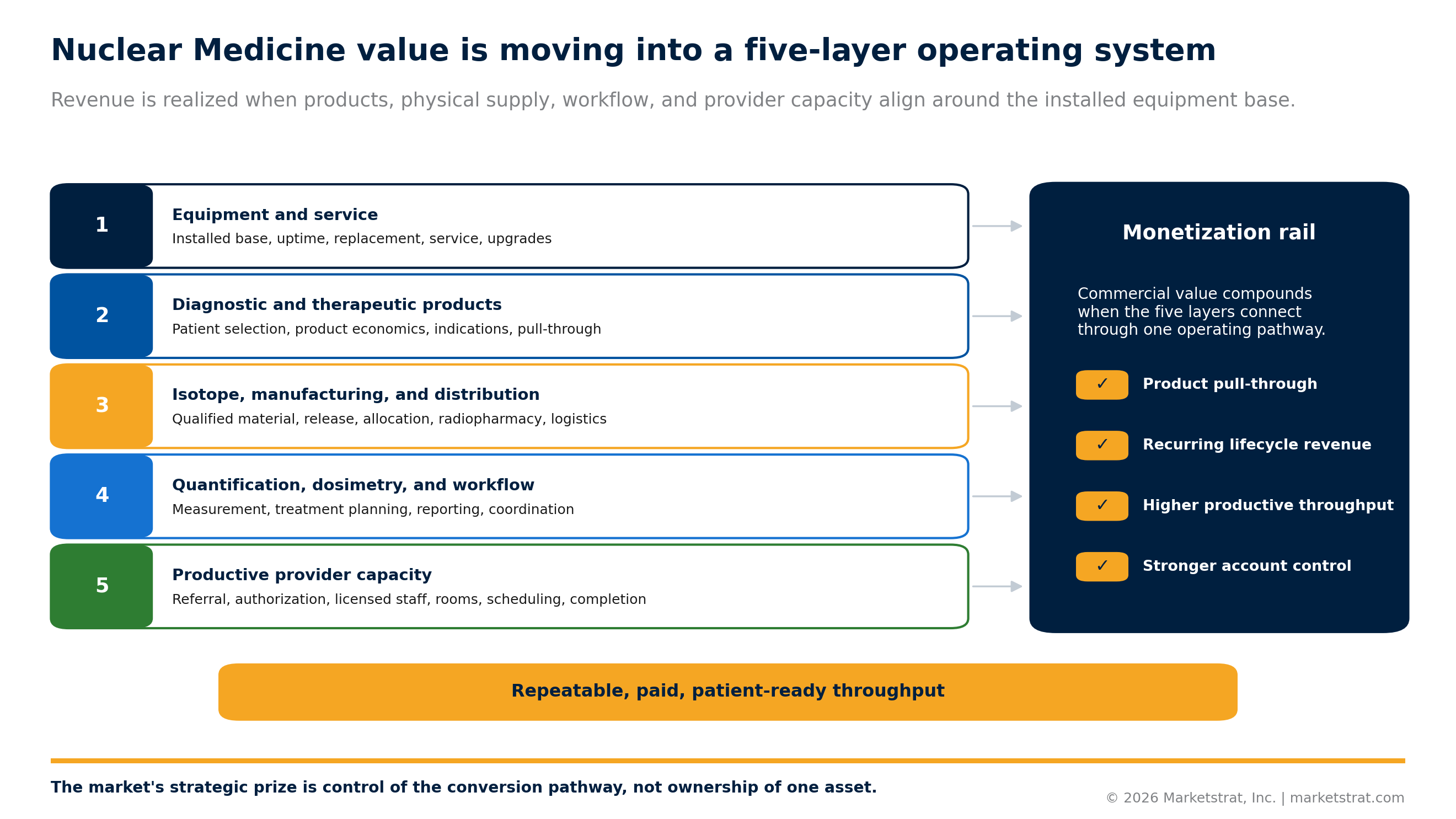
Nuclear Medicine is moving from a modality-centered equipment market toward an integrated diagnostic and therapeutic operating system.
Marketstrat estimates that the core Nuclear Medicine ecosystem increases from US$16.2 billion in 2025A to US$29.4 billion in 2036E, representing a 5.6% CAGR.
Radiopharmaceuticals drive approximately 75% of total market growth. Diagnostic radiopharmaceuticals remain the largest revenue layer, while therapeutic radiopharmaceuticals become the principal growth engine.
Equipment remains the access platform. Digital PET/CT, long-axial-field-of-view PET, PET/MR, and SPECT/CT gain strategic weight as the fleet becomes more digital, hybrid, quantitative, and connected to specialty clinical pathways. Service, software, and upgrades increase the lifetime value of the installed base.
The market does not follow one uniform growth path.
Mature diagnostic categories such as Tc-99m and FDG retain scale. PSMA, cardiac, neuro, and specialty PET create new product and workflow opportunities. Radioligand therapy expands the therapeutic market but requires qualified isotope, product-specific manufacturing, distribution, reimbursement, licensed staff, treatment rooms, scheduling, and course completion.
North America remains the largest commercial market. Europe retains a large installed and clinical base. China, India, and Rest of Asia-Pacific gain share through different combinations of equipment expansion, local production, public procurement, private oncology investment, reimbursement, and provider development.
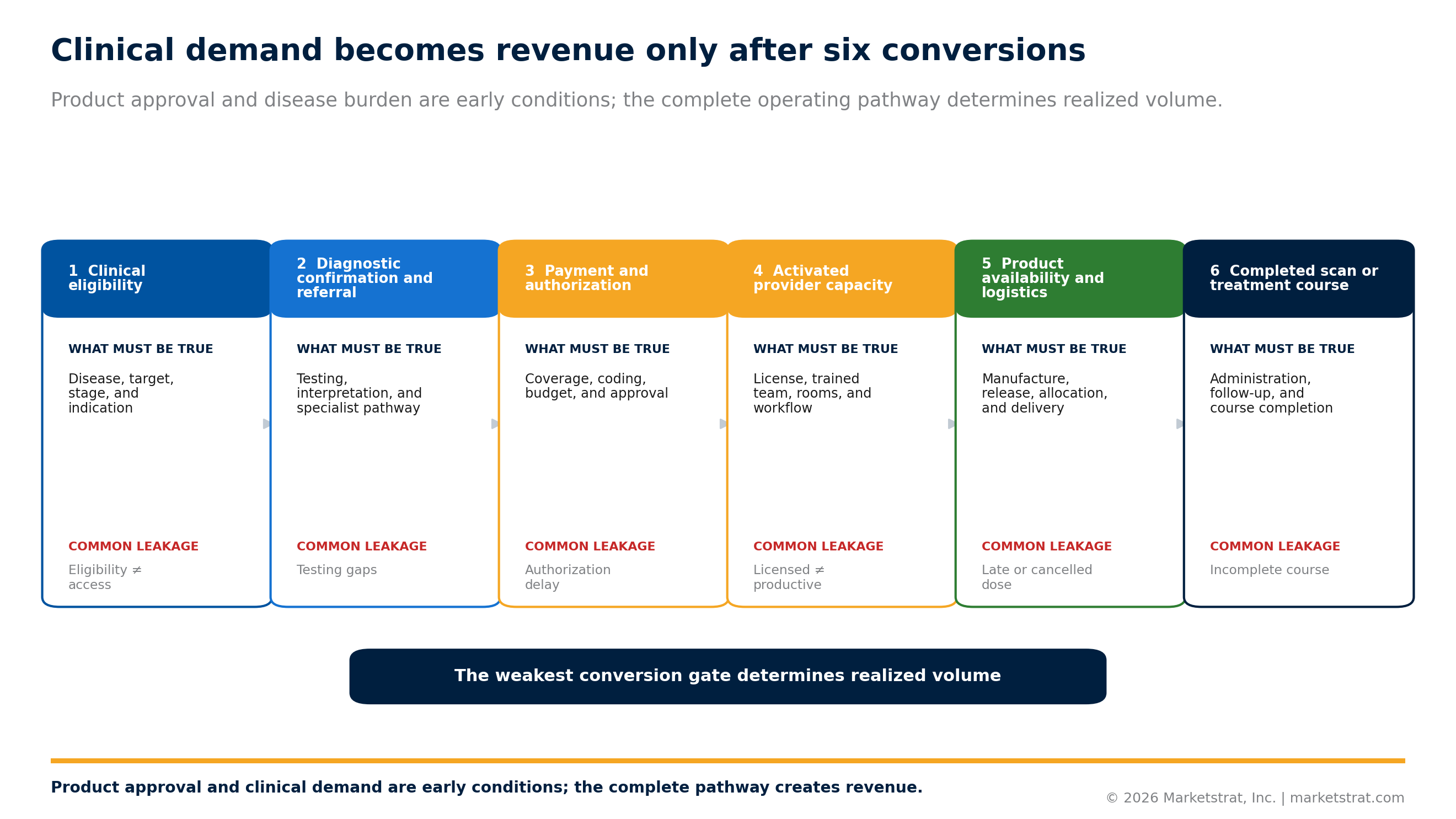
Clinical momentum creates the opportunity. Product supply, payment, and productive provider capacity determine how much of that opportunity becomes revenue.
Radioligand therapy links diagnostic selection, medical isotopes, drug-product manufacturing, distribution, provider activation, dosimetry, and longitudinal follow-up. Commercial advantage increasingly depends on the ability to manage the complete pathway.
The diagnostic market is broad and durable, but internal growth is changing. Cardiac, neuro, PSMA, and specialty PET gain weight, while established Tc-99m and FDG pathways continue to support procedure volume, installed equipment, service, and regional radiopharmacy networks.
Digital PET/CT expands through replacement, dose efficiency, throughput, quantitative consistency, and specialty pathway demand. LAFOV and total-body PET influence premium competition before they become large installed-base categories.
SPECT-only systems decline in mix, but the active SPECT fleet remains large. SPECT/CT gains relevance through hybrid replacement, cardiology, quantitative imaging, theranostics, and dosimetry.
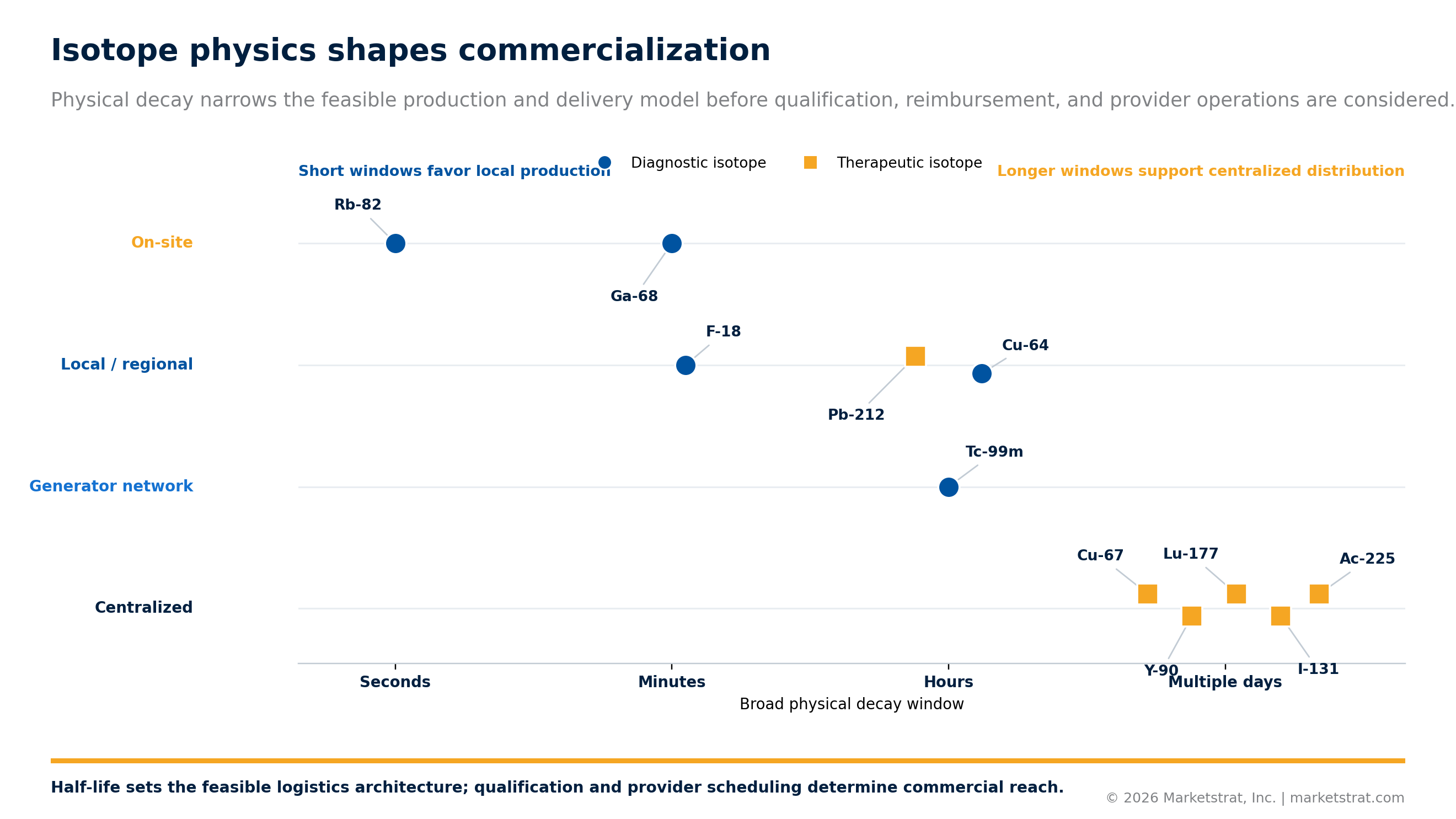
Announced production is not equivalent to qualified and delivered supply. The report distinguishes announced, constructed, licensed, operating, customer-qualified, allocated, released, delivered, and administered capacity.
A contracted or licensed treatment site does not automatically represent productive capacity. Workforce, authorized users, rooms, payer authorization, dose scheduling, radiation safety, and repeated treatment-course commitments determine throughput.
The strongest opportunities are in reconstruction, oncology quantification, theranostics dosimetry, cardiac and neuro analysis, reporting, trial analytics, remote review, and operational coordination. Embedded scanner software and separately monetized vendor software are treated differently.
An attractive equipment market may have limited radiopharmaceutical access. A strong diagnostic market may have limited therapy capacity. Country strategy must reflect product registration, reimbursement, local production, distribution, service, workforce, and provider readiness.