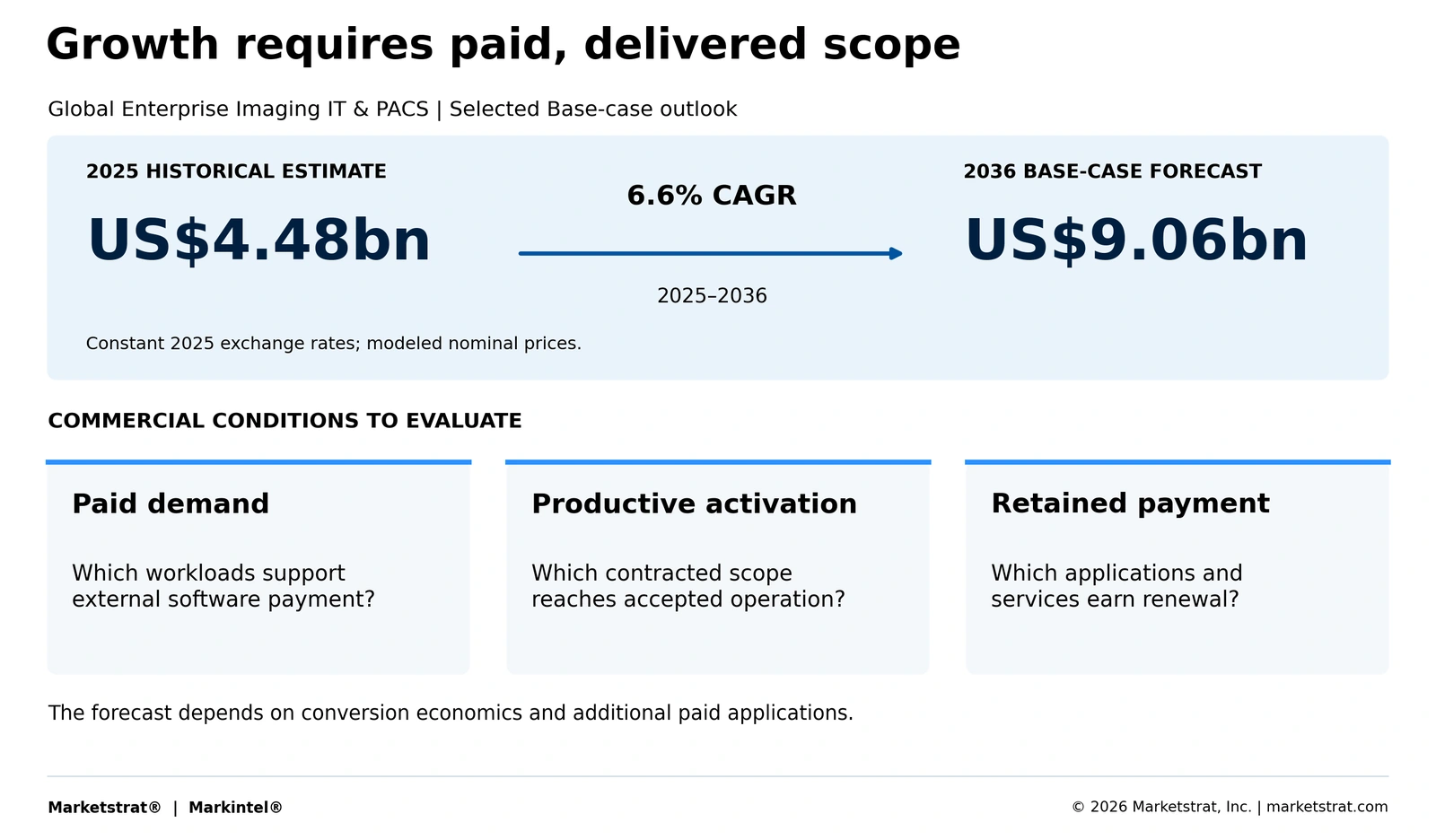
Marketstrat estimates the report-defined market at US$4.48 billion in 2025, increasing to US$9.06 billion in 2036 under its selected Base case, a 6.6% CAGR.
| Market measure | Selected estimate |
|---|---|
| Global market, 2025 historical estimate | US$4.48 billion |
| Global market, 2036 Base-case forecast | US$9.06 billion |
| Base-case CAGR, 2025–2036 | 6.6% |
The forecast depends materially on the transition to recurring-contract economics and additional paid applications, alongside clinical activity, commercial coverage and pricing. It measures eligible vendor receipts. Changes in those receipts can include transferred hosting responsibilities and changes in who receives existing application payments.
Source: Marketstrat estimates and analysis. Conditional Base case; historical values are estimated. Constant 2025 exchange rates with modeled nominal prices. Detailed scenario, sensitivity and allocation assumptions are provided in the report.
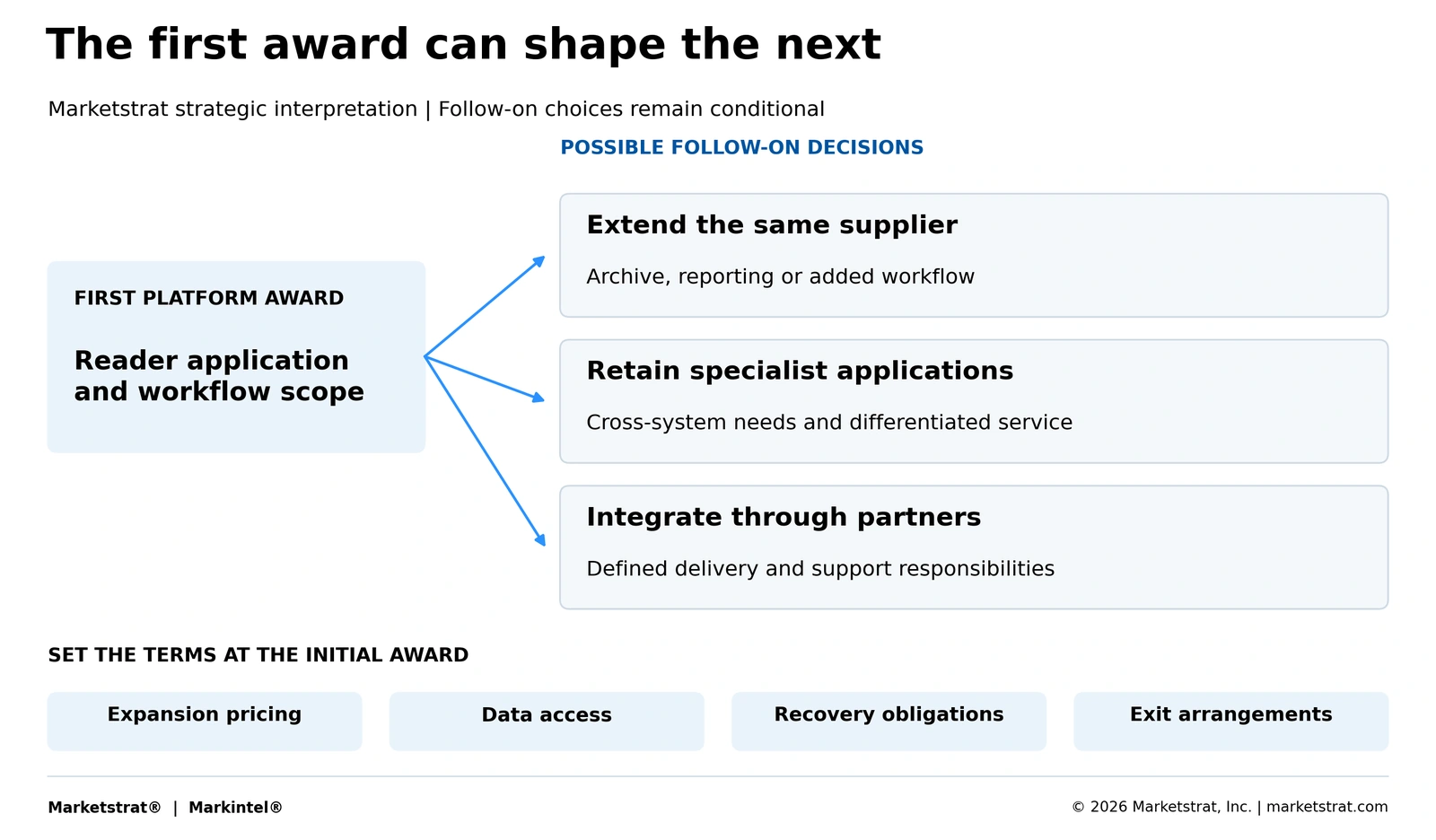
How does the first platform award affect the next purchase?
A bounded viewer or workflow purchase can establish a route to broader account consolidation. The report examines procurement sequences, expansion opportunities, specialist roles and partnership choices. Buyers can use this analysis to assess follow-on pricing, data access and exit arrangements at the first award. Suppliers can identify the next funded application decision and the operating capability required to win it.
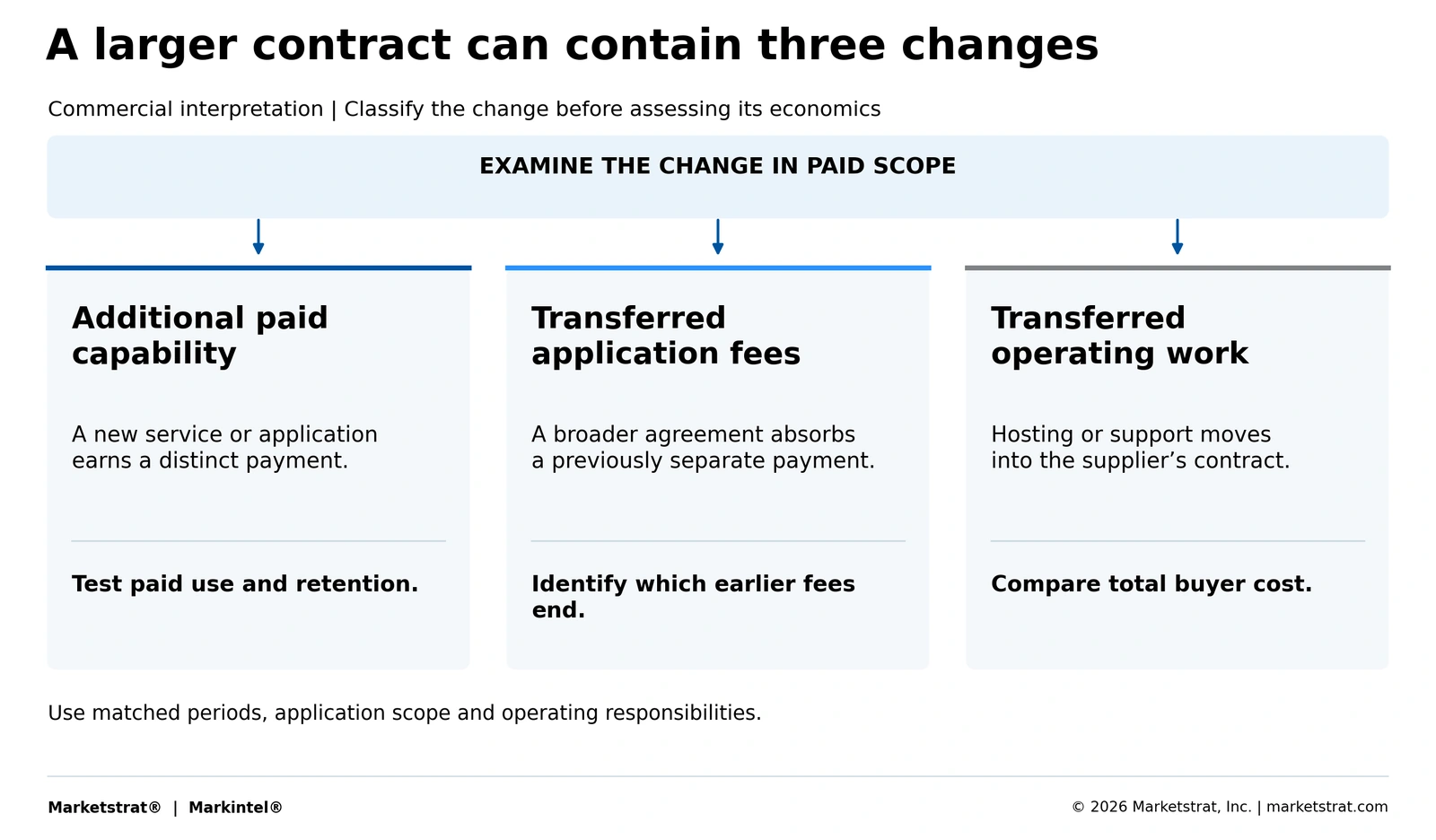
What does a larger recurring contract actually represent?
A broader agreement can combine newly paid functionality, payments transferred from another application supplier, and operating work moved into a managed service. The report examines these mechanisms separately. Its contract analysis addresses minimum commitments, usage overages, renewals, migration, parallel operation and responsibility for continuing support.
Where can AI-assisted reporting and orchestration earn durable payment?
Reporting and orchestration bring enterprise platforms, incumbent applications, independent specialists and provider-origin businesses into overlapping buying decisions. The report examines workflow acceptance, paid attachment, substitution, distribution and the fees retained for continuing integration and governance. Clinical-algorithm receipts remain outside the common-application market definition.
How should commercial strategy change by country and buyer?
An enterprise health system, a radiology group and a public imaging network can have different purchasing authority, application dependencies and delivery requirements. The country chapters connect market opportunity with local workflow, procurement, affordability, implementation capacity and supplier participation. The resulting analysis supports more specific market-entry and account plans.
The decision behind the company comparison
The report organizes competition into seven Competitive Clusters: enterprise imaging platforms; locally integrated PACS/RIS suppliers; archives, interoperability and access businesses; reporting and reader-productivity suppliers; unified-reader and provider-origin platforms; orchestration and governance platforms; and selected EHR, cloud and infrastructure adjacencies.
Coverage includes 62 company and business spotlight entries, with explicit treatment of brands, business units, historical participants and adjacencies. Selected coverage includes Pro Medicus/Visage, Sectra, Agfa HealthCare, Fujifilm, Philips, GE HealthCare, Intelerad, Siemens Healthineers, Merge/Merative, Dedalus, INFINITT, TechMatrix/PSP, Hyland, Mach7, Microsoft/Nuance, Rad AI, Sirona Medical, RadNet/DeepHealth, deepc, Incepto, CARPL.ai and Ferrum Health.
The analysis assesses the relevant buying decision, product and service scope, distribution position, implementation obligations and conditions for retained payment. Company coverage is broader than the selective competitive-positioning frameworks. The spotlight count includes relevant businesses and does not represent 62 independent ultimate owners.
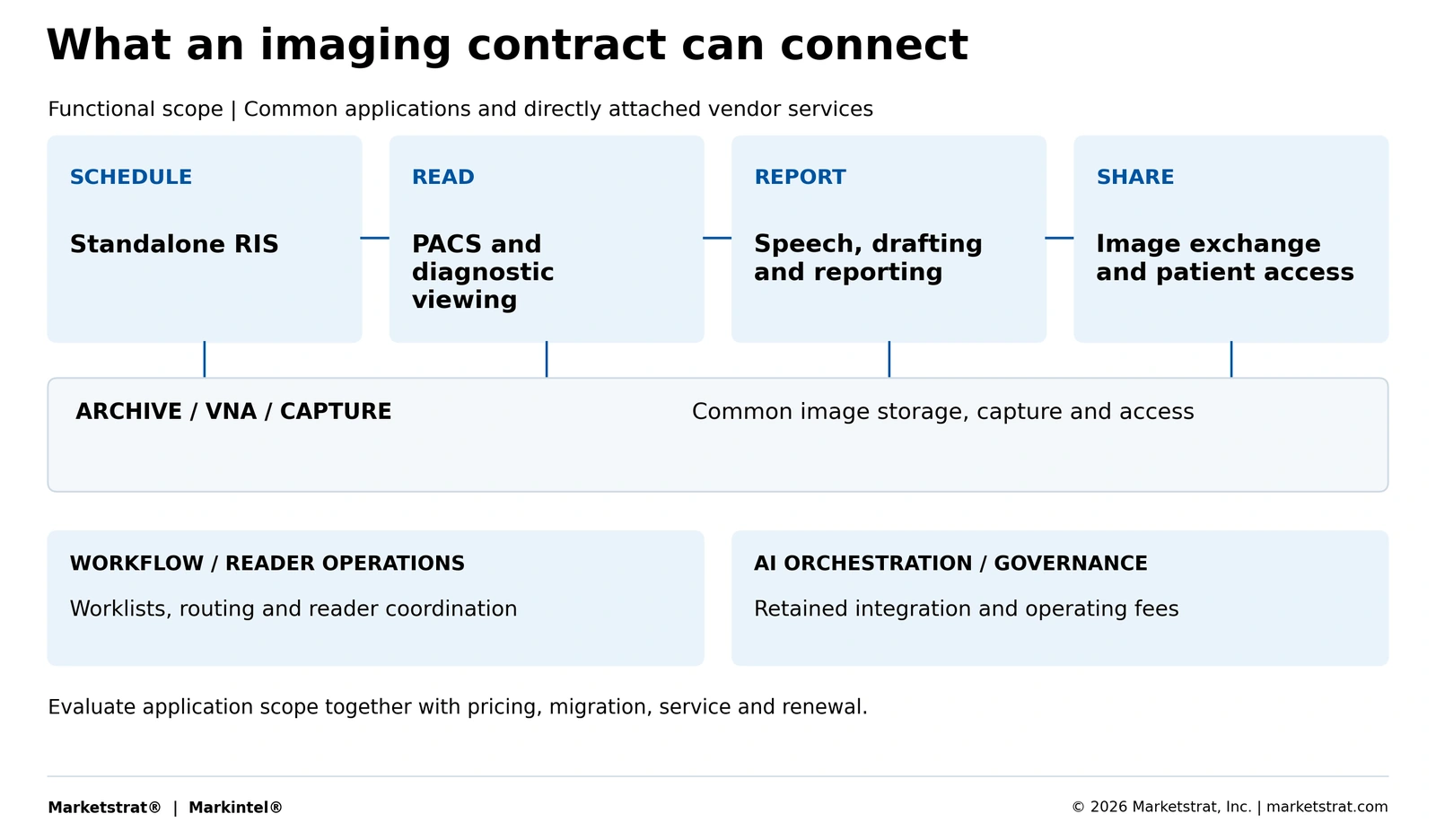
The seven functional categories cover the common imaging environment and reconcile to one defined vendor-revenue total.
| Functional coverage | Commercial questions examined |
|---|---|
| PACS and diagnostic viewing | Replacement decisions, reader-platform relationships, performance and enterprise expansion |
| Archive, VNA and capture | Data migration, cross-system access, common multi-specialty imaging and archive consolidation |
| Standalone RIS | Local radiology workflow, separately paid functionality and substitution within broader imaging or EHR arrangements |
| Reporting, speech and drafting | AI-assisted reporting, workflow acceptance, paid adoption and the retirement of earlier fees |
| Workflow and reader operations | Worklists, routing, reading coordination and the operating requirements for added scope |
| Image exchange and patient access | Shared image availability, external access and the distinction between connected reach and paid activity |
| Retained AI orchestration and governance | Integration, monitoring, administration, platform fees and continuing delivery obligations |
Directly attached implementation, integration and operating services are included within their relevant functions. Vendor-bundled managed hosting is included in eligible application-service revenue. Common cardiology image capture, viewing and archiving follow the same scope rules across standalone and bundled purchases.
Clinical AI algorithms, dedicated specialty analytics, equipment, modality workstations, general EHR activity, professional interpretation, internal provider labor and directly provider-paid infrastructure are excluded from the core market. The cardiology treatment and associated scope clarification were explicitly retained in the completed review.