Global Contrast Media & Injectors Horizon: Market Structure, Forecasts, Competitive Dynamics, and Delivery Economics, 2025A–2036E - October 2026

Individual License: $4,950 | Team and Enterprise License Options Available


Key Takeaways


  • Marketstrat estimates the global contrast media and injectors market at approximately $9.1 billion in 2025, covering finished non-radioactive agents, injection equipment, consumables, paid service, and narrowly attributable contrast-management software.
  • Iodinated contrast agents remain the largest revenue foundation. Generic entry, realized pricing, presentation availability, and qualified supply influence competitive outcomes.
  • Recurring injector consumables and services are important sources of continuing supplier revenue. Commercial returns depend on productive installations and the purchasing configuration.
  • Lower-gadolinium MRI products and ultrasound-enhancing agents create distinct clinical and commercial opportunities, with adoption depending on local clinical use, purchasing acceptance, and repeat administration.
  • Market conditions vary substantially across regions. Procurement arrangements, domestic manufacturing, product access, and delivery infrastructure influence commercialization.


Market snapshot: the economics of contrast administration

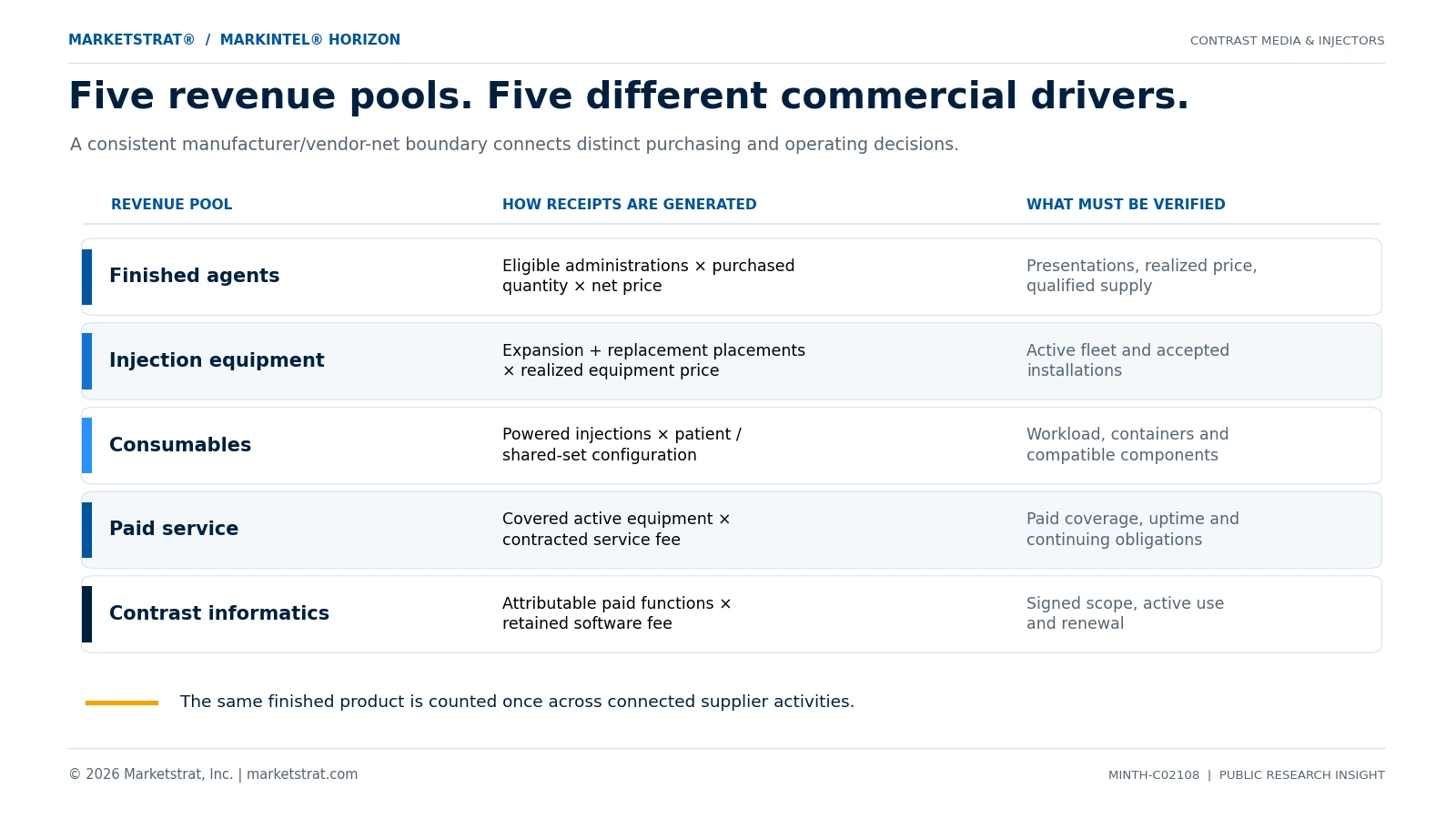
Marketstrat estimates the global core market at approximately $9.1 billion in 2025, with continued expansion projected through 2036. The market includes several businesses with different economic characteristics. Finished contrast agents generate recurring pharmaceutical revenue tied to clinical use, purchasing quantities, product mix, and net realization. Injection systems create equipment and replacement opportunities, while compatible consumables and paid service extend the commercial relationship over the equipment’s operating life.


An important feature of this market is that purchasing decisions can alter supplier revenue without a comparable change in the number of imaging examinations. Product substitutions may redistribute existing revenue among manufacturers. Changes in packaging or delivery configuration can affect the quantities purchased per examination. New clinical applications can expand eligible administration activity, provided healthcare organizations have the capacity and processes needed to support routine use.


The Horizon report models these mechanisms through consistent revenue boundaries, supplier analysis, country-level demand assumptions, and alternative operating scenarios.


Five developments shaping the market


1. Iodinated contrast: pricing, generics, and supply reliability


  • Iodinated agents remain central to CT and X-ray-based contrast imaging. The competitive environment is evolving as additional finished-dose suppliers expand approved products, presentations, and purchasing access.
  • Generic competition creates opportunities for procurement savings and supplier substitution. Commercial outcomes depend on the presentations available, contractual arrangements, continuity of supply, and the amount of business exposed to review.
  • For established suppliers, account retention and comparable realized pricing are important. For entrants, sustained product availability and repeat purchases are necessary to establish a durable commercial position.


The report evaluates these dynamics across major suppliers and procurement-sensitive markets.


2. MRI contrast: new product choices and formulation economics


  • MRI contrast portfolios are evolving through lower-gadolinium agents, new formulations, and alternative development programs.
  • Products such as gadopiclenol and gadoquatrane introduce different dose and active-content characteristics. Their commercial implications depend on the existing formulary, approved clinical use, presentation, pricing, and local adoption.


The analysis examines how MRI contrast innovation affects product substitution, portfolio positioning, purchasing decisions, and longer-term market structure.


3. Ultrasound contrast: translating clinical eligibility into routine use


  • Ultrasound-enhancing agents address defined clinical applications, including echocardiography and selected body-imaging uses.
  • Growth opportunities depend on adoption within actual care pathways. Preparation procedures, trained personnel, clinical protocols, reimbursement arrangements, and product availability all influence whether an eligible examination becomes a completed contrast-enhanced study.


The report assesses established products, emerging programs, competitive participation, and the commercial requirements for wider adoption.


4. Contrast injectors: the recurring economics of delivery


  • Contrast injectors link pharmaceutical purchasing with equipment, disposables, and service.
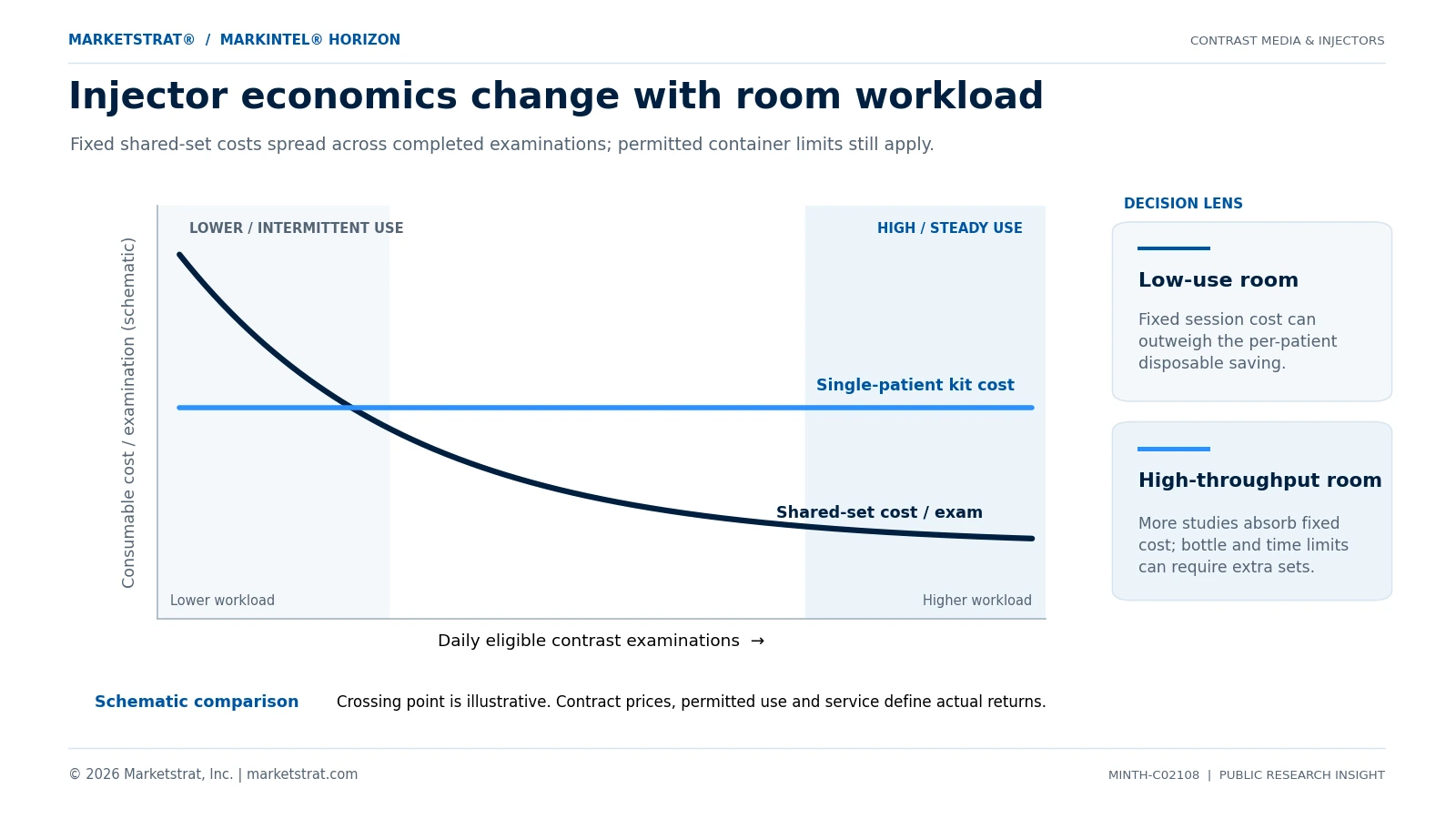
  • The economics of single-patient and multipatient configurations vary by examination workload, container utilization, permitted operating limits, disposable costs, and service obligations.
  • A configuration that performs well in a high-volume department may have different financial characteristics in a backup room or smaller imaging facility.


Marketstrat evaluates injector replacement, active utilization, consumables, paid service, and provider operating economics to explain the commercial potential of delivery technologies.


5. Manufacturing, procurement, and international competition


  • Contrast supply involves specialized chemical inputs, formulation, filling, quality release, packaging, distribution, and customer replenishment.
  • Vertically integrated manufacturers and regional formulation suppliers are increasingly relevant to competitive access, particularly where domestic procurement and product qualification influence purchasing.
  • Established multinational suppliers face different conditions across the United States, Europe, China, India, Japan, and other markets.


The report examines these differences through company analysis, regulatory and procurement evidence, and country-specific commercial assessments.


Report Overview

Contrast media is a recurring and essential component of diagnostic imaging. Iodinated agents support CT and angiography, gadolinium-based agents serve MRI, and ultrasound-enhancing microbubbles enable selected echocardiography and other clinical applications. These products also sit within a wider commercial ecosystem. Injection equipment, compatible consumables, manufacturing and distribution infrastructure, procurement arrangements, and clinical workflow influence how imaging activity becomes supplier revenue.


Marketstrat’s Global Contrast Media & Injectors Horizon examines these relationships through an integrated market and competitive assessment covering 2025 through 2036.


The research evaluates where demand is developing, how purchasing and product substitution affect realized revenue, which delivery configurations offer sustainable economics, and how suppliers can position their portfolios across different markets. The report provides an independent basis for market strategy, product planning, commercialization, competitive intelligence, procurement analysis, and corporate development.
 

Competitive Landscape

The research covers integrated contrast suppliers, generic and local finished-dose manufacturers, injector specialists, ultrasound-agent companies, enabling suppliers, and selected workflow participants.


Companies receiving substantive coverage include GE HealthCare, Bayer, Bracco, Guerbet, Lantheus, Amneal Pharmaceuticals, Beijing Beilu Pharmaceutical, Zhejiang Starry Pharmaceutical, Fresenius Kabi, ulrich medical, Nemoto Kyorindo, ACIST Medical Systems, and Subtle Medical.


The competitive assessment examines product scope, relevant financial disclosures, manufacturing and distribution responsibilities, commercial positioning, technology development, partnerships, and the conditions required for sustained revenue growth. Particular attention is given to the distinction between consolidated company revenue and the revenue attributable to the defined contrast media and injectors market.

Geographic Coverage

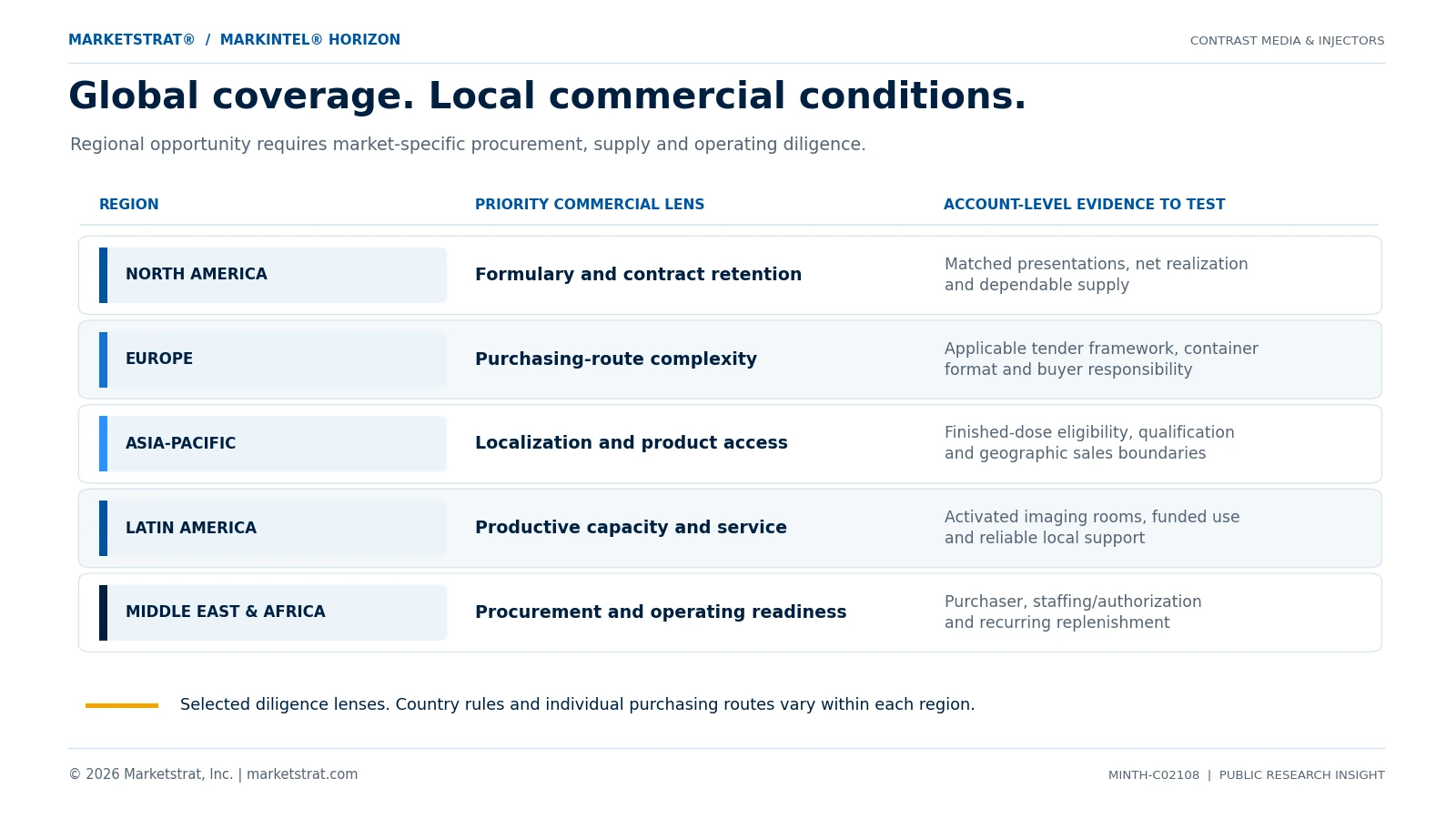
The Horizon report provides a global market model across five major regions and 20 country and regional reporting units.

Coverage includes:


  • North America: United States and Canada.
  • Europe: Germany, France, United Kingdom, Italy, Spain, and Rest of Europe.
  • Asia-Pacific: China, Japan, India, South Korea, Australia/New Zealand, and Rest of Asia-Pacific.
  • Latin America: Brazil, Mexico, and Rest of Latin America.
  • Middle East & Africa: Gulf Cooperation Council, South Africa, and Rest of Middle East & Africa.


Country assessments examine relevant differences in imaging activity, procurement, supplier access, manufacturing, product availability, delivery infrastructure, and commercial execution. These analyses support market prioritization, route-to-market planning, pricing strategy, and evaluation of regional growth opportunities.
 

What the full report delivers

The Horizon report includes:


  • Annual market forecasts, 2025A–2036E, covering the global market and its principal revenue components.
  • Base, Bear, and Bull scenarios, with underlying operating assumptions and sensitivities.
  • Detailed product segmentation, including iodinated, MRI, ultrasound, and oil-based agents; injection equipment; consumables; paid service; and narrow contrast informatics.
  • Clinical-use and end-user analysis, covering CT, MRI, angiography, ultrasound, hospitals, independent imaging organizations, specialty practices, and other users.
  • Competitive and company assessments examining commercial positioning, product portfolios, financial scope, supply, and partnerships.
  • Regional and country analysis across 20 reporting units, incorporating market-specific purchasing and commercialization conditions.
  • Technology and provider economics, including injector configurations, product substitution, clinical adoption, and purchasing considerations.
  • Markintel® strategic frameworks, connecting market structure with technology maturity, commercial readiness, adoption, positioning, and portfolio decisions.
  • Strategic priorities and forecast signposts identifying the evidence and market developments that could change the outlook.


Markintel strategic frameworks


  • The report applies Marketstrat’s proprietary Markintel methodology to connect quantitative market analysis with commercial strategy.
  • The framework applications include the M³ Market Momentum Matrix, Marketstrat Technology Evolution Matrix (M-TEM), Technology Diffusion and Impact Curve (T-DIC), Solution Adoption & Growth Matrix, ARC readiness assessment, Growth Maturity Matrix, and Upgrade & Package Ladder.
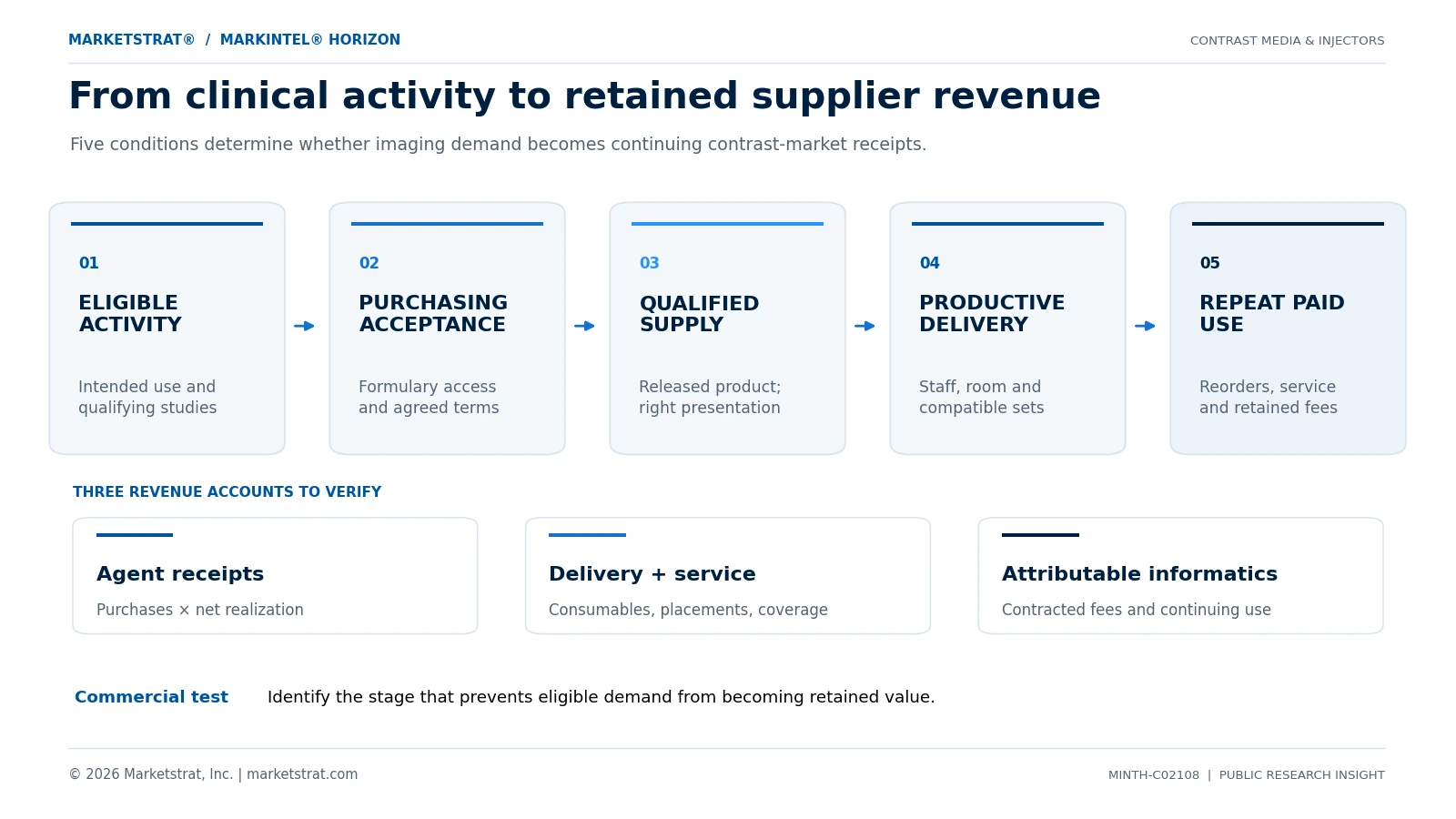
  • A report-specific Commercial Conversion & Value Capture Map further examines how clinical activity moves through purchasing acceptance, qualified supply, productive delivery, and recurring paid use.


Together, these approaches support decisions concerning market prioritization, product development, commercialization investment, account strategy, and partnership opportunities.


Who should use this report?


  • Contrast media manufacturers and pharmaceutical diagnostics businesses can assess market opportunities, product competition, geographic expansion, pricing exposure, and portfolio priorities.
  • Injection-system and consumables suppliers can evaluate the economics of equipment placement, replacement, recurring products, service, and customer configuration.
  • Corporate strategy and business development teams can assess market structure, competitive positions, partnerships, acquisition opportunities, and investment priorities.
  • Healthcare providers and procurement organizations can use the research to understand supplier dynamics, product substitution, delivery configurations, and market-level purchasing economics.
  • Investors, private equity firms, investment banks, and consultants can evaluate market growth, competitive developments, business scope, scenario exposure, and strategic positioning.

Report Details

Field Details
Report title Global Contrast Media & Injectors Horizon
Subtitle Market Structure, Forecasts, Competitive Dynamics, and Delivery Economics, 2025A–2036E
Report ID MINTH-C02108
Publication October 2026
Research series Marketstrat® / Markintel® Horizon
Forecast period 2025A–2036E
Geography Global; five regions and 20 country/regional units
Format Digital PDF
Individual license $4,950
Team license $5,450
Enterprise license $8,950


Request the report


Explore the complete market forecasts, competitive analysis, geographic assessments, and strategic implications in the full Marketstrat Horizon report.

Request the Table of Contents and Sample to review the research coverage and analytical approach.

Purchase the Report for access to the complete publication and accompanying data.

For team and enterprise licensing, or additional geographic and product-specific analysis, contact research@marketstrat.com.


Related Marketstrat Research


The following reports provide complementary perspectives on imaging equipment, clinical applications, workflow, and adjacent markets.

Global CT Scanners Market Horizon | July 2026

Examines global CT equipment demand, technology evolution, installed-base replacement, clinical applications, and competitive structure. Provides complementary context for understanding the imaging activity and equipment infrastructure associated with iodinated contrast use.

Global MRI Horizon | February 2026

Analyzes MRI systems, installed-base economics, technology evolution, and workflow commercialization. Complements the contrast report’s examination of gadolinium-based products, MRI clinical applications, and changing purchasing requirements.


Global Ultrasound Horizon | April 2026

Provides a global assessment of ultrasound technology, clinical applications, competitive dynamics, and commercialization. Offers additional context for evaluating the adoption environment for ultrasound-enhancing microbubble agents.


Global Enterprise Imaging IT & PACS Horizon | October 2026

Examines imaging software, workflow, data management, enterprise platforms, and retained software revenue. Provides complementary analysis of the broader digital infrastructure surrounding contrast documentation, workflow, and connected imaging operations.


Global Nuclear Medicine & PET Horizon | August 2026

Examines molecular imaging, diagnostic and therapeutic radiopharmaceuticals, manufacturing, distribution, and provider capacity. Offers an adjacent perspective on imaging pharmaceuticals and supply chains, with distinct product and revenue boundaries.

By submitting this form, you agree to our Privacy Policy