
What acquisition terms, distribution agreements and operating results reveal about recurring revenue.
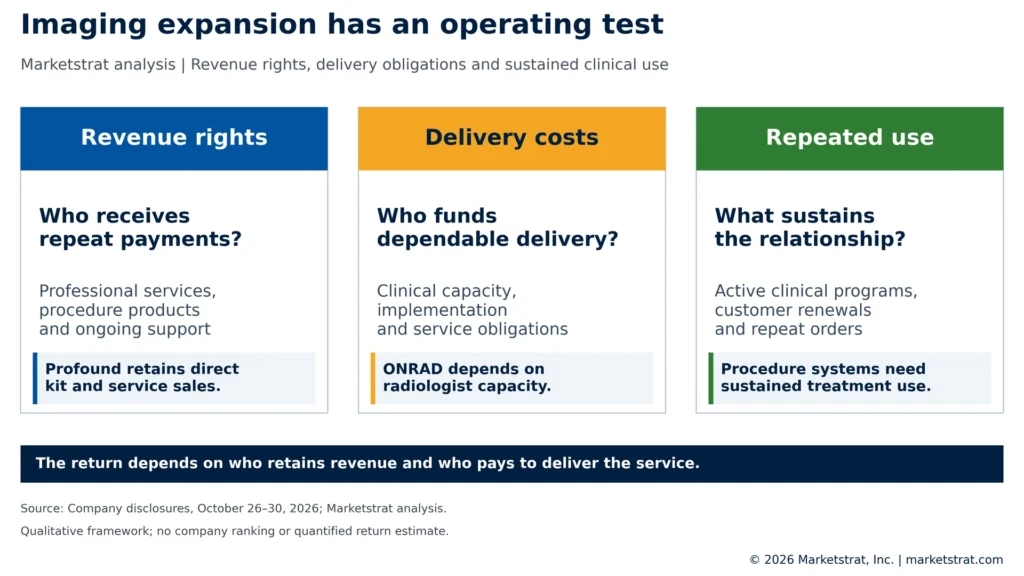
Imaging companies are expanding through acquisitions, distribution partners and new capacity. Marketstrat’s view is that the commercial outcome will depend on the recurring customer relationships they retain and the obligations they assume to serve those customers.
Developments disclosed during October 24–30, 2026 provide several ways to test that view. RadNet (RDNT: Nasdaq) proposed an acquisition of professional interpretation capacity. Profound Medical (PROF: Nasdaq; PRN: TSX) allocated equipment distribution and recurring customer sales between partners. GE HealthCare (GEHC: Nasdaq) reported earnings from an established diagnostic-agent business.
RadNet’s acquisition case starts with professional service
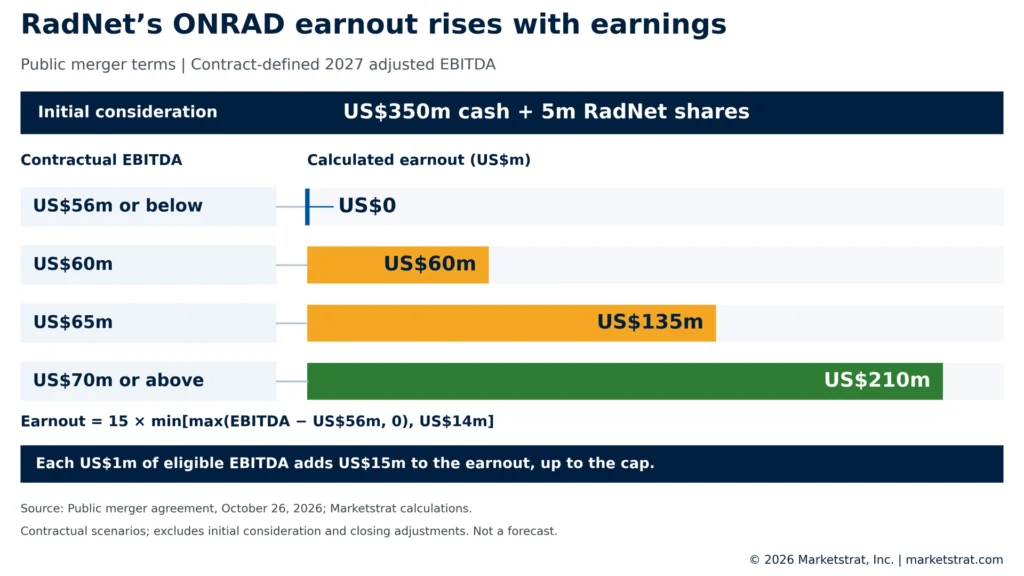
RadNet agreed on October 26 to acquire ONRAD for US$350 million cash and 5 million shares, plus up to US$210 million contingent consideration. Closing is expected in early 2027.
Management describes ONRAD as supporting more than 225 hospital facilities through more than 130 contracted radiologists.
The proposed combination could connect professional interpretation with RadNet’s technology and operating capabilities. The initial commercial requirement is to preserve coverage, radiologist participation and customer relationships.
The earnout also makes future performance part of the purchase price. Under the contract, contingent consideration equals 15 times defined 2027 adjusted EBITDA above US$56 million, capped at US$210 million. That produces illustrative payments of US$60 million at US$60 million EBITDA and US$135 million at US$65 million EBITDA.
These are contractual calculations. Management’s first-year post-closing guidance covers a different stated period and requires reconciliation before it can be used in that formula.
For investors, a technology-led improvement needs to appear in sustainable operating performance. Higher qualifying earnings can also increase the contingent acquisition cost.
Profound separates channel access from recurring sales
Profound Medical announced its U.S. agreement with Cook Medical on October 30. Cook will purchase TULSA-PRO systems at a predetermined transfer price. Customers will buy disposables and service contracts directly from Profound.
The structure preserves Profound’s involvement as procedures recur. The transfer-price amount, minimum purchase commitments and orders are Not disclosed.
Marketstrat expects the pace of treatment-program development to explain meaningful differences between new sites. A purchased system needs appropriate referrals, trained clinicians and access to compatible MRI capacity. Slow activation can add support requirements before substantial disposable revenue arrives.
Configuration eligibility remains relevant. The announcement states that U.S. clearance for using TULSA-PRO with MAGNETOM Free.Max is still being sought. Multiple compatible 1.5T and 3T configurations already have clearance.
Commercial planning should therefore follow commissioning, first treatment and repeat use. The additional channel creates an opportunity whose economics depend on the clinical program.
GE HealthCare provides an operating reference for diagnostic agents
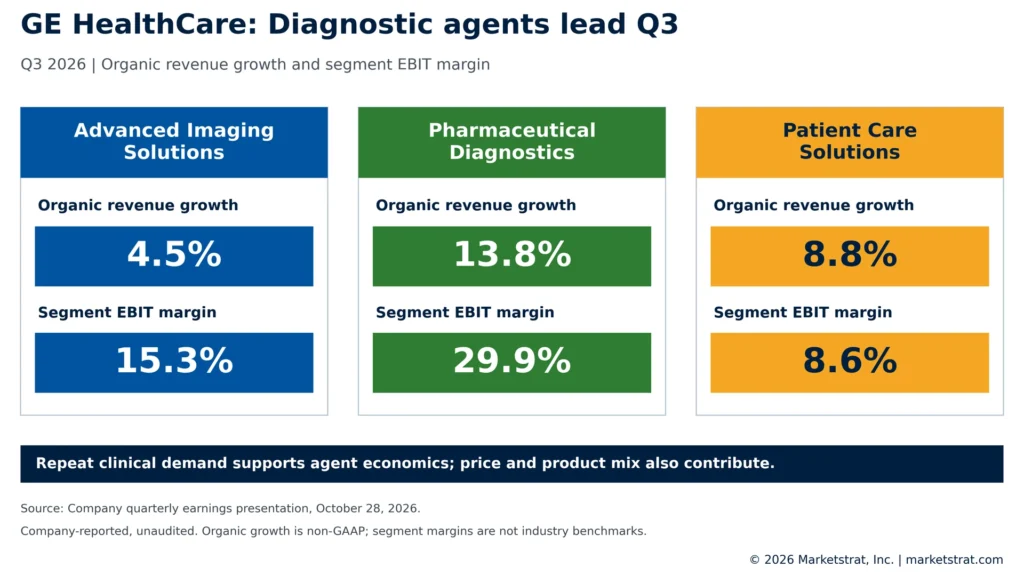
GE HealthCare reported third-quarter Pharmaceutical Diagnostics revenue of US$846 million, 13.8% organic growth and a 29.9% segment EBIT margin.
Advanced Imaging Solutions recorded 4.5% organic growth and a 15.3% margin. Patient Care Solutions reported 8.8% organic growth and an 8.6% margin. These are company-reported segment measures, and organic growth is non-GAAP.
The results show the contribution of diagnostic agents within an established business. They also illustrate why reliable inputs matter to providers trying to use installed equipment effectively.
A provider schedules patients, staff and equipment around clinical demand. Agent availability is part of making that schedule workable. Delivery consistency and recovery options can consequently influence procurement alongside price.
Bracco’s separately announced US$230 million U.S. manufacturing investment addresses the same supply requirement. Its announcements do not disclose a production-start date or qualified annual output.
The distinction affects planning. Customer supply discussions can begin well before a new facility releases commercial product. Forecasts of usable capacity need qualification and production evidence.
GE’s results also require care: growth includes pricing, and margins reflect product mix and scale. They cannot establish the economics of every tracer, new plant or supplier.
4DMedical makes the next commercial question visible
4DMedical (4DX: ASX) reported 119,672 quarterly scan analyses and 724 installed sites, with A$2.3 million unaudited operating revenue. Its footprint includes acquired operations as well as organic growth.
The company also reported gross margin above 90%, A$15.2 million operating cash outflow and A$242.8 million cash at quarter-end.
Together, these disclosures show expanding activity and funding capacity while leaving important product-level questions open. Total scan analyses do not identify paid use for a particular application. A period-end site count combines customers at different stages of activation.
Marketstrat expects mature-account activity and contribution to become increasingly useful indicators as the installed footprint expands. The relevant evidence is whether customers deepen use and whether the cost of delivering that use stabilizes.
High gross margins can support attractive incremental economics. Commercialization still requires an operating cost base that must be funded and assessed separately.
What strategy teams should carry into the next review
The common issue is the allocation of recurring revenue and responsibility for delivery. Ownership, a distribution agreement and a supply relationship each create different operating requirements.
Providers should identify the specific service improvement they are buying and the evidence needed to evaluate it after implementation. Commercial teams should connect the sale to activation and repeat use. Investors should assess the funding required to sustain customer relationships.
These questions also apply to AI productivity claims. A prospective fracture study newly published during the week found a 0.4 percentage-point accuracy improvement in a specific radiographer workflow. It did not measure reading-time savings or downstream outcomes. The commercial benefit must remain tied to what the evidence actually demonstrates.
Marketstrat POV: Follow the recurring relationship
Over the next 12–24 months, Marketstrat expects established clinical relationships and dependable delivery to shape expansion returns. Additional distribution becomes commercially meaningful when it produces sustained, appropriate use at an acceptable delivery cost.
The view would weaken if acquisitions impair retention, new systems remain lightly used or implementation spending persistently outruns customer contribution. Stronger prospective evidence of productivity or patient benefit could support more favorable economics in specific applications.
Related Marketstrat Research
Global Contrast Media & Injectors Horizon: Market Structure, Forecasts, Competitive Dynamics, and Delivery Economics, 2025A–2036E
October 2026
Market structure and delivery economics for contrast agents, injectors and associated recurring revenue, relevant to GE HealthCare and Bracco.
Global Enterprise Imaging IT & PACS Horizon: Market Structure, Forecasts, Competitive Dynamics, and Workflow Monetization, 2025A–2036E
October 2026
Pricing, implementation and recurring-revenue economics for enterprise imaging, PACS and reporting workflows, relevant to Sectra’s live deployment.
Global AI in Medical Imaging Horizon: Forecasts, Competitive Architecture, and Reimbursement-Driven Monetization, 2024A–2035E
June 2026
Forecasts, competitive architecture and reimbursement-driven monetization across imaging AI, supporting assessment of repeated use and revenue.
Global MRI Horizon: Market Structure, Forecasts, and AI Monetization
February 2026
MRI market structure, forecasts and AI monetization, providing modality context for MRI-guided treatment-program development.
The full Pulse note examines these contractual and operating mechanisms in greater detail. Subscribe to The Marketstrat Pulse, explore Marketstrat’s related research and contact Marketstrat for research access or custom analysis.
Source basis: Company disclosures; regulatory and transaction records; peer-reviewed clinical evidence; Marketstrat analysis.
Research process: Marketstrat uses a human-led, AI-enabled workflow. AI systems materially support evidence synthesis, modeling, drafting, coding, and quality control. Marketstrat defines the methodology, evaluates the evidence, determines the conclusions, and approves all published content.
About Marketstrat
Marketstrat® is an independent market intelligence firm focused on MedTech, medical imaging, imaging AI, enterprise imaging, PACS, and adjacent healthcare technology markets. Through its Markintel® research methodology and publishing system, Marketstrat produces Horizon Reports, Focus Reports, Company Research, Market Signals, and weekly Pulse Insights. The firm’s research combines market sizing, forecasting, segmentation, competitive mapping, company intelligence, and event-driven analysis to help corporate strategy, product, commercial, investment, consulting, and industry media professionals interpret fast-moving healthcare markets with greater clarity.
Marketstrat® and Markintel® are registered service marks of Marketstrat, Inc.
Our Research
- Horizon Reports — Comprehensive market landscape assessments with sizing, segmentation, forecasting, and competitive mapping across multi-year time horizons.
- Focus Reports — Targeted market intelligence reports on specific segments, technologies, or competitive dynamics drawn from Marketstrat’s broader Horizon research program.
- Company Research — Decision-grade company intelligence covering strategy, competitive positioning, product portfolio, business model, financial structure, partnerships, and stakeholder impact.
- Market Signals — Event-driven analysis tied to specific catalysts, including regulatory actions, M&A, product launches, policy shifts, reimbursement changes, and earnings. Each signal is structured around strategic implications, not just news.
- Pulse Insights — Weekly market intelligence digest covering what moved, what it means, and what to watch across healthcare, MedTech, medical imaging, imaging AI, and adjacent life sciences markets.
