
Enterprise imaging contracts and integrations shape software access. Marketstrat examines the implications for providers, application vendors and investors.
Imaging software distribution is becoming part of the enterprise platform purchase. Marketstrat expects that relationship to influence more advanced-visualization and imaging-AI buying over the next 12–24 months, raising the importance of application access, implementation responsibility and the provider’s ability to change suppliers.
Developments announced during November 14–20, 2026 show the mechanism at several points in the diagnostic service. Pro Medicus (PME: ASX) has secured a broad provider agreement. GE HealthCare (GEHC: Nasdaq) and Royal Philips (PHG: NYSE) are connecting analysis with the reading workflow. Sectra (SECT B: Nasdaq Stockholm) is extending an existing relationship into pathology. Each gives the platform a different role in determining how software reaches clinical work.
Contract scope makes implementation commercially consequential
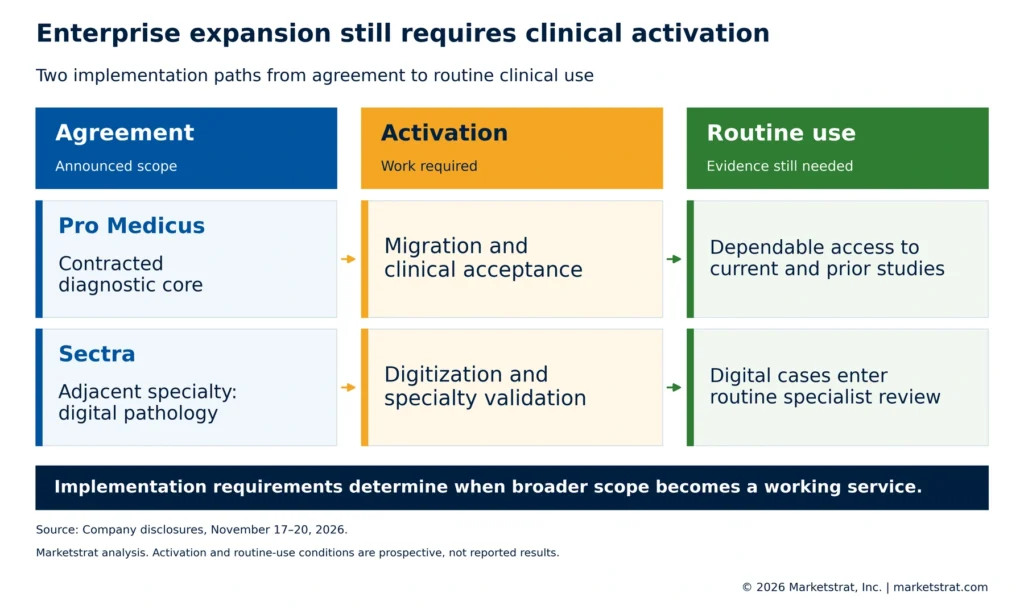
Pro Medicus announced a ten-year, A$128 million agreement with NYC Health + Hospitals for viewing, workflow and archiving. The planned cloud implementation includes legacy archive migration and EHR-integrated image distribution, with go-live targeted for late Q3 2027.
The connection between these functions matters. The reading environment depends on access to the current study and relevant prior examinations. A supplier responsible for the workflow and archive participates in the operating conditions that make interpretation possible.
Marketstrat’s judgment is that migration capability and service accountability should therefore carry substantial weight in comparable procurement. A broad agreement creates an opportunity for a sustained commercial relationship, alongside an obligation to deliver a complex transition.
The disclosed transaction model also leaves future activity important. The headline contract value supplies no annual revenue schedule. Investors need a clear understanding of when the service begins and how activity translates into the commercial result. Providers need acceptance criteria that reflect routine clinical work.
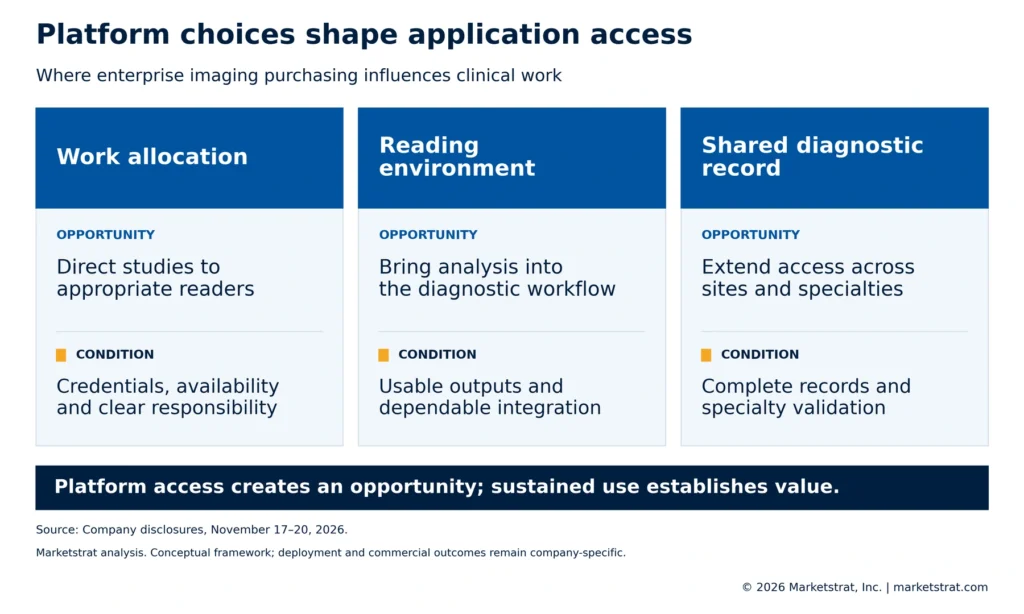
The reading environment becomes an application channel
GE’s AW ONE integration allows advanced-visualization and workflow applications to launch from InteleViewer in the patient’s context. Philips’s Advanced Image Insights combines visualization with third-party imaging-AI orchestration and connections to reporting.
These developments place the application closer to an existing clinical task. That can change the work required to reach a customer and make a tool available to the clinician reviewing a relevant examination. The platform supplier gains influence over application access and the experience of receiving its output.
For specialist software vendors, this creates a commercial trade-off. Distribution through an established relationship may reduce repeated integration work. Channel fees, support obligations and access to customer usage information still determine the economics. The announcements provide no common basis for estimating a margin benefit.
Providers face a related governance question. A managed offering can consolidate responsibility for connecting applications, yet each tool still needs appropriate acceptance and oversight. Philips explicitly preserves application-specific intended uses and regulatory status, with availability varying by market.
The purchasing discussion should include the practical requirements for replacing an application. That option becomes more consequential as several clinical tools depend on the same platform relationship.
A second specialty expands the relationship and the delivery task
Sectra’s Ontario agreement adds digital pathology at three hospitals already participating in an established regional imaging relationship. It illustrates an account-expansion route supported by existing infrastructure and service management.
Pathology nevertheless brings its own operating requirements. Digitizing slides, connecting laboratory systems and validating clinical review can govern the implementation timetable. A functioning radiology service cannot establish readiness for every pathology workflow.
Marketstrat expects this distinction to matter as enterprise suppliers pursue broader diagnostic relationships. Reusing procurement and surrounding infrastructure can help, while the new specialty’s operating work may remain the binding constraint. Buyers should give that specialty clear responsibility for clinical acceptance within the common service agreement.
What the market may be missing
The distribution benefit depends on what happens after access is established. An application can be technically available, appropriately integrated and lightly used. A provider can also buy broad functionality while activating only part of it.
Marketstrat therefore treats platform breadth as a commercial opportunity whose value depends on implementation and repeated use. Named purchases and renewals retaining the applications would strengthen the case. A longer list of demonstrations would provide limited confirmation.
The same discipline applies to pricing power. A supplier may gain influence through the platform relationship while a large buyer negotiates a package discount. Account scope, support burden and realized commercial terms need to be considered together.
MRI contrast has a different evidence timetable
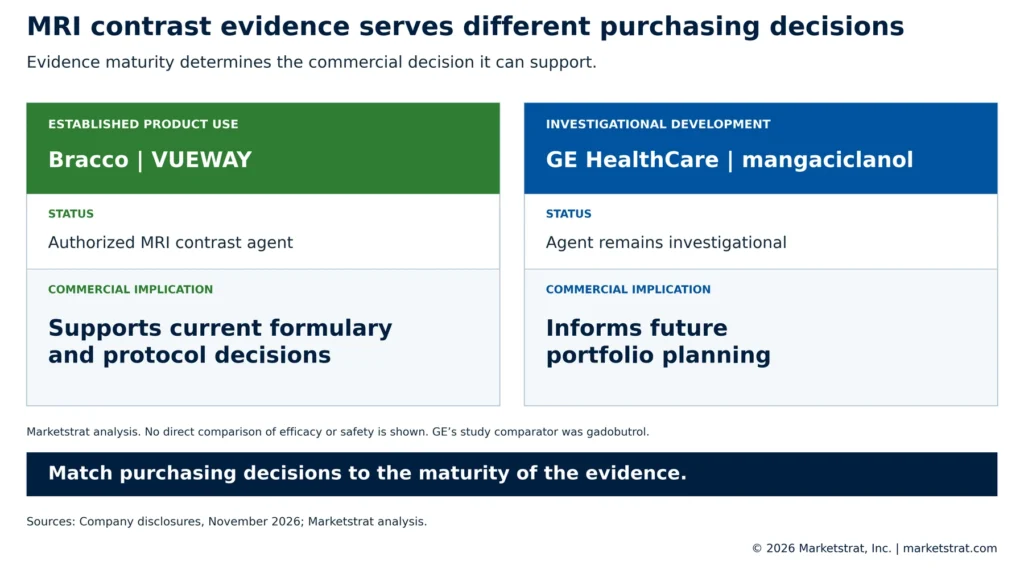
The MRI contrast evidence provides a useful boundary for interpreting commercial signals. GE selected a mangaciclanol dose for LUMINA Phase 3. The agent remains investigational. Bracco’s VUEWAY cumulative-use disclosure, based on September 2026 company data, describes experience with an established product.
These disclosures serve different purchasing questions. Available agents can be assessed against authorized uses, protocol needs, supply reliability and delivered cost. An investigational program informs competitive planning as the clinical evidence develops.
GE’s disclosed comparison used gadobutrol. It does not establish a direct efficacy or safety ranking against VUEWAY. The available information also provides no regulatory timetable for mangaciclanol.
Marketstrat expects LUMINA to influence future portfolio planning and tender evidence requirements. Current purchasing should continue to depend on available products. Provider decisions to defer procurement in anticipation of the investigational agent would be a reason to reassess that expectation.
Implications for strategy, product and procurement teams
For providers, the priority is an accountable service with visibility into the applications it contains. Understanding activation requirements and the practical cost of changing a tool helps preserve choice throughout the contract.
For application vendors, the platform channel needs a commercial model that connects customer access with sustainable support and observable use. Increased availability across an installed base has value only when the resulting economics support continued participation.
For investors and enterprise suppliers, the next evidence should connect contracted scope with an operating service. That requires attention to implementation timing and customer use without assuming that every connected application creates an additional sale.
Marketstrat POV
Enterprise relationships are likely to become more influential in imaging application distribution. The strongest confirmation would be customer purchasing and renewal decisions that explicitly retain those applications after routine use begins.
Our view would weaken if integrated catalogs remained lightly used, channel economics discouraged credible suppliers or direct purchasing delivered comparable deployment economics. These conditions make the thesis testable while keeping the commercial importance of the current developments in proportion.
Related Marketstrat Research
Explore the market models and company analysis relevant to this edition’s developments.
Global Enterprise Imaging IT & PACS Horizon: Market Structure, Forecasts, Competitive Dynamics, and Workflow Monetization, 2025A–2036E
October 2026
Provides market, competitive and commercial context for enterprise imaging. Relevant to this edition’s questions about the scope of provider agreements, implementation obligations and opportunities to expand an existing imaging relationship. Read alongside the Pro Medicus and Sectra developments.
Global AI in Medical Imaging Horizon: Forecasts, Competitive Architecture, and Reimbursement-Driven Monetization, 2024A–2035E
June 2026
Examines imaging-AI revenue models and competitive positioning. Provides context for evaluating how application distribution and enterprise workflow influence purchasing, including the commercial questions raised by GE HealthCare’s integration and Philips’s orchestration offering. The emphasis here is the route from access to a sustainable customer relationship.
Global Contrast Media & Injectors Horizon: Market Structure, Forecasts, Competitive Dynamics, and Delivery Economics, 2025A–2036E
October 2026
Provides context on contrast-agent market structure, competitive positioning and commercialization. Relevant to assessing current purchasing for established MRI agents and the future competitive significance of investigational products, while keeping their evidence stages and commercial timetables distinct.
Explore Marketstrat Pulse and the related research for further context. Visit Marketstrat.com or contact research@marketstrat.com to discuss research access or custom analysis, and subscribe to The Marketstrat Pulse on LinkedIn for future editions.
Research process: Marketstrat uses a human-led, AI-enabled workflow. AI systems materially support synthesis, modeling, drafting, coding, and quality control. Marketstrat sets the methodology, evaluates the evidence, determines the conclusions, and approves all published content.
About Marketstrat
Marketstrat® is an independent market intelligence firm focused on MedTech, medical imaging, imaging AI, enterprise imaging, PACS, and adjacent healthcare technology markets. Through its Markintel® research methodology and publishing system, Marketstrat produces Horizon Reports, Focus Reports, Company Research, Market Signals, and weekly Pulse Insights. The firm’s research combines market sizing, forecasting, segmentation, competitive mapping, company intelligence, and event-driven analysis to help corporate strategy, product, commercial, investment, consulting, and industry media professionals interpret fast-moving healthcare markets with greater clarity.
Marketstrat® and Markintel® are registered service marks of Marketstrat, Inc.
Our Research
- Horizon Reports — Comprehensive market landscape assessments with sizing, segmentation, forecasting, and competitive mapping across multi-year time horizons.
- Focus Reports — Targeted market intelligence reports on specific segments, technologies, or competitive dynamics drawn from Marketstrat’s broader Horizon research program.
- Company Research — Decision-grade company intelligence covering strategy, competitive positioning, product portfolio, business model, financial structure, partnerships, and stakeholder impact.
- Market Signals — Event-driven analysis tied to specific catalysts, including regulatory actions, M&A, product launches, policy shifts, reimbursement changes, and earnings. Each signal is structured around strategic implications, not just news.
- Pulse Insights — Weekly market intelligence digest covering what moved, what it means, and what to watch across healthcare, MedTech, medical imaging, imaging AI, and adjacent life sciences markets.
