
Agilent’s Proscia deal, Sirona’s funding and PocketHealth’s expansion put delivery costs in focus for imaging strategy teams, investors and providers.
A software contract creates an obligation to keep clinical work running. Marketstrat sees implementation, sustained use and the cost of dependable service becoming more important to imaging returns. The developments announced October 10–16, 2026 show several ways that obligation is growing.
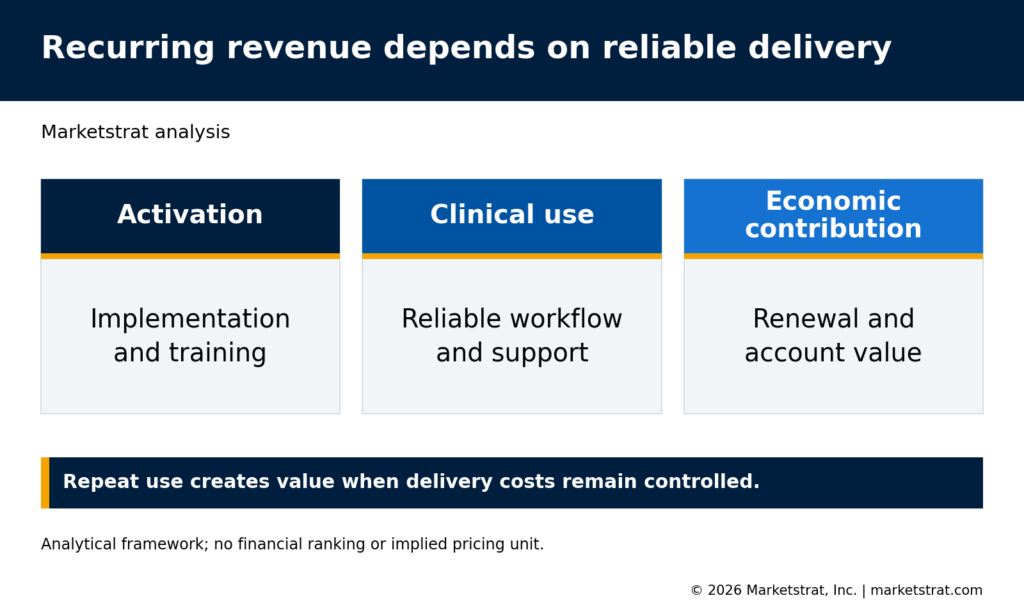
Sources: Company portfolio, transaction and operating disclosures; Marketstrat analysis.
Recurring revenue depends on customers continuing to find value in the work a platform supports. That requires successful deployment, reliable daily operation and a service model the supplier can sustain. Ownership of software or a larger contracted customer base increases the opportunity alongside the responsibility for delivering it.
This week’s announcements connect those commercial requirements with a further question in oncology: whether the evidence supports a product’s intended role in care. Together, they show why the clinical activity behind a sale deserves close attention.
Agilent: The existing customer relationship changes the acquisition question
Agilent announced an agreement to acquire Proscia on October 13. The companies already had a distribution relationship, making the commercial effect of ownership a specific issue for analysis.
Ownership would give Agilent greater influence over the software roadmap, implementation investment and recurring revenue within pathology. Its existing customer relationships provide access to laboratories with identifiable workflow needs. The value of that access depends on expanding paid use and maintaining customer relationships after deployment.
Laboratories also operate equipment and information systems acquired over time. Compatibility across those environments affects how useful a software platform can become. Preserving that reach is commercially relevant to the acquisition’s potential.
Marketstrat’s view is that the existing distribution relationship raises the importance of incremental account value. Paid adoption, renewal quality and implementation economics will show what ownership adds. The agreement remains subject to closing conditions.
Sirona: Contracted growth brings a delivery obligation
Sirona’s October 15 announcement of a $40 million Series D included evidence of growth in both commercial commitments and platform activity. Two selected measures illustrate that expansion: contracted annual recurring revenue reached 2.7 times its prior-year level, while diagnostic reports reached 2.0 times their prior-year level, as of September 30.
These are company-reported measures with different definitions and denominators. They provide no conversion rate between contracted business and live clinical activity.
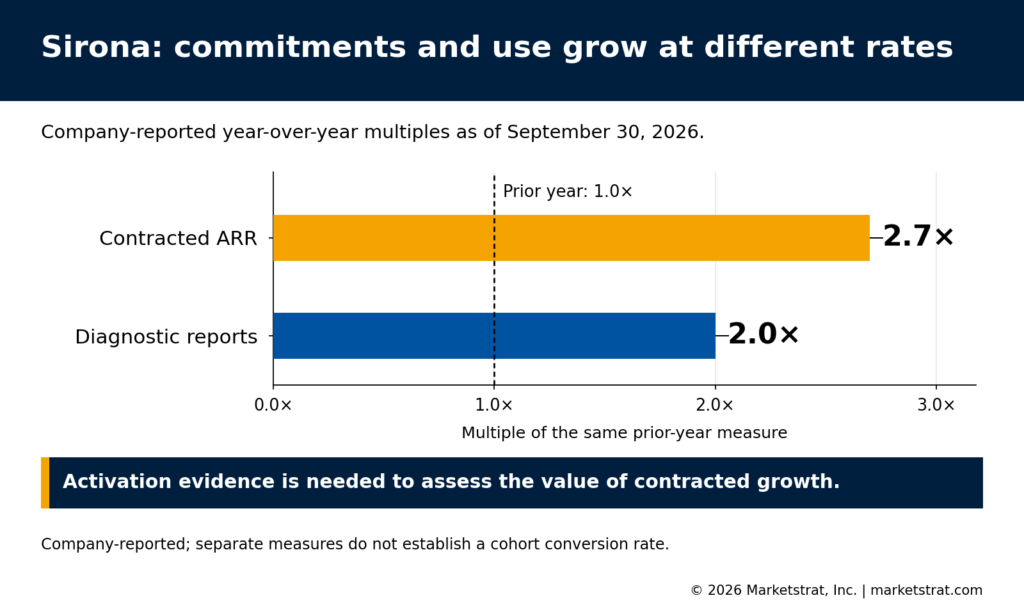
Source: Company operating disclosure, October 15, 2026; Marketstrat analysis.
The financing supports a business with implementation work ahead. Moving customers into production requires migration, system connections, configuration and training. Continuing operations then require support. These activities influence how much value the vendor and provider ultimately obtain from a growing software relationship.
For investors, the relevant uncertainty concerns the economics of delivering that expansion. For providers, it concerns the path to stable clinical use. Evidence of customer activation and dependable support helps assess both. The selected growth figures offer limited visibility into those operating requirements.
PocketHealth: Administrative work affects the economics of completed examinations
PocketHealth expanded its Conductor platform on October 14 into protocoling, reading-room coordination and revenue-cycle work. Those functions reach several points at which administrative preparation can affect a radiology department’s activity.
Earlier authorization work can protect scheduled appointments. Better coordination can reduce interruptions. More complete information can reduce downstream rework. The financial result depends on the department’s actual constraints, including staffing and available scanner capacity.
Marketstrat’s assessment places exception handling within the product’s economic proposition. An automated task that requires repeated manual intervention can create continuing work for the provider. Reliable escalation and clear responsibility influence the value of the broader workflow.
The announcement did not disclose controlled provider-level outcomes for the added functions. Their commercial relevance will become clearer through evidence of completed care, avoided cost and reduced rework. That leaves a concrete question for buyers: whether the new process improves the constraint that matters in their department.
Clinical evidence defines the next commercial boundary
SimBioSys announced TumorSight Risk’s FDA clearance on October 15, following the September 25 decision. The software uses breast MRI with clinical and pathology information to support recurrence prognosis in a defined breast-cancer population.
Its retrospective validation supports the prognostic role. The commercial question concerns how that information fits into care: which decision it informs, whether it adds useful information and how its use is paid for. A recurrence score can provide information while leaving a treatment decision unchanged. Its value needs to be assessed within the role it actually serves.
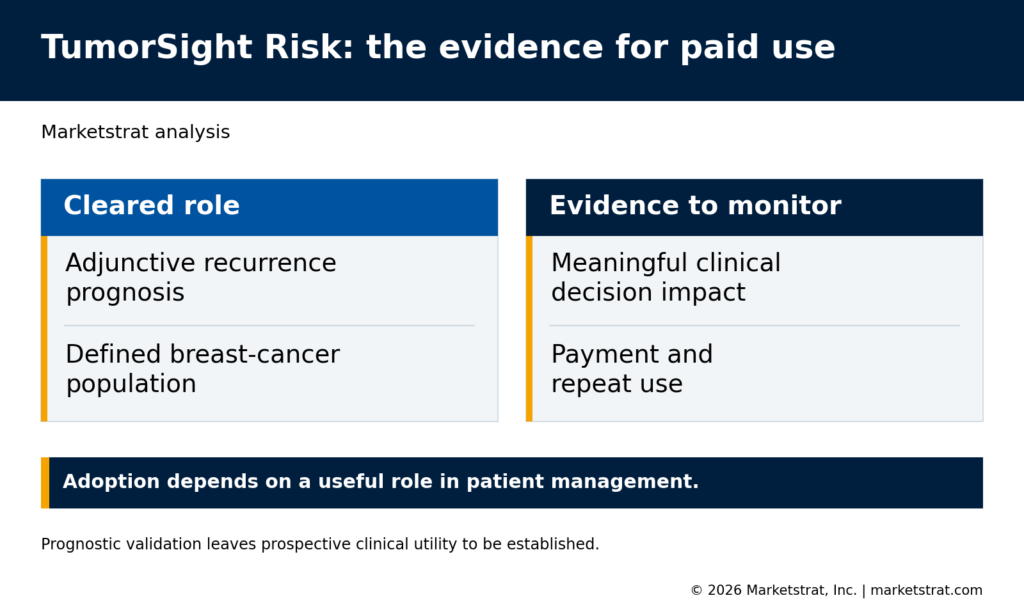
Sources: Regulatory documentation and company disclosures; Marketstrat analysis.
Bristol Myers Squibb’s October 12 ACTION-1 announcement addresses treatment evidence. The company reported that RYZ101 met its Phase 3 progression-free-survival endpoint in patients with somatostatin receptor-positive gastroenteropancreatic neuroendocrine tumors progressing after Lu-177 therapy.
RYZ101 remains investigational, and the complete efficacy and safety results are pending. The result strengthens the development case within that treatment sequence. The eventual commercial opportunity depends on the full evidence, authorization and the ability to deliver treatment.
Both developments make clinical scope important to commercial planning. Evidence of prognosis and evidence of treatment benefit support different decisions. Payment and practical delivery introduce additional requirements in each case.
The commercial value sits in continuing use
Across these selected signals, Marketstrat sees a recurring issue: greater participation in clinical work increases the supplier’s exposure to implementation and service economics. A platform’s reach can grow alongside the resources needed to serve its customers.
For strategy and product teams, that puts attention on the work required after a contract is signed. For investors, it makes the relationship between customer activity and contribution important. Providers have a parallel interest in whether dependable use improves the cost or completion of care.
There is a boundary to this thesis. A platform could achieve reliable deployment, sustained use and strong retention while generating little improvement in provider economics or vendor contribution. Evidence of that outcome would weaken the expected commercial advantage of recurring workflow participation.
The most useful interpretation of the week therefore connects the announced commitment with the work it creates. Marketstrat’s focus is the economic value of keeping that work productive, clinically relevant and dependable. The complete Pulse Insights note examines the broader company implications and the evidence needed to assess them.
Explore Marketstrat Pulse Insights and related research on enterprise imaging, digital pathology, imaging AI and theranostics at Marketstrat.com. Subscribe to the newsletter for continuing analysis, or contact Marketstrat about research access and custom analysis.
Sources: Company announcements and regulatory documentation; Marketstrat analysis.
Research process: Marketstrat uses a human-led, AI-enabled workflow. AI systems materially support synthesis, modeling, drafting, coding, and quality control. Marketstrat sets the methodology, evaluates the evidence, determines the conclusions, and approves all published content.
Related Marketstrat Research
Global Enterprise Imaging IT & PACS Horizon
October 2026
Market structure, implementation economics, competitive positioning, and recurring software monetization across enterprise imaging.
The Ultrasound Control Plane
October 2026
Ultrasound purchasing models, operating economics, vendor positioning, and Siemens Healthineers’ portfolio restructuring.
Global Nuclear Medicine & PET Market Horizon
August 2026
Theranostics, radiopharmaceutical markets, production infrastructure, and commercialization through 2036.
Global AI in Medical Imaging Horizon
June 2026
Imaging AI forecasts, competitive dynamics, reimbursement, and the commercial requirements for sustained adoption.
Explore Marketstrat’s research portfolio at marketstrat.com.
About Marketstrat
Marketstrat® is an independent market intelligence firm focused on MedTech, medical imaging, imaging AI, enterprise imaging, PACS, and adjacent healthcare technology markets. Through its Markintel® research methodology and publishing system, Marketstrat produces Horizon Reports, Focus Reports, Company Research, Market Signals, and weekly Pulse Insights. The firm’s research combines market sizing, forecasting, segmentation, competitive mapping, company intelligence, and event-driven analysis to help corporate strategy, product, commercial, investment, consulting, and industry media professionals interpret fast-moving healthcare markets with greater clarity.
Marketstrat® and Markintel® are registered service marks of Marketstrat, Inc.
Our Research
- Horizon Reports — Comprehensive market landscape assessments with sizing, segmentation, forecasting, and competitive mapping across multi-year time horizons.
- Focus Reports — Targeted market intelligence reports on specific segments, technologies, or competitive dynamics drawn from Marketstrat’s broader Horizon research program.
- Company Research — Decision-grade company intelligence covering strategy, competitive positioning, product portfolio, business model, financial structure, partnerships, and stakeholder impact.
- Market Signals — Event-driven analysis tied to specific catalysts, including regulatory actions, M&A, product launches, policy shifts, reimbursement changes, and earnings. Each signal is structured around strategic implications, not just news.
- Pulse Insights — Weekly market intelligence digest covering what moved, what it means, and what to watch across healthcare, MedTech, medical imaging, imaging AI, and adjacent life sciences markets.
