
Medical imaging AI is entering a more demanding commercialization phase. Regulatory authorization, technical performance and access to a large study pool remain important. They do not establish market adoption on their own.
The decisive question is conversion: how many eligible studies move through an activated workflow, produce a usable result, receive appropriate human review, meet payer requirements, generate payment and lead to completed clinical action?
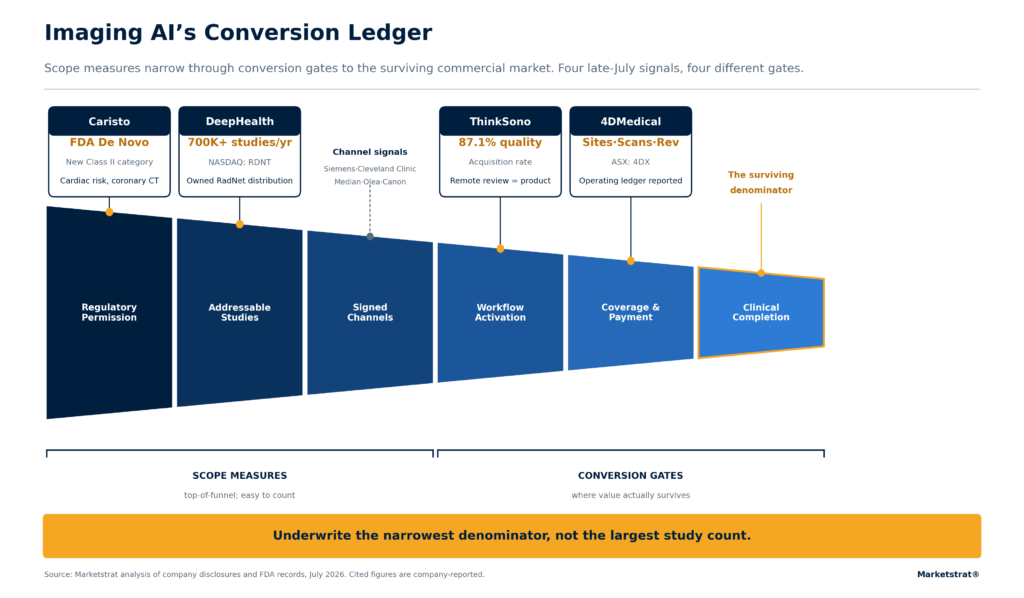
The week ending July 31 supplied four different answers. Caristo Diagnostics created a new regulatory category for long-term cardiovascular risk assessment from coronary CT angiography. DeepHealth gained a breast-ultrasound clearance and can deploy through RadNet (NASDAQ: RDNT). ThinkSono showed how guided acquisition can redistribute ultrasound labor. 4DMedical Limited (ASX: 4DX) reported site, scan, revenue and launch-readiness metrics that move closer to a commercialization ledger.
Together, the developments show why imaging AI is becoming a service-line business.
The Commercialization Chain Has Six Gates
The market often begins with the largest visible denominator: total scans, eligible patients, installed sites or authorized applications. That can overstate the paid opportunity.
A decision-grade model should separate six stages: regulatory permission, indication-eligible volume, workflow activation, staffing and exception handling, coverage and payment, and completed clinical service.
Each stage can reduce the pool. A product can be authorized but not live. A live product can have insufficient reviewer capacity. A technically successful study can fail payer criteria. A paid analysis can still lack evidence that it changed care.
The commercial market is the pool that survives the full chain.
Caristo Creates a Category, With Payment Still to Prove
Caristo’s FDA De Novo authorization establishes a new Class II category for software that provides a long-term cardiovascular risk indicator from coronary CT angiography.
The output is adjunctive, must be reviewed with other clinical information and is subject to postmarket performance expectations. Calibration, generalizability and user communication therefore become part of the operating model.
Caristo has also identified applicable Category III billing codes. Code availability supports tracking and billing, but it does not establish coverage, allowed amounts or profitable claim yield.
The next evidence should include contracted sites, eligible studies submitted, claims accepted, payments received and whether the service changes preventive management.
DeepHealth Can Compress Time to Activation Through RadNet
DeepHealth’s breast-ultrasound clearance has a structural advantage: the company sits inside RadNet, a large outpatient imaging provider.
That relationship can shorten procurement, integration, training and access to eligible examinations. RadNet can function as an internal commercialization environment.
The company has identified more than 700,000 annual studies that may qualify for reimbursement. That figure is the top of the funnel. The paid pool will depend on activated centers, qualifying examinations, payer policy, claim acceptance and downstream workflow effects.
Owned distribution also concentrates accountability. RadNet must demonstrate value after accounting for sonographer work, radiologist time, repeat imaging, recalls and biopsy activity.
ThinkSono Turns Labor Design Into a Product Feature
ThinkSono guides non-ultrasound-trained healthcare professionals through DVT image acquisition, while a qualified clinician remains responsible for review and interpretation.
The model can bring acquisition closer to the patient. It redistributes specialist labor into remote review, credentialing, exception management and clinical accountability.
The reported evidence showed an 87.1% diagnostic-quality acquisition rate. Providers therefore need a defined pathway for examinations that do not meet the quality threshold and enough reviewer capacity to prevent a new bottleneck.
The service should be evaluated on total episode performance, including successful acquisition, review time, rescue imaging, staffing cost and clinical outcome.
4DMedical Raises the Disclosure Standard
4DMedical reported the week’s most complete operating evidence by connecting installed sites, scan activity, operating revenue and readiness for an anticipated SimonMed launch.
This is more useful than a partnership count because it links footprint with utilization. The remaining questions are scans per active site, paid share, payer mix, revenue per analysis, renewal and outcome evidence.
The company also separated current activity from prospective launch contribution. Signed, technically onboarded, trained, live, routinely utilized and renewed are different stages and should be reported separately.
Distribution Is Becoming Part of the Clinical Product
The Siemens Healthineers (ETR: SHL) and Cleveland Clinic alliance combines equipment, technical support, training, workflow development and clinical-program support. Median Technologies (EPA: ALMDT), Olea Medical and Canon Inc. (TSE: 7751) created a distribution and integration route for lung-screening software.
These structures show that channel access increasingly includes implementation, workflow authority, service levels, data access and measurement rights.
For providers, broader partnerships can reduce fragmentation while increasing platform dependence. Procurement should define third-party application rights, usage visibility, performance responsibilities and exit terms.
What Stakeholders Should Measure Now
Providers should build a study-level conversion ledger: eligible, active, technically successful, reviewed, covered, paid and clinically completed. Exception measures should include inadequate acquisition, repeat imaging, override, specialist minutes and downstream work.
Vendors need three evidence packages alongside the regulatory dossier. The activation package should define implementation, training and live volume. The labor package should specify who acquires, reviews and resolves exceptions. The payment package should track payer rules, submitted claims, accepted claims and allowed amounts.
Payers should assess the net pathway after downstream imaging, procedures, labor and patient delay.
Investors and strategic acquirers should use the narrowest conversion denominator. Addressable studies and installed sites measure scope. Activated use, paid claims, revenue per completed study and renewal measure commercial quality.
The commercial market is the paid, clinically completed pool that survives every conversion gate, not the largest addressable study count.
Marketstrat View
Imaging AI competition is moving into service-line architecture. The strongest position combines regulatory permission with eligible-study access, workflow activation, staffed execution, payment evidence and measurable clinical completion.
Few companies control every stage. That creates room for provider-owned deployment, OEM alliances, distribution partnerships and remote specialist models. It also creates execution risk at every handoff.
The next disclosure standard should be conversion yield. Companies that report how many eligible studies become active, covered, paid and clinically completed provide a clearer picture of commercial value than companies reporting only clearances, partnerships or addressable volume.
Access the Full Research
The full Marketstrat Pulse Insights note for the week ending July 31 includes the complete signal table, four detailed event analyses, stakeholder implications, full conversion-chain exhibit, company control profiles, evidence ledger, catalyst watchlist, falsification conditions and compact source appendix.
For direct subscription access, contact research@marketstrat.com or visit marketstrat.com. Entitled institutional users may also access Marketstrat research through their existing research platforms.
Related Research Themes
Imaging AI commercialization and reimbursement, cardiac CT AI and preventive risk, breast imaging AI and outpatient platforms, AI-guided ultrasound and specialist capacity, enterprise imaging distribution and workflow control, lung-screening AI channels, postmarket performance and model lifecycle governance.
About Marketstrat
Marketstrat® is an independent market intelligence firm focused on MedTech, medical imaging, imaging AI, enterprise imaging, PACS, and adjacent healthcare technology markets. Through its Markintel® research methodology and publishing system, Marketstrat produces Horizon Reports, Pulse Reports, Company Research, Market Signals, and weekly Pulse Insights. The firm’s research combines market sizing, forecasting, segmentation, competitive mapping, company intelligence, and event-driven analysis to help corporate strategy, product, commercial, investment, consulting, and industry media professionals interpret fast-moving healthcare markets with greater clarity.
Marketstrat® and Markintel® are registered service marks of Marketstrat, Inc.
Our Research
- Horizon Reports — Comprehensive market landscape assessments with sizing, segmentation, forecasting, and competitive mapping across multi-year time horizons.
- Focus Reports — Targeted market intelligence reports on specific segments, technologies, or competitive dynamics drawn from Marketstrat’s broader Horizon research program.
- Company Research — Decision-grade company intelligence covering strategy, competitive positioning, product portfolio, business model, financial structure, partnerships, and stakeholder impact.
- Market Signals — Event-driven analysis tied to specific catalysts, including regulatory actions, M&A, product launches, policy shifts, reimbursement changes, and earnings. Each signal is structured around strategic implications, not just news.
- Pulse Insights — Weekly market intelligence digest covering what moved, what it means, and what to watch across healthcare, MedTech, medical imaging, imaging AI, and adjacent life sciences markets.
