
An imaging platform can become technically broader without becoming easier to commercialize. The cost of establishing another clinical use may still sit in evaluation, integration, referrals or delivery.
Marketstrat’s assessment of developments disclosed September 12–18, 2026, centers on that gap. DeepHealth, Cognita, Telix and Curium address different parts of it. Their announcements concern a defined AI application, evaluation research, a diagnostic approval and another therapeutic supply option.
The common commercial question is whether each business can turn its supported use into recurring activity at an acceptable cost. The answer requires a different adoption model for each product.
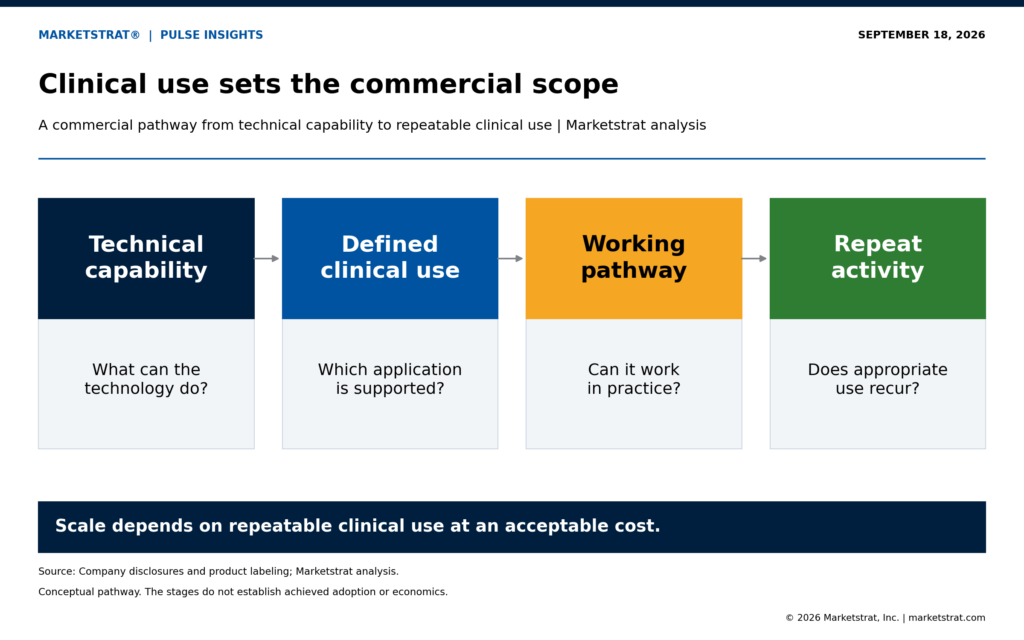
DeepHealth: Architecture and commercial scope are different assets
DeepHealth described its next-generation Chest XRay application as built on a foundation model. Its announced clearance covers four finding categories, while existing customers are eligible for an update.
That creates two opportunities worth keeping separate. The application offers a defined clinical function. The underlying architecture may make future product development more efficient.
Marketstrat would reserve the broader platform argument for evidence that common technology reduces the work required across successive applications. Reusing engineering while rebuilding validation and deployment at every step could leave much of the commercial burden unchanged.
The existing customer base is relevant, but eligibility alone says little about how quickly accounts update or how consistently they use the product afterward. Distribution access becomes more valuable when implementation is repeatable and customers retain useful functionality without escalating support requirements.
For product strategy, the implication is to identify where reuse actually occurs. A shared model can be valuable without making every prospective capability part of the current commercial proposition.
Cognita: More evaluation becomes valuable only when it is trustworthy
Cognita’s September disclosure concerns FDA-funded research into using automated evaluators to assess generated radiology reports, with radiologists adjudicating important disagreements. It describes a planned research program rather than completed results or endorsement of a commercial reporting system.
The project addresses a potentially important cost constraint. Representative evaluation needs sufficient breadth to reveal consequential errors, while specialist review requires time. Automation could change that relationship by extending coverage and focusing expert effort.
However, an evaluator introduces another source of error. Several models may share a blind spot. Agreement could then appear reassuring while providing little protection against the missed finding.
Marketstrat’s interpretation is conditional: evaluation infrastructure could improve product-development economics if it provides credible measurement with less expert burden. The value depends on the reliability of the method, not simply the volume it can process.
There is also a competitive boundary. Reproducible, widely available methods could benefit many developers rather than create enduring pricing power for one evaluation supplier. Better infrastructure and a proprietary commercial advantage need not develop together.
Telix: The referral decision sets the practical diagnostic opportunity
Pixclara’s approved use addresses a particular neuro-oncology question: differentiating recurrent or progressive glioma from treatment-related change, in conjunction with other diagnostic evaluations.
For Telix, the commercial task extends beyond making the tracer available. Relevant clinicians need to refer appropriate patients, imaging services must fulfill those referrals, and the findings must return to the team making the clinical assessment.
This is why Marketstrat places greater weight on a functioning referral pathway than on a broad disease-population estimate. Eligibility describes potential use. Repeat ordering indicates that the pathway is becoming operational, although it still does not establish attractive economics or improved outcomes.
The product label reinforces the distinction. Reader-dependent agreement results and the adjunctive indication do not support positioning the examination as a stand-alone confirmation or exclusion of recurrence.
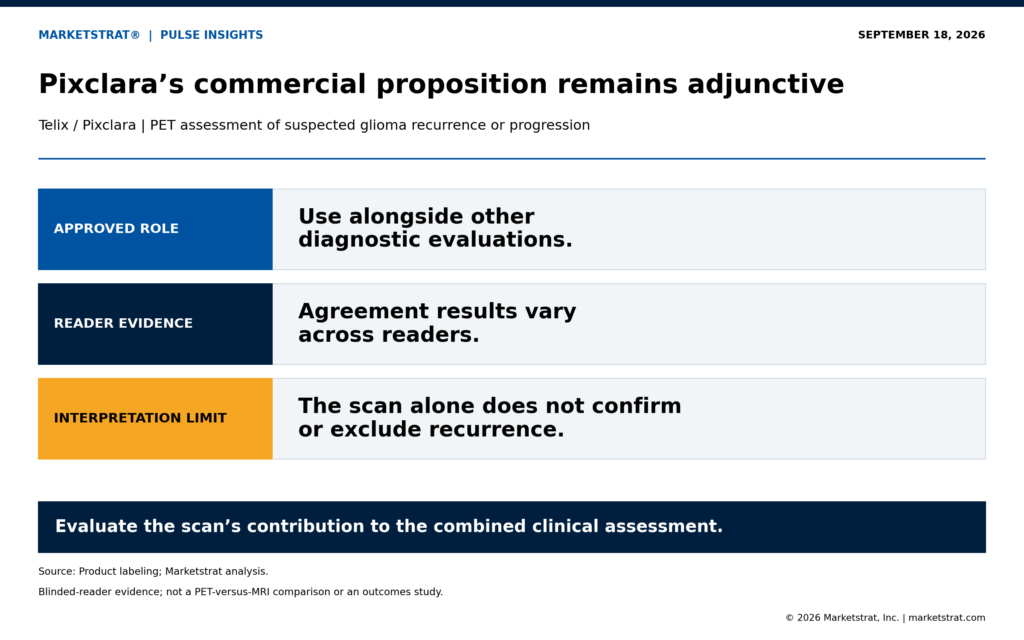
That boundary can guide a more credible commercial proposition. The product must contribute useful information within the existing evaluation, with interpretation and uncertainty handled explicitly. Product availability cannot substitute for evidence that referring teams find the information useful in the intended setting.
Curium: A second supplier creates a different growth question
Curium announced approval and availability of Bexlutry for adults with somatostatin receptor-positive gastroenteropancreatic neuroendocrine tumors.
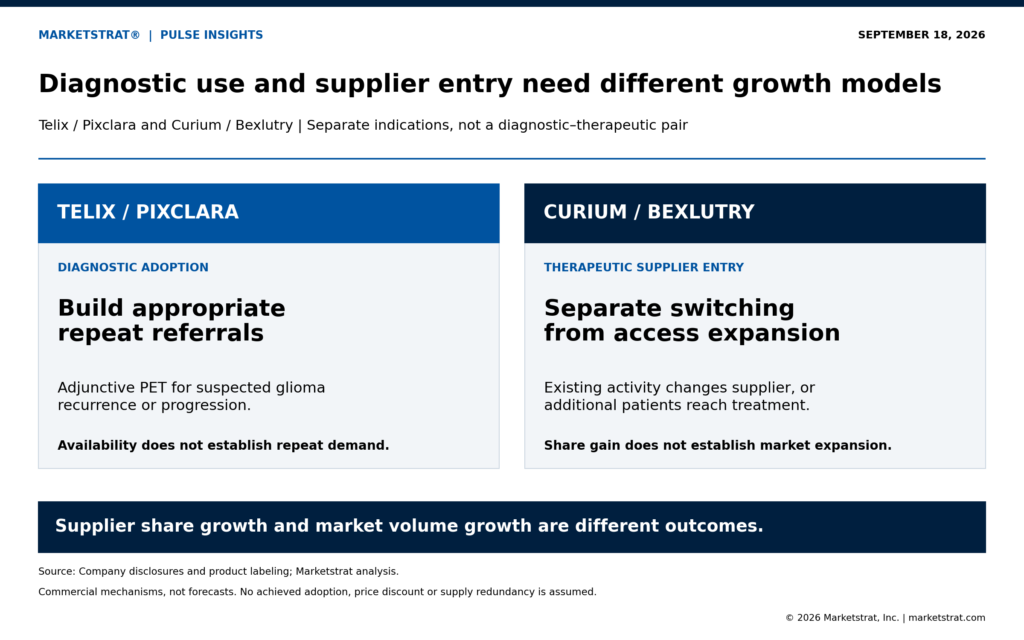
The relevant market mechanism differs from a new diagnostic pathway. A therapeutic entrant may win existing activity from another supplier. It may also enable additional treatment where access or delivery has been constrained. Both can generate sales for the entrant, but only the latter necessarily adds treatment activity to the market.
Marketstrat therefore separates customer conversion from access expansion. An approval announcement does not establish the mix, just as stated availability does not establish repeat orders.
Provider benefits also remain contingent. Another purchasing option could improve choice, but lower net prices and dependable alternative supply require their own evidence. A second commercial brand is insufficient proof that upstream risks are independent.
For buyers, the useful comparison includes actual delivery performance and the work required to support treatment. For commercial teams, a gain in supplier share should remain distinct from a claim that the overall patient market has expanded.
What the market may be missing
The cost of the next application is a useful way to evaluate platform scale. Does it become easier to establish the evidence, fit the workflow and support recurring use? Or does each extension recreate much of the original burden?
A platform earns its scale advantage when the next supported clinical use costs less to establish and deliver.
That is Marketstrat’s commercial test, not an achieved outcome attributed to any company. Technical commonality can help, but the return depends on which costs fall and who retains the benefit.
Implications for executive decisions
Product leaders should distinguish currently supported uses from future technical possibilities. Providers should evaluate the complete operating requirement around the clinical decision. Investors should separate recurring activity, supplier switching and market expansion before assigning the same growth assumptions to different businesses.
The evidence to monitor is correspondingly practical: successful customer updates, appropriate repeat referrals and dependable fulfillment. These measures do not replace clinical validation. They show whether a supported product is becoming a repeatable business.
Our view would weaken if reusable technology leaves validation and implementation largely bespoke, or if automated evaluation cannot reduce expert effort without missing important errors. Those conditions belong in the commercial assessment alongside the opportunity.
Subscribe to Marketstrat Pulse Insights and explore related Horizon research at Marketstrat.com. For access to the complete analysis or custom research, contact Marketstrat.
Sources: Company disclosures and product labeling; Marketstrat analysis.
Related research themes: Imaging AI commercialization and platform economics; generative radiology reporting and validation; neuro-PET and radiopharmaceutical market access; enterprise imaging workflow and capacity economics.
Research process: Marketstrat uses a human-led, AI-enabled workflow. AI systems materially support synthesis, modeling, drafting, coding, and quality control. Marketstrat sets the methodology, evaluates the evidence, determines the conclusions, and approves all published content.
About Marketstrat
Marketstrat® is an independent market intelligence firm focused on MedTech, medical imaging, imaging AI, enterprise imaging, PACS, and adjacent healthcare technology markets. Through its Markintel® research methodology and publishing system, Marketstrat produces Horizon Reports, Focus Reports, Company Research, Market Signals, and weekly Pulse Insights. The firm’s research combines market sizing, forecasting, segmentation, competitive mapping, company intelligence, and event-driven analysis to help corporate strategy, product, commercial, investment, consulting, and industry media professionals interpret fast-moving healthcare markets with greater clarity.
Marketstrat® and Markintel® are registered service marks of Marketstrat, Inc.
Our Research
- Horizon Reports — Comprehensive market landscape assessments with sizing, segmentation, forecasting, and competitive mapping across multi-year time horizons.
- Focus Reports — Targeted market intelligence reports on specific segments, technologies, or competitive dynamics drawn from Marketstrat’s broader Horizon research program.
- Company Research — Decision-grade company intelligence covering strategy, competitive positioning, product portfolio, business model, financial structure, partnerships, and stakeholder impact.
- Market Signals — Event-driven analysis tied to specific catalysts, including regulatory actions, M&A, product launches, policy shifts, reimbursement changes, and earnings. Each signal is structured around strategic implications, not just news.
- Pulse Insights — Weekly market intelligence digest covering what moved, what it means, and what to watch across healthcare, MedTech, medical imaging, imaging AI, and adjacent life sciences markets.
