
Epsilon Health, Sectra and Nanox reveal new imaging operating choices. Marketstrat examines implications for providers, strategy teams and investors.
The value of an imaging platform depends partly on work outside the product: clinician coverage, implementation, exception handling and supply continuity. Deciding who performs that work can change the business as much as adding another technical capability.
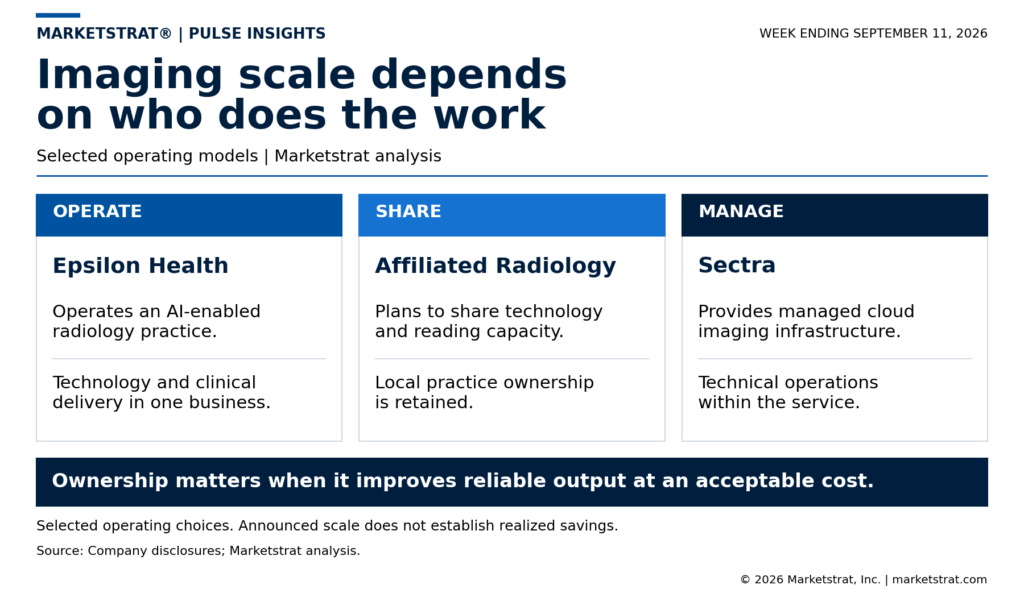
Disclosures during September 5–11, 2026 show companies drawing those boundaries differently. Epsilon Health operates an AI-enabled radiology practice. Affiliated Radiology aims to pool selected resources across independent practices. Sectra assumes managed imaging infrastructure responsibilities. Nanox and Siemens Healthineers are moving in different directions on manufacturing ownership.
Marketstrat’s conclusion is that selective operating control can support scale. The advantage is conditional: the company or network must deliver useful output at an acceptable cost, and retain enough of the benefit to justify its responsibilities.
Epsilon Health brings technology and clinical delivery together
Epsilon’s practice model changes the commercialization route for AI. Instead of depending entirely on an external customer to implement software and reorganize work, the business places technology development and interpretation within the same organization.
A customer can purchase the service rather than undertake a separate technology implementation. That could make an operating improvement easier to realize and retain, but it also puts clinical staffing and delivery obligations inside the supplier’s economics.
Epsilon reports processing more than 2,500 studies daily. The disclosure establishes a company-reported activity measure, not an independent assessment of quality or profitability.
The commercial distinction matters for comparison. This model should be assessed against the alternatives for delivering interpretation, including conventional reading services and internal coverage. Software deployment alone is an incomplete benchmark for a business responsible for completing clinical work.
Affiliated Radiology separates shared scale from ownership consolidation
Colorado Imaging Associates and TRA Medical Imaging launched Affiliated Radiology to provide shared technology and reading capacity while retaining local ownership.
The model creates a potential middle position between an independent practice and ownership consolidation. Members could access infrastructure and coverage that would be more difficult to support individually.
The operating requirement is more demanding than the organizational announcement. Practices can agree to purchase technology together without having resolved how to allocate cases, compensate shared work or meet demand peaks. Those decisions determine whether affiliation creates useful capacity.
For technology suppliers, the network could aggregate buying power. For participating practices, the benefit depends on savings and coverage improvements exceeding shared fees, transition effort and coordination costs. A larger membership roster would not settle that calculation.
Sectra shows what a managed-service relationship actually transfers
Sectra’s expansion across Denmark’s Region Østdanmark extends an existing managed cloud imaging relationship to additional hospitals. The agreement runs through 2037.
This arrangement assigns the hardware, software and supporting IT components within the service to the supplier. It does not automatically resolve how clinicians should share expertise or reorganize reporting.
Marketstrat sees the commercial opportunity in repeatable expansion. An existing service can provide the basis for adding institutions, but the wider operating scope also brings migration, support and availability obligations.
For the provider, the economic comparison therefore extends beyond local infrastructure spending versus a cloud fee. Transition effort, integration and service continuity remain part of the decision. Contract duration provides visibility into the relationship; it is not evidence of completed migration or a disclosed measure of incremental revenue.
Nanox and Siemens Healthineers expose the manufacturing tradeoff
Nanox’s transfer of substantially all chip manufacturing to external partners contrasts with Siemens Healthineers’ completed investment in internal PET detector facilities.
The difference argues against assigning a general premium to either outsourcing or vertical integration. Internal production can be strategically relevant when it supports performance, engineering feedback, supply assurance or economics at attainable volume. It can also create fixed obligations that are difficult to justify before sufficient demand develops.
Outsourcing changes those obligations but introduces dependencies on external execution. The comparison needs to include quality, transition costs and supply reliability.
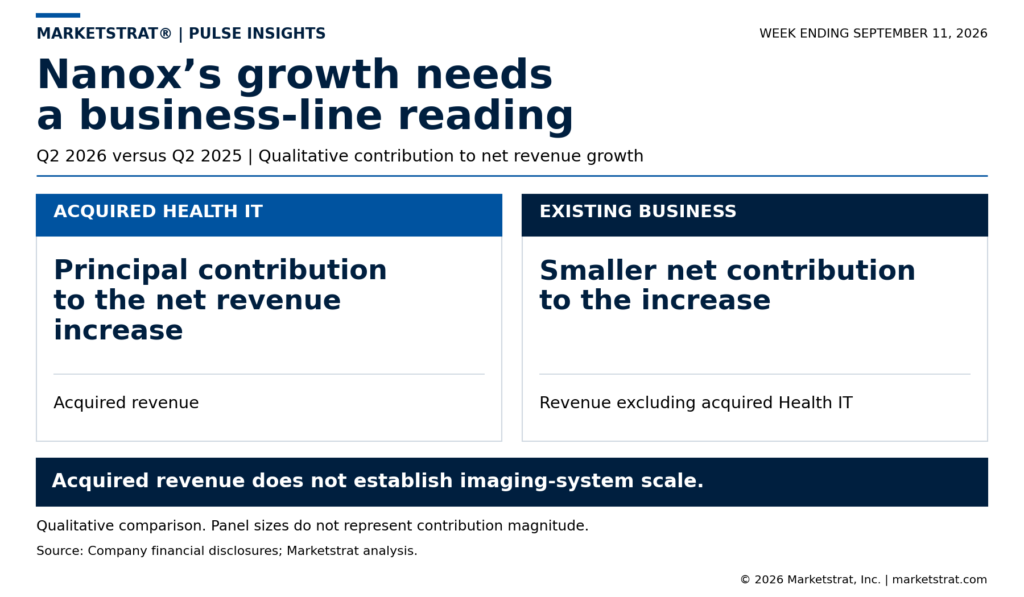
Nanox’s revenue composition reinforces the need for separate tests. Acquired Health IT contributed most of its second-quarter year-over-year revenue increase. Group growth therefore cannot, by itself, validate the imaging-system commercialization strategy. The restructuring decision and the product’s revenue trajectory require their own evidence.
What the market may be missing
Operating control and economic value do not necessarily accrue to the same party. A supplier can take on more responsibility while customers capture the benefit through pricing. A network can improve member economics without producing a high-margin central organization.
Marketstrat would therefore trace each claimed improvement through the costs incurred, the party receiving the operational benefit and the party retaining the financial return.
This is also why platform breadth is an incomplete measure of competitive strength. Adjacent capabilities can add obligations without changing the constraint that prevents the next useful case from being completed.
A company can gain control of more work without retaining more of its economic value.
Clinical evidence sets a further boundary
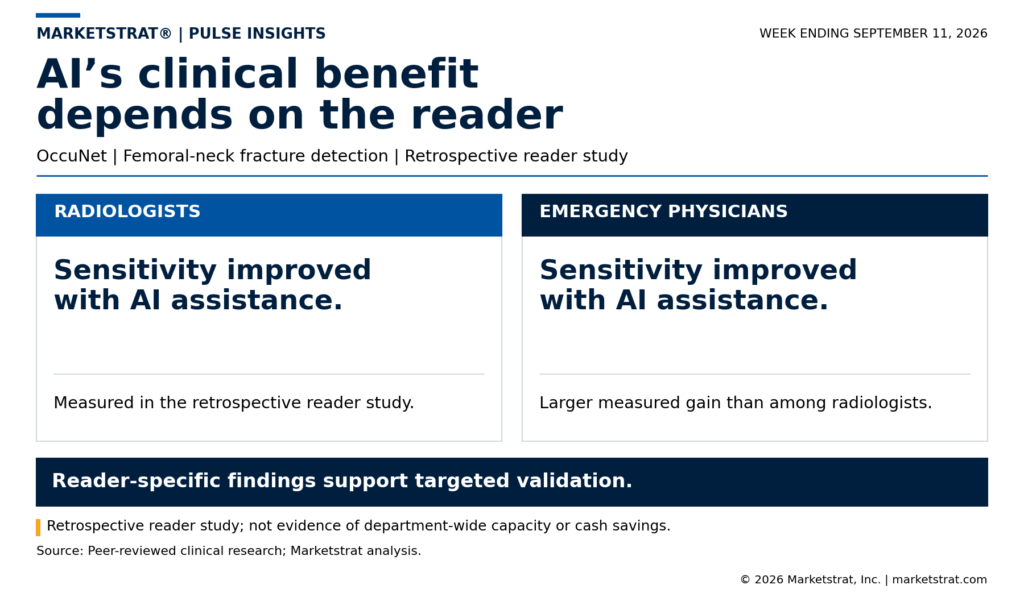
The retrospective OccuNet fracture-detection study reported improved assisted-reader sensitivity, with different gains across reader groups. It supports targeted evaluation of the intended user and task.
It does not demonstrate routine deployment, reduced staffing needs or a department-wide capacity gain. Nor can evidence from a separate research model validate an AI-enabled practice’s own technology.
For commercial planning, clinical performance, usable capacity and economic contribution remain distinct claims. An improvement can be clinically valuable without immediately reducing expenditure. That distinction should sharpen the business case rather than diminish the evidence.
Implications for providers, vendors and investors
For providers, the starting point is a clear allocation of responsibilities. Specify who handles difficult cases, who maintains continuity and what obligations remain with local teams. Evaluate accepted clinical output and service reliability alongside price.
For vendors, the strategic question is where ownership improves the proposition enough to justify added operating burden. A partner can broaden distribution while also controlling activation, pricing or renewal.
Investors should keep acquired revenue, internally developed products and service operations separate before crediting integration benefits. The relevant proof is contribution after clinical labor, infrastructure and partner payments.
Marketstrat’s view would strengthen with repeatable deployment, reliable shared coverage and improving contribution. It would weaken if scale depended on continuing customization, unpriced work or deteriorating continuity.
The ownership choice matters because it determines who must make the operating model work. Its value still has to be demonstrated.
Related research themes: Enterprise imaging IT and PACS commercialization; radiology AI operating models and provider capacity; nuclear medicine and PET manufacturing infrastructure; imaging reimbursement and evidence-conditioned adoption.
Source: Company disclosures and peer-reviewed research; Marketstrat analysis.
Explore Marketstrat Pulse Insights and related Horizon research at Marketstrat.com. Subscribe to the Pulse Insights newsletter, or contact research@marketstrat.com for research access and custom analysis.
Research process: Marketstrat uses a human-led, AI-enabled workflow. AI systems materially support synthesis, modeling, drafting, coding, and quality control. Marketstrat sets the methodology, evaluates the evidence, determines the conclusions, and approves all published content.
About Marketstrat
Marketstrat® is an independent market intelligence firm focused on MedTech, medical imaging, imaging AI, enterprise imaging, PACS, and adjacent healthcare technology markets. Through its Markintel® research methodology and publishing system, Marketstrat produces Horizon Reports, Focus Reports, Company Research, Market Signals, and weekly Pulse Insights. The firm’s research combines market sizing, forecasting, segmentation, competitive mapping, company intelligence, and event-driven analysis to help corporate strategy, product, commercial, investment, consulting, and industry media professionals interpret fast-moving healthcare markets with greater clarity.
Marketstrat® and Markintel® are registered service marks of Marketstrat, Inc.
Our Research
- Horizon Reports — Comprehensive market landscape assessments with sizing, segmentation, forecasting, and competitive mapping across multi-year time horizons.
- Focus Reports — Targeted market intelligence reports on specific segments, technologies, or competitive dynamics drawn from Marketstrat’s broader Horizon research program.
- Company Research — Decision-grade company intelligence covering strategy, competitive positioning, product portfolio, business model, financial structure, partnerships, and stakeholder impact.
- Market Signals — Event-driven analysis tied to specific catalysts, including regulatory actions, M&A, product launches, policy shifts, reimbursement changes, and earnings. Each signal is structured around strategic implications, not just news.
- Pulse Insights — Weekly market intelligence digest covering what moved, what it means, and what to watch across healthcare, MedTech, medical imaging, imaging AI, and adjacent life sciences markets.
