
Medical imaging capacity is entering a new phase. Scanner count still matters, but it no longer provides a sufficient view of how much clinical work an imaging organization can complete.
The more useful measure is productive capacity: the number of studies that move from referral and authorization through acquisition, interpretation, reporting and payment. This week’s developments across MRI, ultrasound, photon-counting CT, portable imaging and commercial distribution show why that distinction is becoming more important.
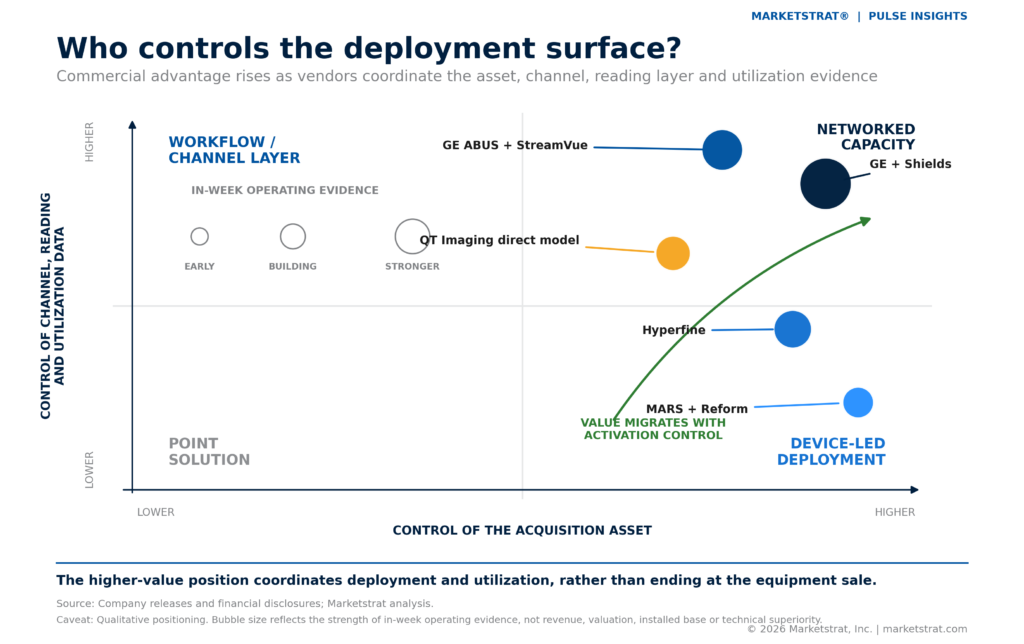
GE HealthCare is extending its role from equipment supplier toward fleet-wide capacity partner. MARS Bioimaging and Hyperfine are moving acquisition closer to patients and specialist referral pathways. QT Imaging is building more direct control over clinical education and enterprise selling. At the same time, new evidence shows that interpretation turnaround continues to worsen.
The market is gaining acquisition capability faster than it is solving the full operating chain.
GE HealthCare is treating the installed fleet as an upgradable operating base
GE HealthCare and Shields Health plan to add ten advanced MRI systems and upgrade several existing units with deep-learning applications. The agreement also includes continued software-upgrade coverage.
The strategic significance is the combination of capital equipment and lifecycle software. A provider can potentially improve protocol consistency and scanner productivity across multiple locations without treating each system as a separate technology island. The OEM gains a recurring relationship tied to the installed fleet rather than relying only on the next equipment replacement.
GE HealthCare’s automated breast-ultrasound launch points in the same direction. The company paired standardized acquisition tools with browser-based remote review. That architecture allows studies to be acquired across distributed sites while scarce specialist readers operate at the network level.
The commercial question is whether technical acceleration becomes usable capacity. A shorter sequence does not automatically create another appointment. Room turnover, technologist availability, patient preparation, repeat imaging and reader coverage can absorb the gain.
Providers should therefore measure incremental completed examinations, final-report turnaround, overtime and contribution per scanner hour. Technical acceptance is the starting point.
MARS Bioimaging and Hyperfine are testing distributed acquisition
MARS Bioimaging recorded the first clinical sale of its portable photon-counting extremity CT system to Reform Radiology. The transaction moves the product from regulatory availability into a real clinical reference site.
That is a meaningful commercialization step, but one site does not establish a repeatable market. The next evidence should include routine scan volume, referral sources, service requirements, reimbursement and replication at additional locations.
Hyperfine is further along in building operating evidence for portable MRI. The company sold 12 systems during the quarter covered in the Pulse note. The broader proposition is similar: place imaging in settings where conventional high-field MRI access is limited or operationally difficult.
Distributed acquisition changes where imaging can occur. It does not remove the need for trained operators, dependable service, image-quality controls, interpretation coverage and downstream action. The commercial unit is an active system producing recurring completed studies, not a device that has been shipped or installed.
QT Imaging is testing whether greater channel control improves adoption
QT Imaging is adding a direct U.S. commercial layer while retaining distributor reach. The strategy can improve access to breast-imaging centers, specialists and integrated delivery networks. It can also give the company closer control over clinical education, evidence generation and future software attachment.
The trade-off is higher fixed selling expense and potential channel friction. A direct team must show that it shortens the sales cycle, improves conversion or increases gross margin enough to justify the added cost.
For emerging imaging companies, this is a recurring choice. Distributors can provide reach and established relationships. Direct commercial teams can provide account intelligence, workflow feedback and ownership of the customer relationship. Hybrid models require clear rules for lead ownership, pricing, service and data access.
Interpretation remains the system constraint
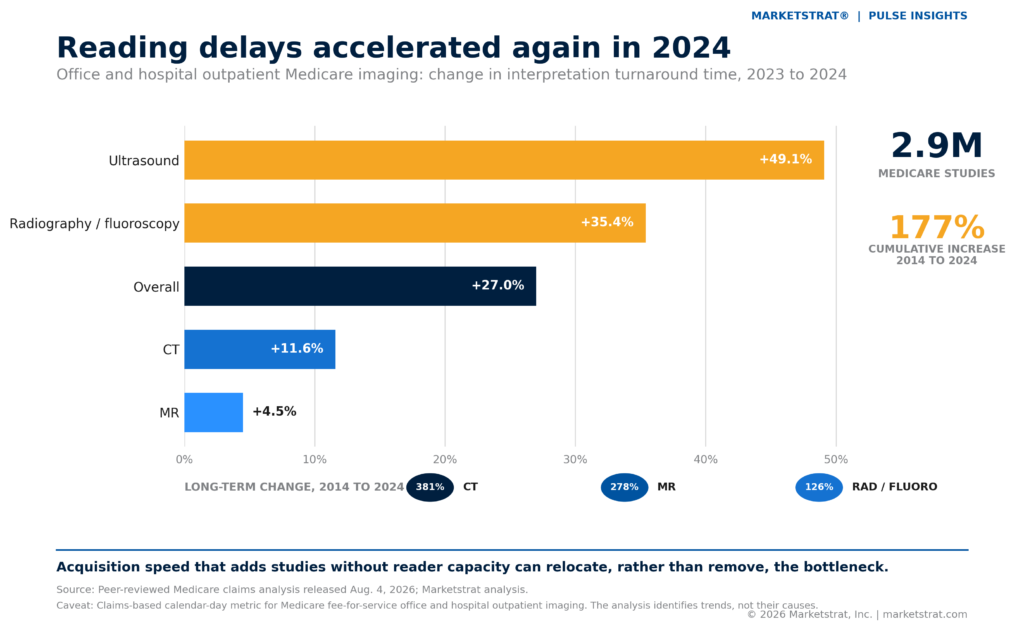
The strongest counter-signal came from a peer-reviewed analysis of 2.9 million Medicare office and hospital outpatient imaging studies. Interpretation turnaround time increased 27% from 2023 to 2024.
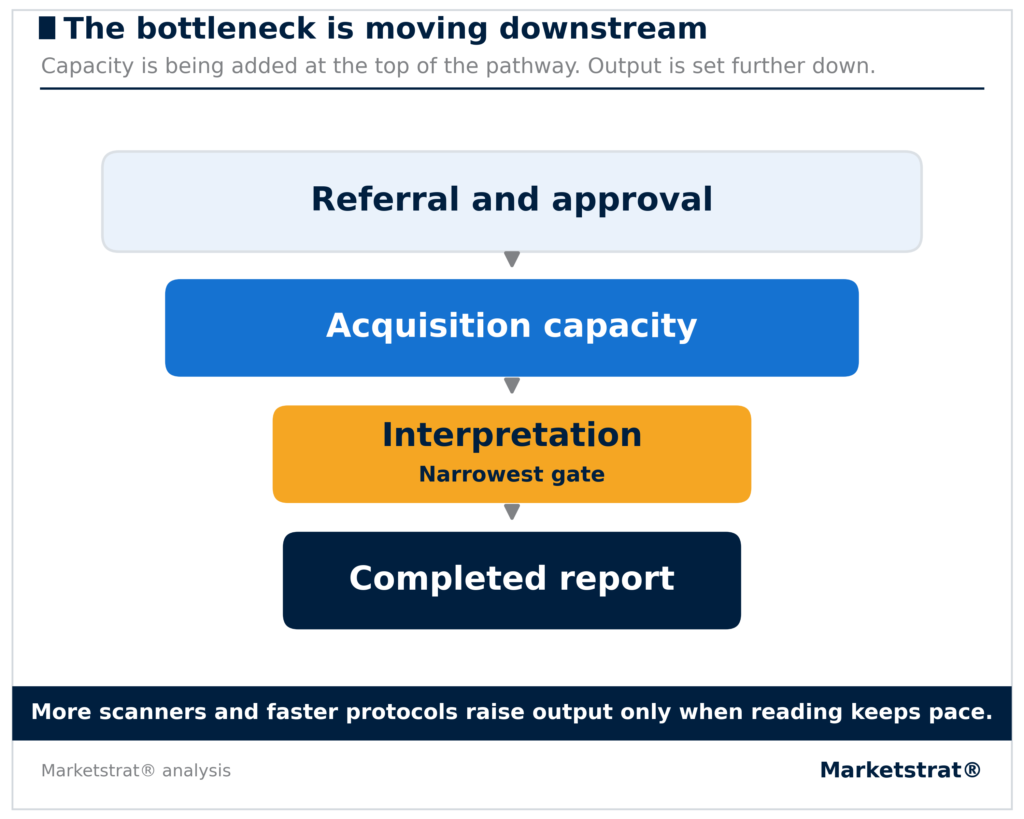
That finding changes how acquisition-side innovation should be evaluated. Faster MRI, distributed ultrasound and portable CT can increase the number of studies entering the reading environment. When reader supply, worklist routing and subspecialty coverage do not expand, the queue moves downstream.
A provider can therefore improve scanner productivity while worsening time to clinical decision. The appropriate operating measure is completed, clinically usable reports per staffed scanner hour. Related indicators include unread worklist age, report turnaround by urgency and modality, outsourced read share, addenda and downstream treatment delay.
Remote review and enterprise work allocation become more valuable in this environment. Their value depends on integration with the primary worklist, prior studies, reporting and identity controls. A separate viewer or secondary queue can add friction instead of releasing capacity.
Capacity depends on administrative and physical continuity
The week also included two less visible constraints. CMS finalized a phased electronic prior-authorization measure for hospitals, creating implementation milestones for standards-based workflows. Separately, FDA posted a recall affecting one lot of imaging contrast.
Neither event changes the central thesis on its own. Together, they show that productive capacity depends on more than a functioning scanner. Authorization workflows, contrast availability, software licenses, network connectivity, coils, probes, service parts and specialist coverage can each idle an otherwise available asset.
This is why imaging capacity is becoming a network-management problem.
What market leaders should do next
Providers should maintain one operating ledger from referral to completed report and payment. Equipment and software purchases should be tied to baseline and post-deployment measures. Portable-imaging companies should disclose active utilization, service burden and interpretation coverage. Enterprise platforms should expose routing, queue age, exceptions and completion telemetry. Investors should separate contracted systems from installed systems, installed systems from active systems, and active systems from recurring paid use.
Marketstrat’s view is that value will migrate toward organizations that control more of the deployment surface: installed assets, software upgrades, clinical workflows, reader networks, operating data and commercial completion.
A faster scanner can still produce a slower imaging service. The winning capacity model is the one that improves the full pathway.
The full Marketstrat Pulse Insights research note includes the complete weekly signal assessment, stakeholder implications, operating KPIs, falsification conditions and paid-note exhibits. Subscribe to the public Pulse Insights brief and explore Marketstrat research access and licensing options at marketstrat.com.
About Marketstrat
Marketstrat® is an independent market intelligence firm focused on MedTech, medical imaging, imaging AI, enterprise imaging, PACS, and adjacent healthcare technology markets. Through its Markintel® research methodology and publishing system, Marketstrat produces Horizon Reports, Pulse Reports, Company Research, Market Signals, and weekly Pulse Insights. The firm’s research combines market sizing, forecasting, segmentation, competitive mapping, company intelligence, and event-driven analysis to help corporate strategy, product, commercial, investment, consulting, and industry media professionals interpret fast-moving healthcare markets with greater clarity.
Marketstrat® and Markintel® are registered service marks of Marketstrat, Inc.
Our Research
- Horizon Reports — Comprehensive market landscape assessments with sizing, segmentation, forecasting, and competitive mapping across multi-year time horizons.
- Focus Reports — Targeted market intelligence reports on specific segments, technologies, or competitive dynamics drawn from Marketstrat’s broader Horizon research program.
- Company Research — Decision-grade company intelligence covering strategy, competitive positioning, product portfolio, business model, financial structure, partnerships, and stakeholder impact.
- Market Signals — Event-driven analysis tied to specific catalysts, including regulatory actions, M&A, product launches, policy shifts, reimbursement changes, and earnings. Each signal is structured around strategic implications, not just news.
- Pulse Insights — Weekly market intelligence digest covering what moved, what it means, and what to watch across healthcare, MedTech, medical imaging, imaging AI, and adjacent life sciences markets.
