
Reimbursable chest-CT AI, modality-native software, and platform ownership shift value from model novelty to monetized workflow control.
Marketstrat® Pulse Insights | Week ending April 17, 2026
Coverage: Medical Imaging AI | Enterprise Imaging IT | Imaging Reimbursement | AI-Enabled MedTech | Image-Guided MIS
🎧 Listen to this week’s Marketstrat Pulse Insight:
If the April 10 week was about routability, the April 17 week was about monetization. Bunkerhill’s OPPS pathway and FDA-cleared chest-CT calcium analysis created one of the clearest reimbursement lanes yet for opportunistic imaging AI. Philips pushed AI deeper into premium CT with Verida, AIRS showed that “AI stacked on OEM AI” is now a regulated MRI pathway, Sectra’s Oxipit close tightened platform ownership around autonomous radiology AI, and GE HealthCare / DeepHealth reinforced that breast AI is scaling through OEM-distributed workflow surfaces rather than point-solution selling. At the same time, ARRS delivered the week’s reality check: AI triage in PE care did not improve turnaround time or length of stay, raising the evidence bar for workflow claims.
The commercial takeaway: imaging AI is becoming easier to fund when it is billable, embedded, or owned by the workflow surface.
Key Takeaways
- Reimbursable opportunistic AI
- Modality-native AI
- Platform ownership
- Breast AI workflow
- Evidence discipline
- Image-guided MIS
Innovation Hook: Opportunistic AI Starts to Monetize
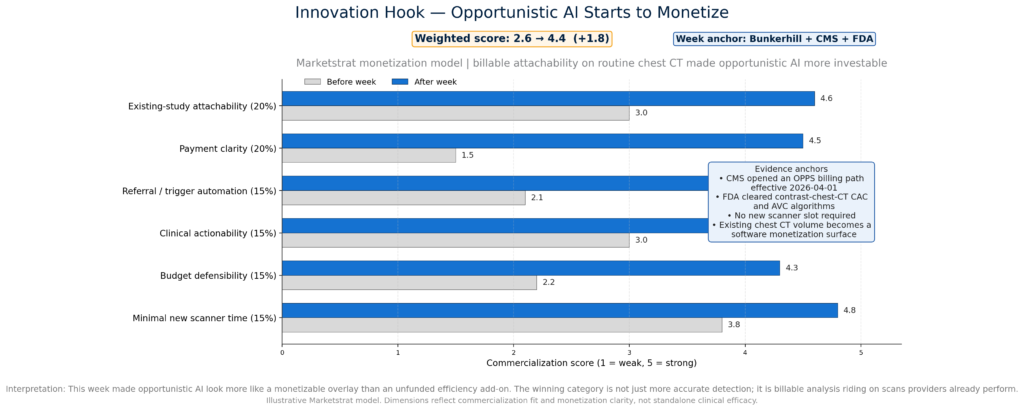
The real breakthrough is not another calcium algorithm. It is the combination of routine-chest-CT attachability, zero new scanner time, and a named OPPS pathway. That makes opportunistic imaging AI easier to defend in capital committees and harder to dismiss as unfunded software.
Chart showing how opportunistic chest-CT AI monetizes through routine scan attachability, FDA clearance, and CMS OPPS reimbursement.
Sources: Bunkerhill Health; CMS; Marketstrat Analysis
Market Lens — U.S. Ultrasound AI Bridge
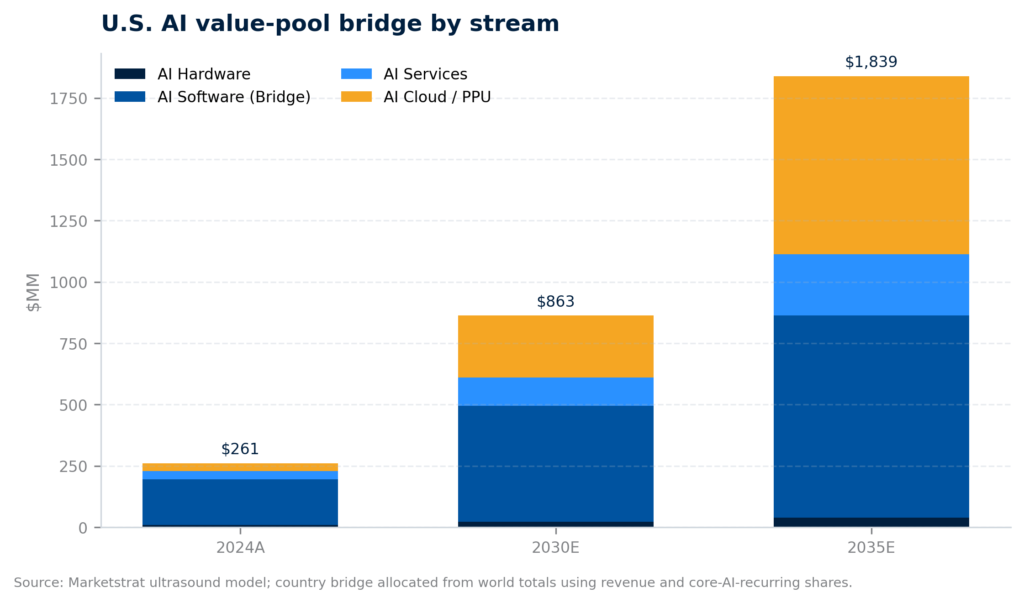
The U.S. AI Bridge is not a subscription-only forecast. Under Marketstrat’s Markintel Horizon methodology, it captures the broader AI value layer across ultrasound, including AI-enabled hardware, embedded and attachable software, workflow services, cloud infrastructure, and usage-linked / PPU economics. The separation is important because ultrasound monetization is increasingly moving above the probe into guided acquisition, automated measurements, reporting, governance, and cloud-connected workflows — not all of which show up as clean recurring software revenue.
Marketstrat chart showing the U.S. ultrasound AI value-pool bridge across hardware, software, services, cloud, and usage-linked economics.
Related research: U.S. Ultrasound Horizon / Global Ultrasound Horizon / Ultrasound AI Market Outlook
FDA Lanes Map: Billable, Installable, or Ownable AI
This week’s regulatory map split into three commercially distinct lanes:
- Monetizable regulatory lane: Bunkerhill paired FDA clearance with a named OPPS pathway, making its lane more commercially legible than most AI categories.
- Modality-upgrade lane: Philips, AIRS, and Lunit advanced AI that improves the installed modality or its immediate workflow rather than creating a standalone software destination.
- Autonomy-inside-platform lane: Sectra’s Oxipit close shows that autonomous AI becomes easier to underwrite when it sits inside an enterprise imaging owner.
Bottom line: The regulatory tape favored tools that were billable, installable, or ownable. The middle ground — interesting AI without a clear route to surface or payment — keeps getting harder to fund.
Related Marketstrat research: This Pulse Insight draws on Marketstrat’s broader Horizon methodology for ultrasound AI, imaging IT, and AI-enabled workflow monetization. Contact Marketstrat for access to Horizon market models and segment forecasts.
MIS (Minimally Invasive Surgery) Lens
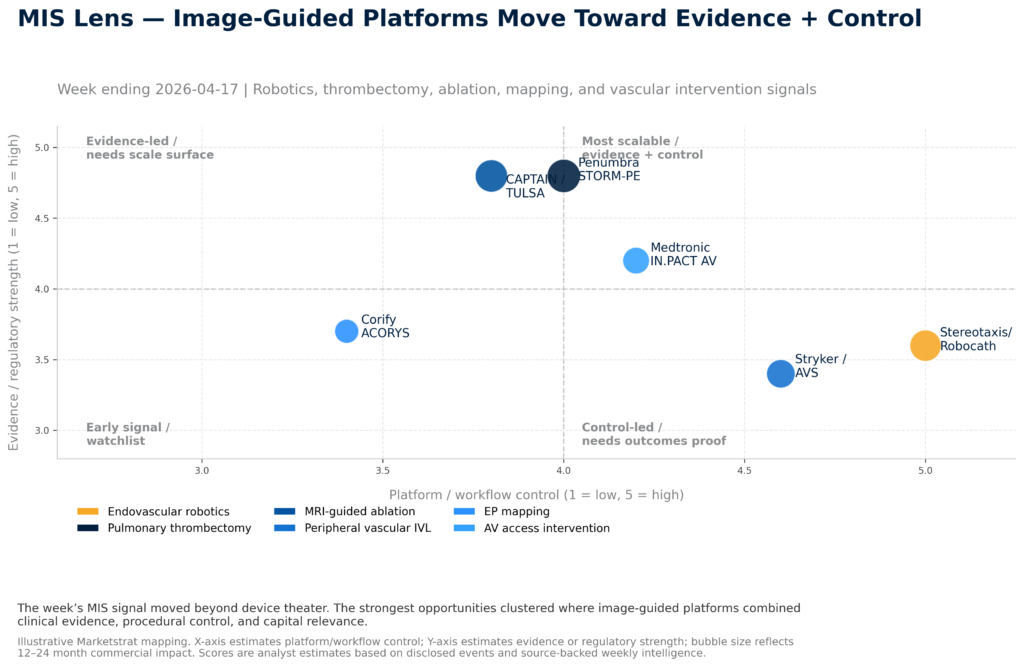
The MIS signal was not “more robots.” It was stronger image-guided evidence. Endovascular robotics, thrombectomy, and MRI-guided ablation all kept competing for the same capital pool as imaging modernization. The strongest signals clustered where clinical evidence and procedural control overlap.
Bubble chart mapping image-guided MIS platforms by evidence strength, workflow control, and commercial impact.
Sources: Stereotaxis; Penumbra; Society of Interventional Radiology, Marketstrat Analysis
Signal-to-Noise Radar: Where the Week’s Signal Was Clearest
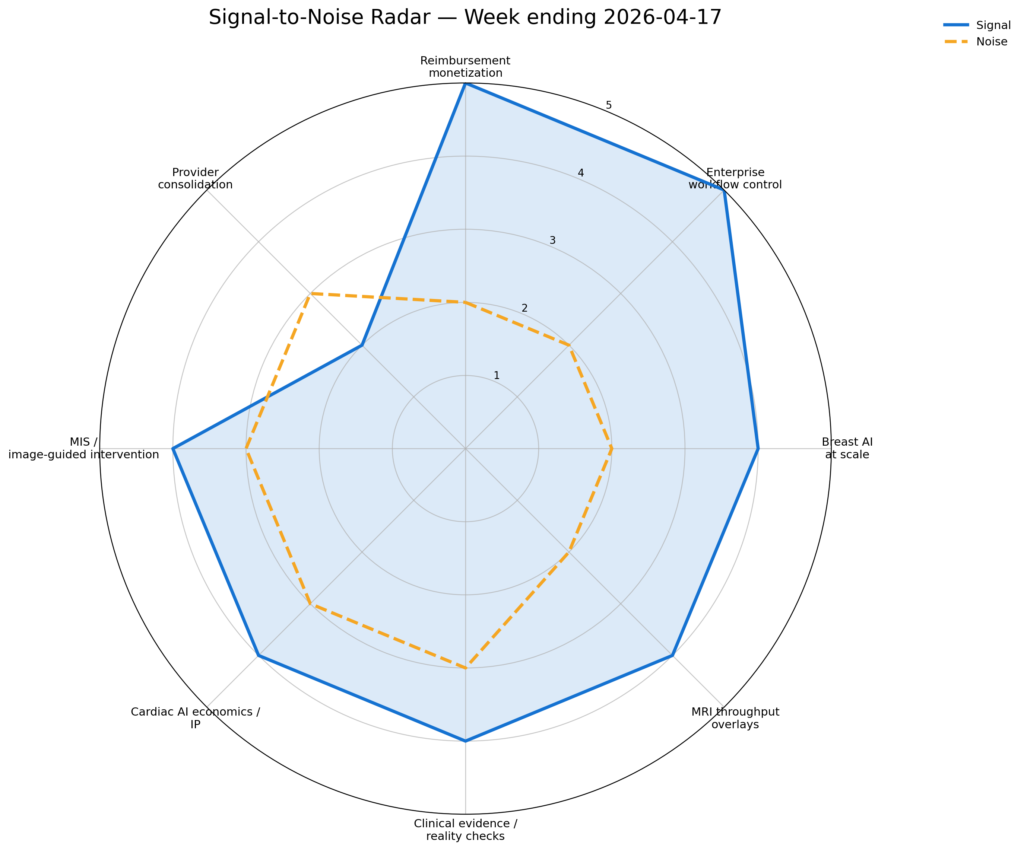
Signal most clearly outran noise where AI became billable, ownable, or attachable to installed base. Noise remained highest where workflow claims still ran ahead of proven downstream results.
Marketstrat Signal-to-Noise Radar comparing reimbursement monetization, enterprise workflow control, breast AI, MRI throughput, clinical evidence, cardiac AI, MIS, and provider consolidation.
Sources: Marketstrat Signal-to-Noise Scoring Model; Marketstrat Event Tracking Analysis; AlphaSense; company disclosures; regulatory materials; trade press and sources listed in the Source Appendix.
What the Full Note Includes
The full Marketstrat Pulse Insights note includes the complete event table, source keys, Company Spotlight, Regulatory Pulse, Ecosystem Voice Index, deeper dives across regulatory, reimbursement, enterprise imaging IT, MIS, and clinical evidence, plus full source appendix.
Company Spotlight in the full note: Sectra’s Oxipit acquisition is analyzed as a selective vertical-integration move into autonomous radiology AI, with implications for PACS ownership, marketplace strategy, and independent AI vendor route-to-market pressure.
The full note also includes Marketstrat’s Regulatory Pulse and Ecosystem Voice Index for the week ending April 17, 2026.
Companies and entities covered: Bunkerhill Health, Philips, AIRS Medical, Sectra, Oxipit, GE HealthCare, DeepHealth, RadNet, Lunit, QT Imaging, Olea Medical, Elucid, HeartFlow, Cleerly, Nanox, Stereotaxis, Robocath, Penumbra, ARRS, SIR, CMS, FDA.
Access the full note: The complete PDF version of this Marketstrat Pulse Insights research note includes full event tables, source keys, company spotlight, Regulatory Pulse, Ecosystem Voice Index, and deeper dives. Contact Marketstrat or access the full note through AlphaSense.
About Marketstrat
Marketstrat® is an independent market intelligence and advisory firm focused on MedTech, medical imaging and AI-enabled healthcare. Guided by its Markintel™ methodology, Marketstrat publishes specialized research and briefings, and provides custom research and advisory work that help leaders evaluate market opportunity, track competitive, regulatory, and evidence shifts, and make sharper strategy, product, and commercialization decisions.
Marketstrat® and Markintel™ are trademarks of Marketstrat Inc. All other trademarks are the property of their respective owners.
Our Research
- Horizon Reports – Comprehensive market landscape assessments with sizing, segmentation, forecasting, and competitive mapping across multi-year time horizons.
- Pulse Reports – Focused market intelligence on specific segments, technologies, or competitive dynamics drawn from our Horizon research program.
- Company Research – Decision-grade company intelligence. Deep-dive analyses covering strategy, competitive positioning, product pipeline, financial structure, and stakeholder impact for individual companies.
- Market Signals – Event-driven analysis tied to specific catalysts: regulatory actions, M&A, product launches, policy shifts, and earnings. Structured around strategic frameworks with clear implications.
- Pulse Insights – Weekly market intelligence digest. What moved, what it means, and what to watch across healthcare and life sciences markets.
Contact: marketstrat.com | info@marketstrat.com
