
Johnson & Johnson, GE HealthCare, DeepHealth and CARPL.ai show imaging AI moving from model access to governed clinical action.
Medical imaging AI is entering a more demanding phase of commercialization. Model availability continues to expand, but the strategic contest is moving to the infrastructure that converts technical output into a standardized, governed and completed clinical action.
This week’s Marketstrat Pulse Insights note connects developments involving Johnson & Johnson (NYSE: JNJ), GE HealthCare (Nasdaq: GEHC), DeepHealth, a RadNet company (Nasdaq: RDNT), CARPL.ai, HOPPR, Penumbra (NYSE: PEN), EndoQuest Robotics and professional societies. The events differ in technology and clinical setting, but they point to the same market mechanism.
The strongest position is no longer defined by owning a model alone. It is defined by controlling one or more of the layers that determine whether the model, standard or device becomes part of routine care.
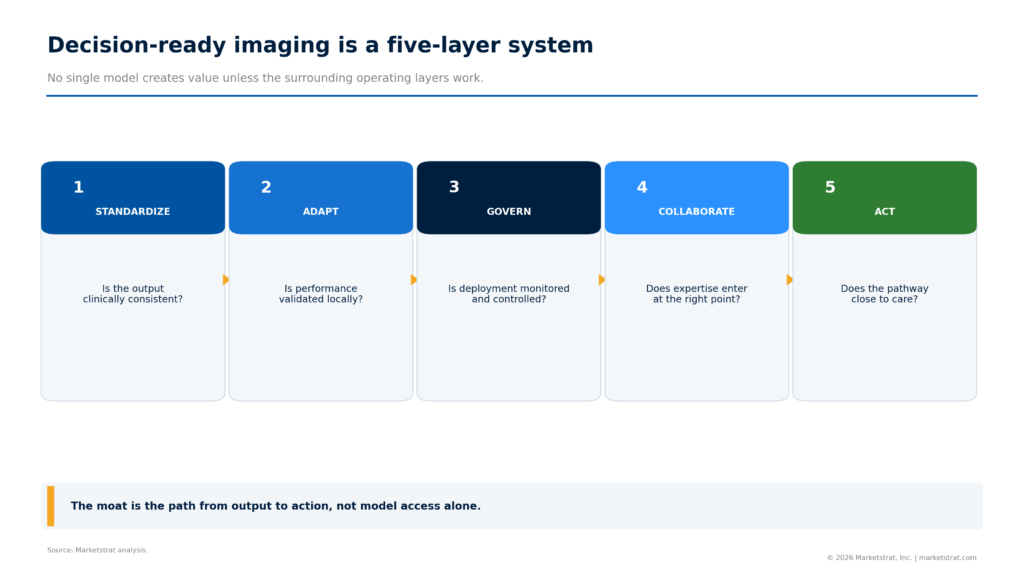
Standardization becomes an operating layer
The publication of PE-RADS gives acute pulmonary embolism imaging a common clinical language. That matters because AI output often loses value when it cannot be translated consistently into reporting, escalation and treatment workflows.
A standardized framework can improve communication among radiologists, referring clinicians and pulmonary embolism response teams. It can also create more stable definitions for software development, validation and post-deployment monitoring.
The commercial implication is not that publication immediately creates a new market. Adoption remains the gate. A standard becomes infrastructure only when it is embedded in reporting templates, care protocols, registries and downstream decision pathways.
This favors vendors that can convert a clinical framework into routine workflow. Reporting platforms, enterprise imaging systems and decision-support tools may capture more value than a standalone application that simply references the terminology.
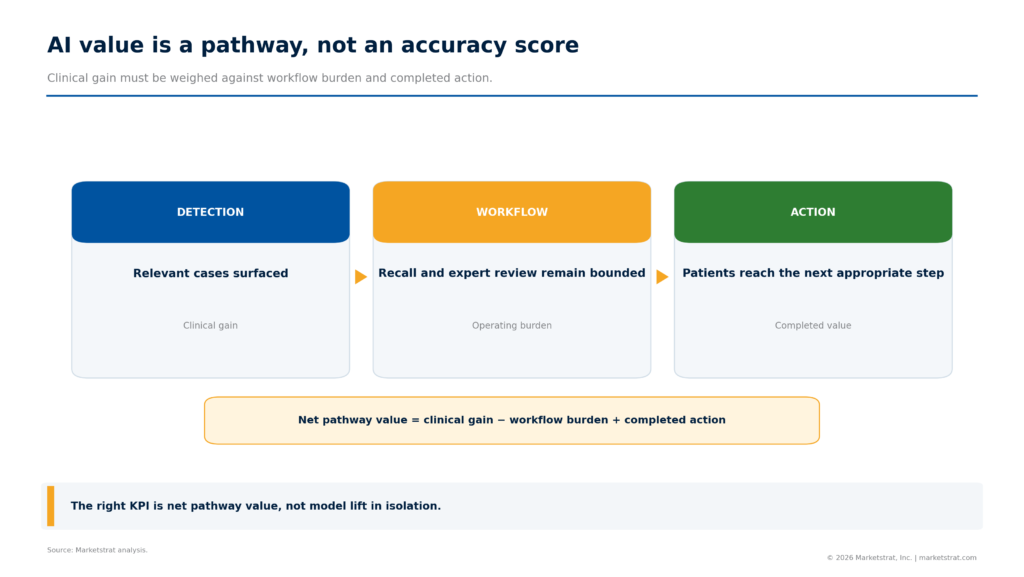
Workflow evidence changes the unit of value
DeepHealth’s breast-screening study is important because it evaluated a multistage workflow rather than an isolated algorithm. AI was used to identify higher-risk cases, specialist review was applied selectively, and the local radiologist retained final authority.
The evidence supports the idea that AI can help extend scarce specialist judgment across a distributed screening network. It also shows why the commercial denominator cannot be model performance alone.
Improved detection must be assessed alongside recall burden, diagnostic workups, specialist-review time, patient access and downstream completion. A workflow can generate clinical gain while also creating new operating demands.
For providers, this changes the business case. The relevant question is not simply whether AI improves a single performance metric. It is whether the complete pathway produces better outcomes and acceptable economics after all added work is included.
The platform market is separating into control points
GE HealthCare’s MIM Anyware, CARPL.ai and HOPPR illustrate three different positions in the imaging AI stack.
MIM Anyware extends advanced imaging and oncology applications into a browser-based shared work surface. CARPL.ai focuses on evaluating, deploying and monitoring multiple AI applications through a vendor-neutral layer. HOPPR operates further upstream through foundation models, curated data and development support.
These offerings may all be called platforms, but they do not control the same commercial rights.
The work surface can own the user relationship and the point of clinical interaction. The orchestration layer can influence application choice, integration and usage visibility. The model foundry can shape how local data becomes an application-ready capability.
Health systems therefore need a more precise procurement framework. They must determine which layer can approve applications, access data, monitor performance, manage failures and document use. They also need clear rights around interoperability, usage data and exit.
For vendors, the challenge is similar. Breadth is not enough. A platform must demonstrate that it can reduce implementation friction, support governance and generate evidence of activated use.
Procedure platforms move toward closed-loop proof
Johnson & Johnson’s OTTAVA authorization introduces a major incumbent into soft-tissue robotics with a table-integrated architecture and a selective commercial launch. The strategic significance extends beyond the robotic system itself.
The operating model includes setup, instruments, training, service, digital connectivity and procedure expansion. The commercial test is whether those elements translate into reliable utilization, room efficiency and completed care.
Penumbra and EndoQuest Robotics reinforce the same direction from different procedure categories. Their disclosed evidence emphasizes procedural outcomes such as reperfusion, treatment speed, resection completeness and safety.
The studies have limitations and should not be treated as comparative proof. Their strategic importance is that they move the discussion toward the metrics that matter for adoption. Procedure platforms are increasingly evaluated as operating systems, not capital equipment alone.
Reimbursement remains a code-level problem
The week’s reimbursement signal also supports a more granular view of value. Code-level Medicare impact tables show why specialty averages can conceal meaningful differences by procedure, modality and site of service.
A workflow tool can improve capacity while still producing an unattractive return if the additional volume is concentrated in adversely revalued services or higher-cost settings. Providers and vendors need to connect workflow assumptions to actual code mix and site economics.
This makes reimbursement part of the decision-infrastructure thesis. Technical capability, workflow capacity and payment exposure must be evaluated together.
What this means for the market
The market is not consolidating into one universal imaging AI platform. It is separating into layers that can be owned by different organizations.
Clinical standards define the grammar. Model foundries adapt capabilities. Orchestration platforms govern deployment. Enterprise work surfaces coordinate human review. Procedure platforms convert guidance into care.
The defensible position will combine control with accountability. Buyers will increasingly ask whether a vendor can activate the technology, measure use, manage exceptions and show clinical or operating improvement.
The competitive moat is not model access. It is control of the path from model output to completed clinical action.
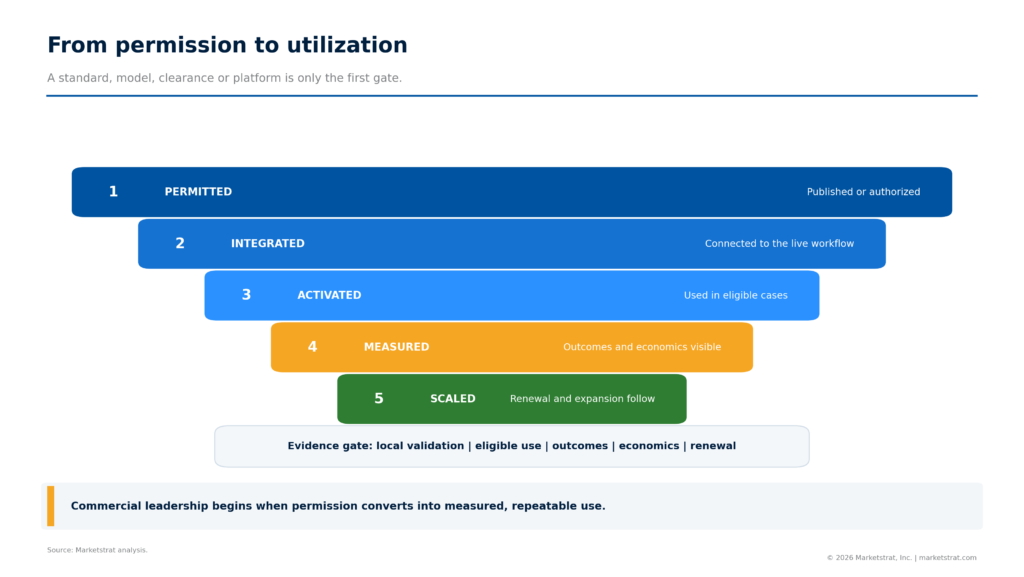
Marketstrat’s view is that permission remains necessary but insufficient. A published standard, regulatory authorization, product catalog or signed contract is only the first gate. Commercial leadership begins when that permission converts into integrated, activated, measured and repeatable use.
Access the full research
The full Marketstrat Pulse Insights note includes the verified event analysis, evidence limitations, stakeholder implications, market watchlist and detailed decision-infrastructure frameworks.
Subscribe to Marketstrat Pulse Insights for the weekly signal. Contact research@marketstrat.com to discuss direct access to Pulse Insights and broader Marketstrat research.
Related research themes
Medical imaging AI commercialization and governance, enterprise imaging and workflow control, breast-screening AI and specialist capacity, surgical robotics and image-guided procedures, radiology reimbursement and code-level economics.
Access the Full Research
The full Marketstrat Pulse research note includes the complete event analysis, stakeholder implications, deep dives, source appendix and proprietary visual exhibits. For direct access or to discuss subscriptions, visit marketstrat.com or contact research@marketstrat.com. Entitled institutional users may also access Marketstrat research through their existing research platforms.
About Marketstrat
Marketstrat® is an independent market intelligence firm focused on MedTech, medical imaging, imaging AI, enterprise imaging, PACS, and adjacent healthcare technology markets. Through its Markintel® research methodology and publishing system, Marketstrat produces Horizon Reports, Pulse Reports, Company Research, Market Signals, and weekly Pulse Insights. The firm’s research combines market sizing, forecasting, segmentation, competitive mapping, company intelligence, and event-driven analysis to help corporate strategy, product, commercial, investment, consulting, and industry media professionals interpret fast-moving healthcare markets with greater clarity.
Marketstrat® and Markintel® are registered service marks of Marketstrat, Inc.
Our Research
- Horizon Reports — Comprehensive market landscape assessments with sizing, segmentation, forecasting, and competitive mapping across multi-year time horizons.
- Focus Reports — Targeted market intelligence reports on specific segments, technologies, or competitive dynamics drawn from Marketstrat’s broader Horizon research program.
- Company Research — Decision-grade company intelligence covering strategy, competitive positioning, product portfolio, business model, financial structure, partnerships, and stakeholder impact.
- Market Signals — Event-driven analysis tied to specific catalysts, including regulatory actions, M&A, product launches, policy shifts, reimbursement changes, and earnings. Each signal is structured around strategic implications, not just news.
- Pulse Insights — Weekly market intelligence digest covering what moved, what it means, and what to watch across healthcare, MedTech, medical imaging, imaging AI, and adjacent life sciences markets.
