
Pro Medicus, Vitestro and Radiobotics show why imaging AI value now depends on activation, lifecycle evidence and renewal economics for providers and investors.
🎧 Listen to this week’s Marketstrat Pulse Insight:
The strategic question in medical imaging and AI-enabled MedTech is changing. Regulatory authorization remains necessary, but it no longer provides enough evidence of commercial strength. The more important test is what happens after permission: whether the product becomes active workflow, produces observable performance, withstands lifecycle scrutiny and converts into renewal economics.
Marketstrat’s view is that durable value is moving toward continuous operating proof. This week’s developments across Pro Medicus, FDA policy, radiology-AI evidence and autonomous phlebotomy show why.
In imaging AI, durable value is increasingly determined by the conversion rate between authorization, activation, measured use and renewal.
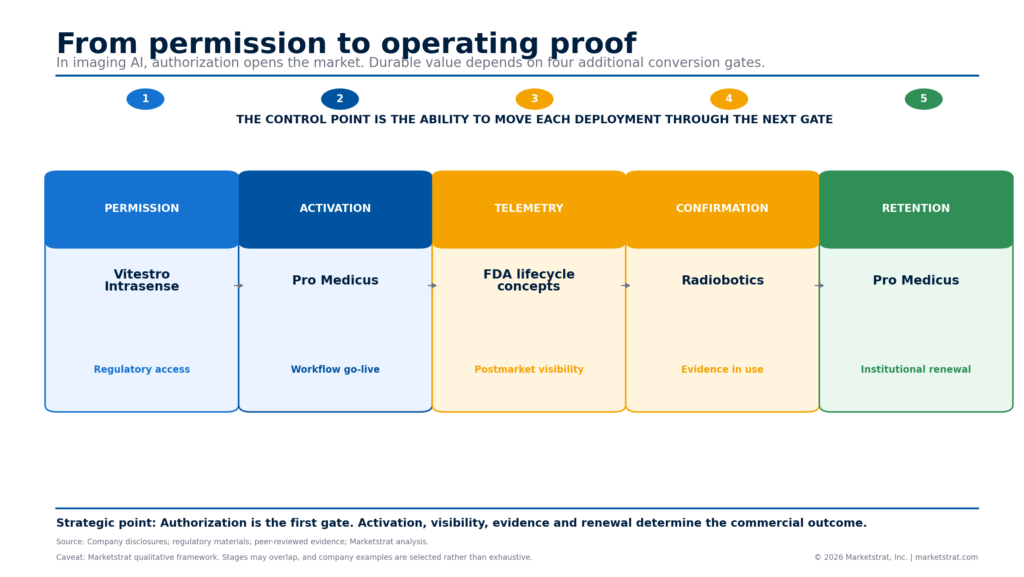
Clearance opens the market, but activation, telemetry, evidence and renewal determine the commercial outcome.
Pro Medicus links implementation to renewal
Pro Medicus provided the clearest commercial example. The company reported A$261.7 million of FY26 revenue and completed 16 go-lives during the year. All six contracts due for renewal were extended for another five years at higher per-transaction fees.
Those disclosures connect several stages that vendors often report separately. Contract wins establish demand. Go-lives show that customers have moved beyond procurement into deployment. Transaction pricing links revenue to imaging activity. Renewal tests whether the platform remains embedded after the original implementation cycle.
This is a stronger operating signal than a clearance count, pilot announcement or contracted-site total. It does not remove every uncertainty. Forward contract value is not recognized revenue, and company-level profitability does not isolate every product, implementation or support cost. Still, the conversion sequence is visible.
The strategic implication is broader than one company. Enterprise imaging vendors should be evaluated on time to go live, active study volume, service incidents, user adoption, product attachment and renewal economics. Product capability matters, but institutional dependence is created through reliable execution.
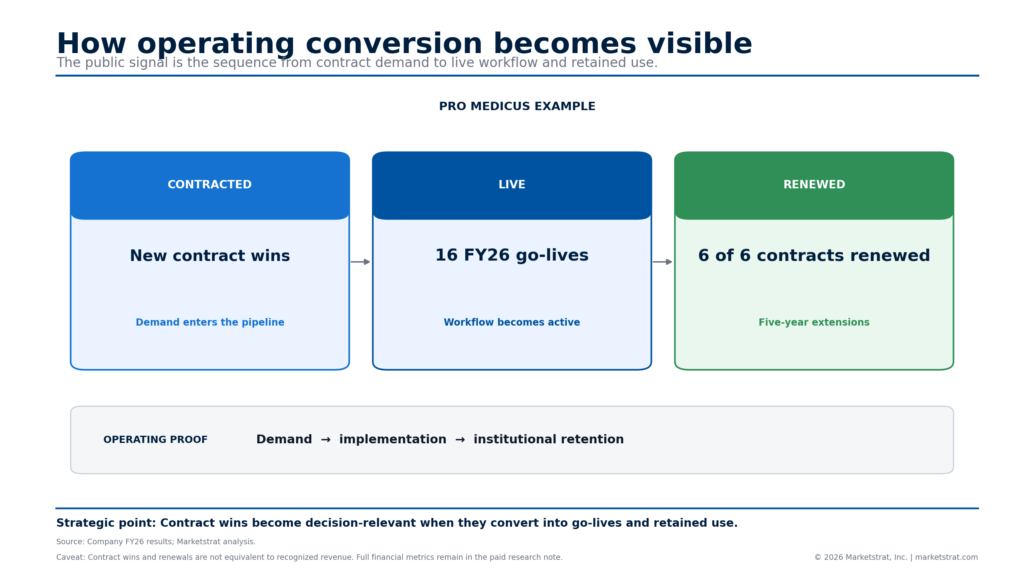
The strongest commercial signal is the conversion of demand into active workflow and retained use.
FDA puts lifecycle evidence into the GenAI discussion
FDA’s discussion paper on generative AI-enabled medical devices proposed a possible two-axis risk framework, a competency-assessment concept and risk-proportionate postmarket monitoring. The agency described a potential sequence that includes nonclinical benchmarking, clinical confirmation and ongoing observation after deployment.
The paper is exploratory. It is not draft or final guidance, and it does not create binding requirements. That qualification matters.
Even so, the commercial direction is clear. Generative and agentic systems may require a different evidence architecture from static software. Vendors could need auditable version control, subgroup monitoring, drift detection, human-review controls and defined escalation processes when performance changes.
This creates a structural advantage for companies already embedded in enterprise workflow. Platforms that observe study routing, model invocation, reader interaction, report creation and downstream action are better positioned to generate lifecycle evidence. Standalone algorithms with limited post-deployment visibility may need deeper platform integration or provider partnerships.
The evidence gap remains wide
A peer-reviewed census examined 1,357 FDA-cleared or approved AI and machine-learning devices. Only three evaluated patient-centered outcomes through publicly linked studies.
The finding should be interpreted carefully. It does not establish that the remaining devices are ineffective or that no internal validation exists. It does show that authorization has expanded much faster than publicly visible outcome evidence.
Radiobotics offered a stronger middle tier of proof. In a retrospective study of 1,500 consecutive cases across three European hospitals, AI assistance increased reader sensitivity by 10.6 percentage points without a statistically significant change in specificity.
That result is more decision-relevant than standalone accuracy because it measures human-plus-AI performance across multiple institutions. It also exposes the next gap. Reader improvement does not automatically demonstrate better patient outcomes, lower total cost or stronger commercial retention. Local performance varied by anatomy and site, reinforcing the need for institution-specific monitoring rather than reliance on one pooled result.
For providers, the implication is practical. Evidence should be matched to the claim being purchased. Technical accuracy supports one type of decision. Reader improvement supports another. Workflow efficiency, clinical action, patient outcomes and economic return require additional proof.
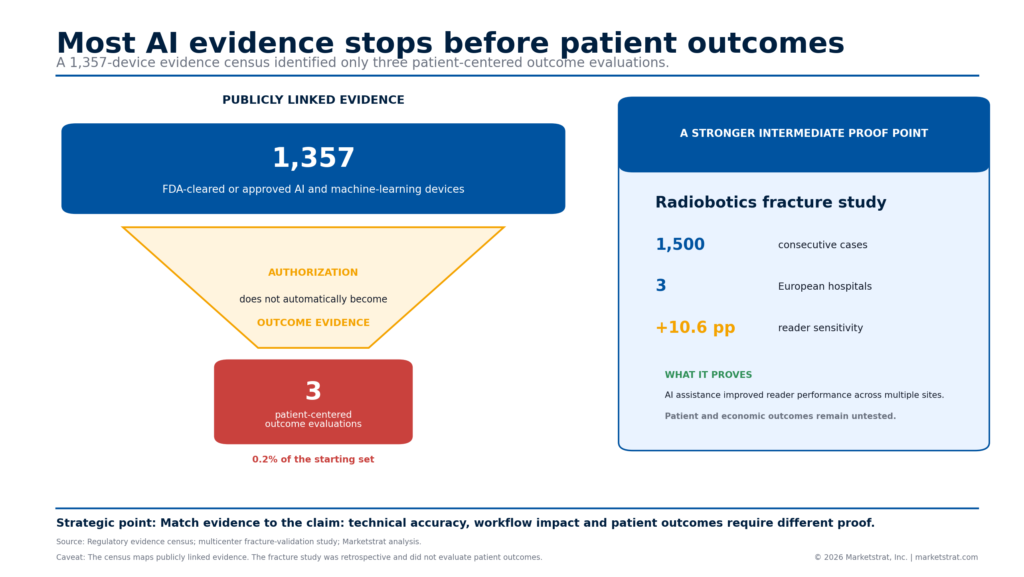
Evidence should be matched to the clinical, workflow or economic claim being made.
Vitestro makes autonomy a capacity test
FDA’s De Novo authorization of Vitestro’s Aletta created a new category for autonomous robotic phlebotomy. The system uses near-infrared imaging and Doppler ultrasound to guide vein selection, and one trained phlebotomist can supervise as many as three devices.
The authorization shifts the economic question from software assistance to labor and capacity. A 1:3 supervision ratio could expand outpatient throughput, but only if routine operations support it.
The relevant measures are completed draws per staffed hour, abstention, supervisor intervention, procedure success, uptime, patient acceptance and total cost per successful collection. Authorization establishes the category. It does not establish the business case.
This distinction will apply across AI-enabled robotics. Products that physically execute care must prove more than technical performance. They must show reliable throughput, manageable service requirements and a cost structure that improves the operating model.
Reliability becomes part of the value proposition
Class II recall postings involving PACS measurement software and CT bolus-tracking software reinforced another part of the thesis. Once software is embedded in clinical workflow, reliability, remediation and fallback procedures become ongoing commercial obligations.
Enterprise contracts should define notification, patch validation, installation timing, affected-case review, downtime procedures and responsibility for repeat work. Postmarket reliability is not separate from product value. It affects trust, renewal and the cost of maintaining the deployed base.
This is also why telemetry matters. Providers and vendors need to know which version was active, which studies were affected, how users responded and whether remediation was completed.
What the market may be missing
The market often treats authorization, distribution, installation, evidence and renewal as interchangeable signs of progress. They are separate gates.
A product can be authorized but unavailable. It can be available but not integrated. It can be integrated but lightly used. Usage can climb without changing clinical action or economics at all. It can produce value but still fail to renew if support costs, workflow friction or pricing overwhelm the benefit.
The stronger underwriting question is the conversion rate between adjacent gates: permission to activation, activation to measured use, measured use to clinical or economic confirmation, and confirmation to renewal with positive contribution.
Implications for decision-makers
Corporate strategy teams should identify which operating-proof gate they control and where value may leak. Product leaders should design telemetry, evidence capture and remediation into the platform. Providers should require site-level monitoring and clear data rights. Investors should separate market access from active use and active use from retained economics. For technology partners the question is blunter: does the integration improve visibility and conversion, or does it just add implementation burden?
The thesis has boundaries. Stronger evidence may not produce pricing power if buyers continue prioritizing immediate workflow relief. Lifecycle monitoring may remain an unfunded provider responsibility. Autonomous systems may fail to achieve their stated supervision ratios under routine conditions. FDA’s GenAI concepts may also remain exploratory for an extended period.
Those conditions should be monitored. They do not change the central conclusion: in imaging AI and AI-enabled MedTech, durable value increasingly depends on proving what happens after go-live.
Explore the latest Marketstrat Pulse analysis and related Horizon research, subscribe to Marketstrat’s LinkedIn newsletter, or contact Marketstrat (research@marketstrat.com) for research access and custom analysis.
Research process: Marketstrat uses a human-led, AI-enabled workflow. AI systems materially support evidence synthesis, modeling, drafting, coding, and quality control. Marketstrat defines the methodology, evaluates the evidence, determines the conclusions, and approves all published content.
About Marketstrat
Marketstrat® is an independent market intelligence firm focused on MedTech, medical imaging, imaging AI, enterprise imaging, PACS, and adjacent healthcare technology markets. Through its Markintel® research methodology and publishing system, Marketstrat produces Horizon Reports, Pulse Reports, Company Research, Market Signals, and weekly Pulse Insights. The firm’s research combines market sizing, forecasting, segmentation, competitive mapping, company intelligence, and event-driven analysis to help corporate strategy, product, commercial, investment, consulting, and industry media professionals interpret fast-moving healthcare markets with greater clarity.
Marketstrat® and Markintel® are registered service marks of Marketstrat, Inc.
Our Research
- Horizon Reports — Comprehensive market landscape assessments with sizing, segmentation, forecasting, and competitive mapping across multi-year time horizons.
- Focus Reports — Targeted market intelligence reports on specific segments, technologies, or competitive dynamics drawn from Marketstrat’s broader Horizon research program.
- Company Research — Decision-grade company intelligence covering strategy, competitive positioning, product portfolio, business model, financial structure, partnerships, and stakeholder impact.
- Market Signals — Event-driven analysis tied to specific catalysts, including regulatory actions, M&A, product launches, policy shifts, reimbursement changes, and earnings. Each signal is structured around strategic implications, not just news.
- Pulse Insights — Weekly market intelligence digest covering what moved, what it means, and what to watch across healthcare, MedTech, medical imaging, imaging AI, and adjacent life sciences markets.
