Global CT Scanners Market Horizon Report: Market Structure, Forecasts, Clinical Demand, Competitive Dynamics, and AI Monetization Architecture, 2024A–2035E - July 2026

Individual License: $4,950 | Team and Enterprise License Options Available


This Marketstrat® Horizon report provides an in-depth global analysis of the computed tomography market and the broader CT ecosystem. It is built for medical imaging OEM executives, corporate strategy and development teams, service and aftermarket leaders, component suppliers, clinical AI companies, enterprise imaging platforms, investors, provider organizations, and commercial teams with exposure to CT.


The report integrates CT systems, installed-base economics, procedure demand, replacement and expansion shipments, realized ASPs, service contracts, X-ray tubes and parts, software upgrades, clinical AI, enterprise AI orchestration, financing, and selected adjacencies into one reconciled decision model.


Unlike conventional CT market reports that focus primarily on scanner shipments, slice counts, or top-line equipment revenue, this report examines where value is moving across the complete CT lifecycle.


The central question is not only how many scanners will be sold. It is:

Who will control the premium configuration, service relationship, software upgrade path, clinical AI workflow, enterprise platform, and financing architecture around the installed scanner?

The report was developed through Markintel®, Marketstrat’s proprietary research methodology, strategic framework stack, and evidence-to-insight workflow system. The analysis combines public and proprietary evidence with a bottom-up global market model and publishable analytical cuts that reconcile to the same governing totals.
 

Market Snapshot

CT remains one of the most clinically essential and operationally resilient medical imaging modalities. It supports emergency medicine, trauma, stroke, oncology, cardiovascular imaging, pulmonary disease, vascular assessment, abdominal diagnosis, interventional procedures, and population screening.


Global CT procedure volume increases from approximately 564 million examinations in 2024A to 874 million in 2035E. The active installed base expands from approximately 97,600 to 151,600 scanners, while annual new-system shipments increase from approximately 12,900 to 21,200 units.


Those figures do not describe one homogeneous growth cycle.


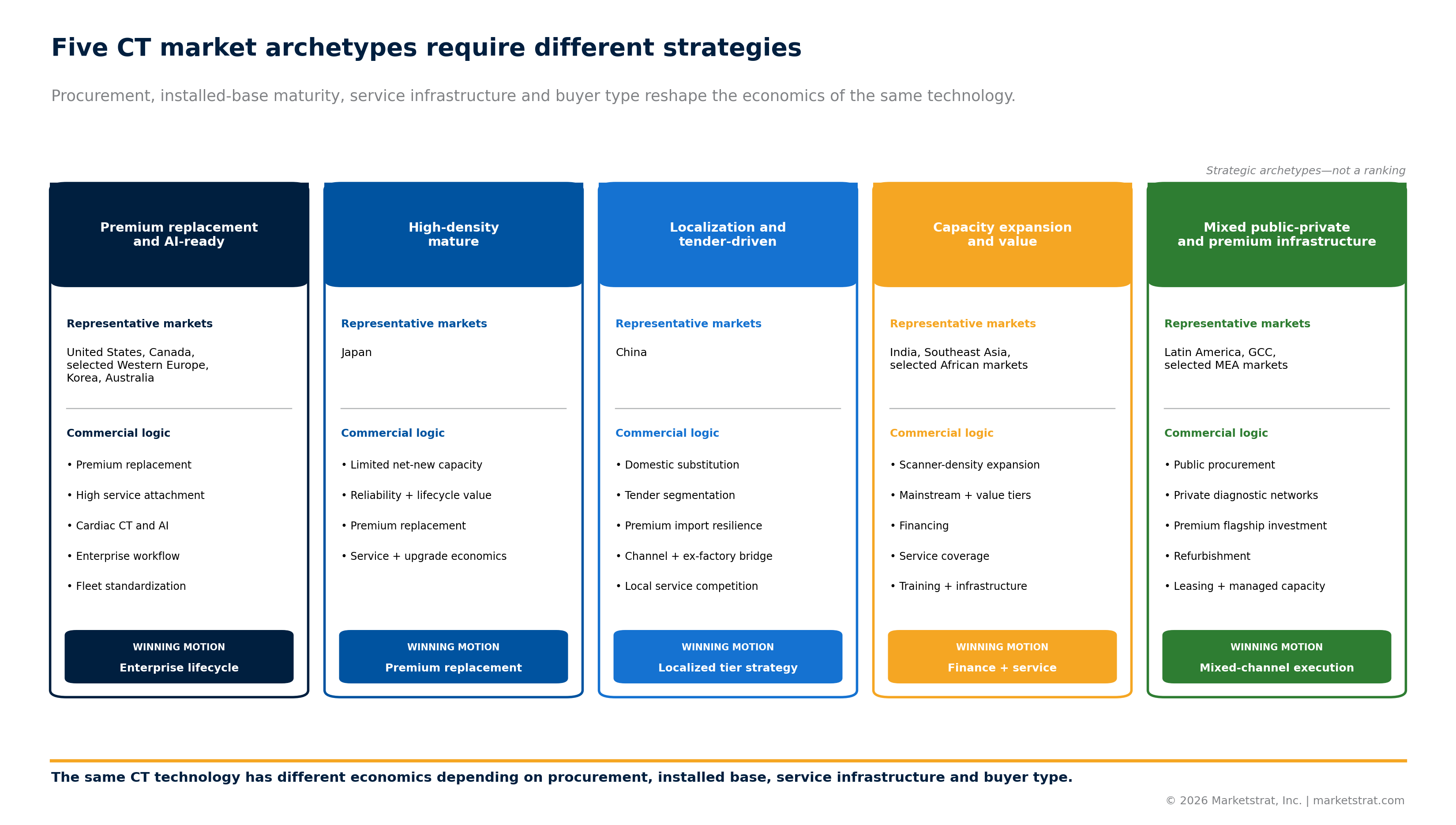
Mature markets are primarily replacement-led. Their economics depend on fleet age, utilization, premium configuration, service attachment, software upgrades, AI adoption, and enterprise contracting.


Lower-density markets remain more expansion-led. Their conversion from clinical need into scanner placements depends on capital availability, public procurement, financing, service coverage, workforce, parts availability, and realized system pricing.


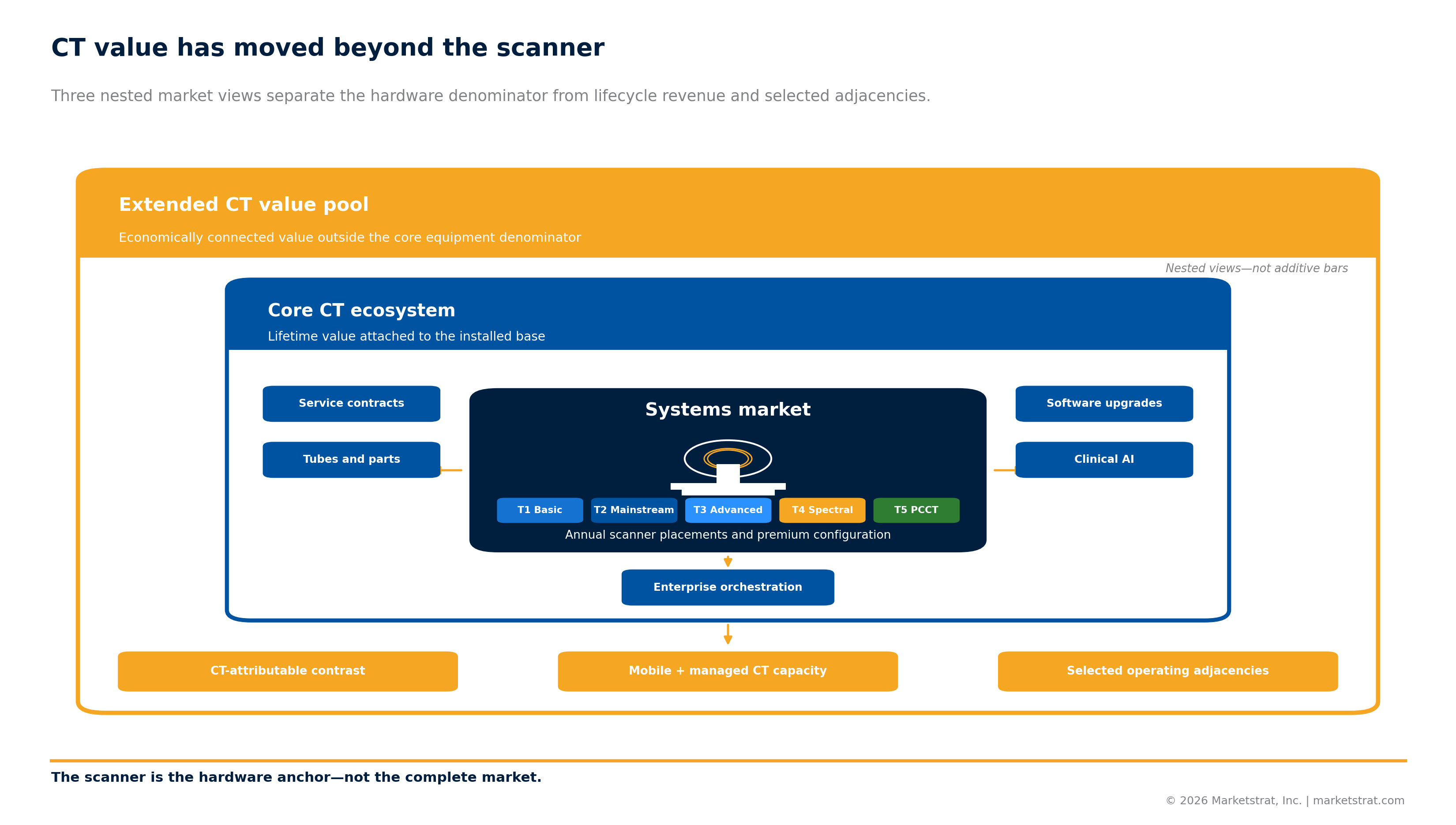
The broader value migration is equally important. Systems revenue grows steadily, but service, tubes and parts, software, clinical AI, and orchestration expand the economic value of the installed base.


Under the final scenario architecture, the 2035E extended CT value pool ranges from approximately US$24.3 billion in the Bear case to US$31.8 billion in the Bull case, compared with US$27.6 billion in the Base case.
Key Market Trends: What Is Structurally Changing

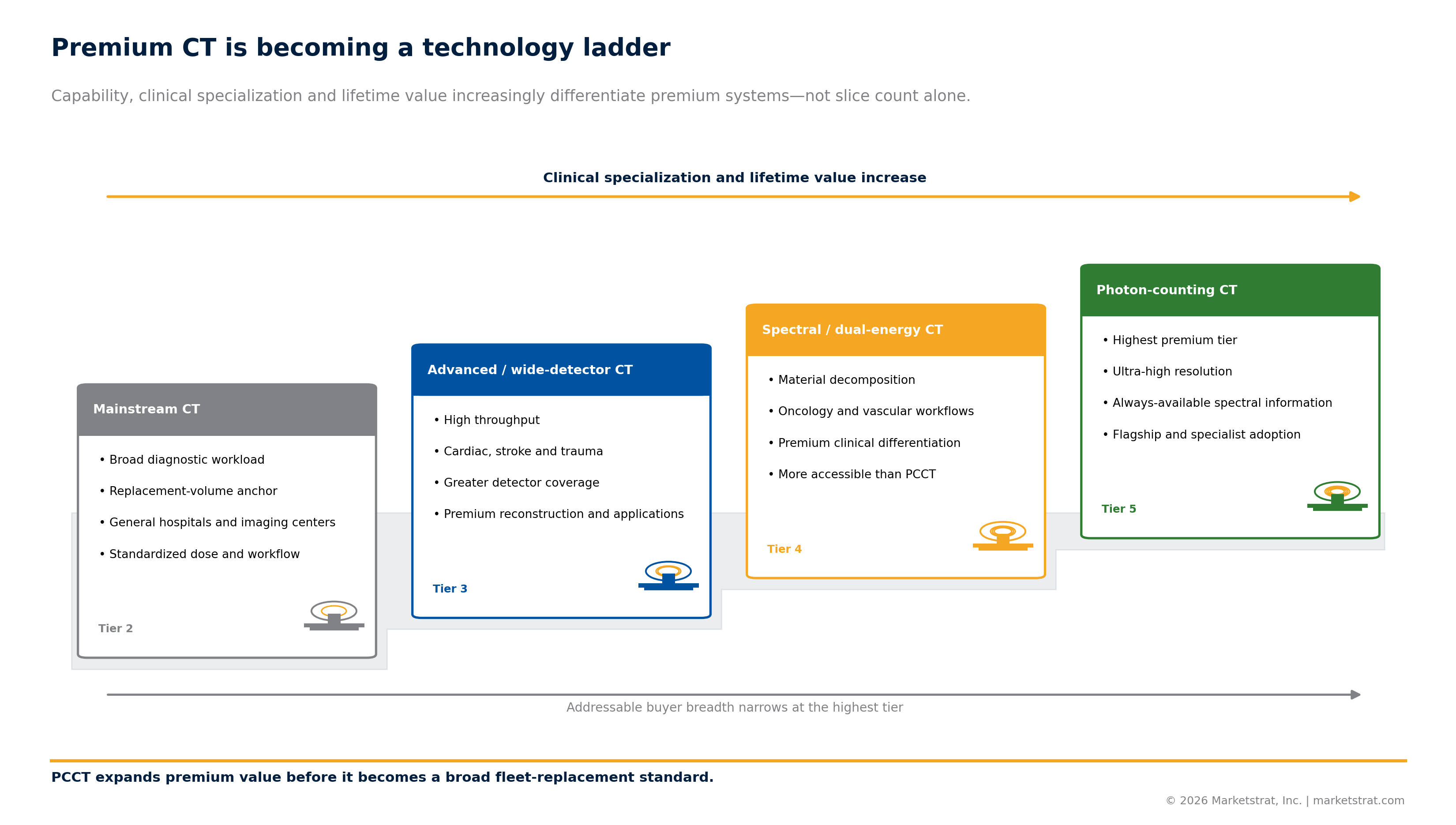
  • Premium CT is moving beyond slice-count competition
  • Photon-counting CT changes the premium market before it changes the installed base
  • Service and aftermarket remain strategic control points
  • China is a separate competitive system
  • AI monetization depends on workflow and payment architecture
  • Buyer power is consolidating
  • Financing is becoming part of product strategy

Competitive Landscape: Cluster-Based Ecosystem Architecture

Marketstrat organizes the CT market into strategic clusters to clarify where value is controlled and how competitors monetize their position.


Clusters: Premium integrated OEMs; China and value-tier challengers; Photon-counting and advanced spectral CT; Cardiac CT AI; Stroke and neuro CT AI; Lung, thoracic, and multi-condition CT AI; Enterprise AI orchestration and workflow; Service, aftermarket, and enabling components; Financing and managed equipment.


Competitors Covered: Siemens Healthineers; GE HealthCare; Canon Medical Systems; Philips; Fujifilm Healthcare; Hitachi; United Imaging Healthcare; Neusoft Medical Systems; Wandong Medical; HeartFlow; Cleerly; Elucid; Caristo Diagnostics; Artrya; Circle Cardiovascular Imaging; Keya Medical; Viz.ai; RapidAI; Aidoc; Brainomix; Nicolab; Optellum; Coreline Soft; DeepHealth; Aidence; Gleamer; Riverain Technologies; Infervision; deepc; Microsoft; Nuance; Sectra; Sirona Medical; Visage Imaging; Pro Medicus; Blackford; Calantic; Varex Imaging; Dunlee; TRIMEDX; Agiliti; Block Imaging; Siemens Financial Services.


Within each cluster, the report examines:

  • where the moat sits;
  • how revenue is captured;
  • relative competitive standing;
  • evidence and regulatory position;
  • geographic reach;
  • installed-base and channel leverage;
  • major execution risks; and
  • signals to monitor over the next 12–24 months.
  • Company highlights

Methodology and Markintel® Strategic Frameworks

The report is developed through Markintel®, Marketstrat’s proprietary research methodology, strategic frameworks, and workflow system.


The research architecture combines:

  • a reconciled bottom-up global market model;
  • country-level procedures and installed-base logic;
  • replacement and expansion shipment modeling;
  • scanner-tier and realized-ASP analysis;
  • service, tube, parts, software, and AI layers;
  • clinical-segment allocations reconciled to systems revenue;
  • end-use organization allocations reconciled to systems revenue;
  • Base, Bull, and Bear scenarios;
  • regulatory and reimbursement research;
  • company filings and announcements;
  • procurement and tender evidence;
  • broker research and expert call transcripts;
  • clinical literature; and
  • Marketstrat estimates and strategic analysis.


The objective is not only to identify where the market grows. It is to explain:

  • how value is captured;
  • what evidence supports adoption;
  • who controls the commercial relationship;
  • where risks sit; and
  • what actions matter for different stakeholders.

What the Report Covers

  • Core global market model, 2024A–2035E
  • CT scanner segmentation
  • Clinical market structure
  • End-use market structure
  • Geographic coverage
  • Commercial and strategic analysis


Intended Audience


This report is designed for decision-makers with product, commercial, operational, or capital exposure to CT, including:

  • CT and medical imaging OEM executives;
  • product management and portfolio leaders;
  • corporate strategy and corporate development teams;
  • service and aftermarket organizations;
  • clinical AI and imaging-software vendors;
  • enterprise imaging, PACS, reporting, and orchestration platforms;
  • X-ray tube, detector, component, and subsystem suppliers;
  • healthcare investors, banks, and private equity;
  • IDN, hospital, and outpatient imaging leaders;
  • procurement and imaging-operations teams;
  • financing, leasing, and managed-equipment providers;
  • consulting and advisory firms; and
  • government and public-sector imaging programs.

Why This Report

The CT market is too complex for a shipment-only forecast and too operational for a generic top-down market estimate.


Marketstrat® sits between sell-side research and traditional syndicated market reports: structured enough for strategy, corporate development, investment, and consulting teams, but close enough to product architecture, clinical workflow, reimbursement, tenders, installed-base economics, and commercial execution to be useful for operators.


This report provides one reconciled structure for evaluating:

  • systems;
  • installed base;
  • shipments;
  • service;
  • parts;
  • software;
  • AI;
  • clinical demand;
  • end-use organizations;
  • geographies;
  • competitors; and
  • scenarios.


The result is not simply a larger dataset. It is a decision system for understanding:

  • where value is forming;
  • where it is being compressed;
  • which competitors control the relevant commercial layers;
  • and what strategic actions are required to capture the next phase of CT growth.


Use the report to:

  • test market-entry assumptions;
  • refine product roadmaps;
  • prioritize countries and buyer segments;
  • benchmark competitors;
  • evaluate premium-technology timing;
  • model service and AI attach;
  • assess partnerships or acquisitions;
  • prepare investment theses;
  • structure financing offers; or
  • challenge an existing CT market forecast.

Report Details

  • Title: Global CT Scanners Market Horizon Report
  • Subtitle: Market Structure, Forecasts, Clinical Demand, Competitive Dynamics, and AI Monetization Architecture, 2024A–2035E
  • Type: Markintel® Horizon Report — Flagship, In-Depth
  • Publication: July 2026
  • Report ID: MINTH-02101
  • Forecast Period: 2024A–2035E
  • Length: Approximately 237 pages
  • Content: 100 numbered tables and 50 figures, including proprietary strategic frameworks
  • Format: PDF digital delivery plus companion Excel market-model and analytical-cut deliverables
  • Geographical Coverage: North America | Europe | China | Japan | Broader APAC | Latin America | Middle East and Africa
  • Detailed Country Coverage: United States, Canada, Germany, United Kingdom, France, Italy, Spain, China, Japan, India, Brazil, Mexico, Saudi Arabia / UAE, and South Africa
  • Licensing: Individual, Team, and Enterprise options
  • Price: Individual $4,950 | Team $5,450 | Enterprise $8,950

By submitting this form, you agree to our Privacy Policy