Global X-ray & Digital Radiography Horizon Report - Market Structure, Forecasts, Competitive Dynamics, and AI Monetization Architecture, 2024A–2035E - June 2026

Individual License: $4,950 | Team and Enterprise License Options Available


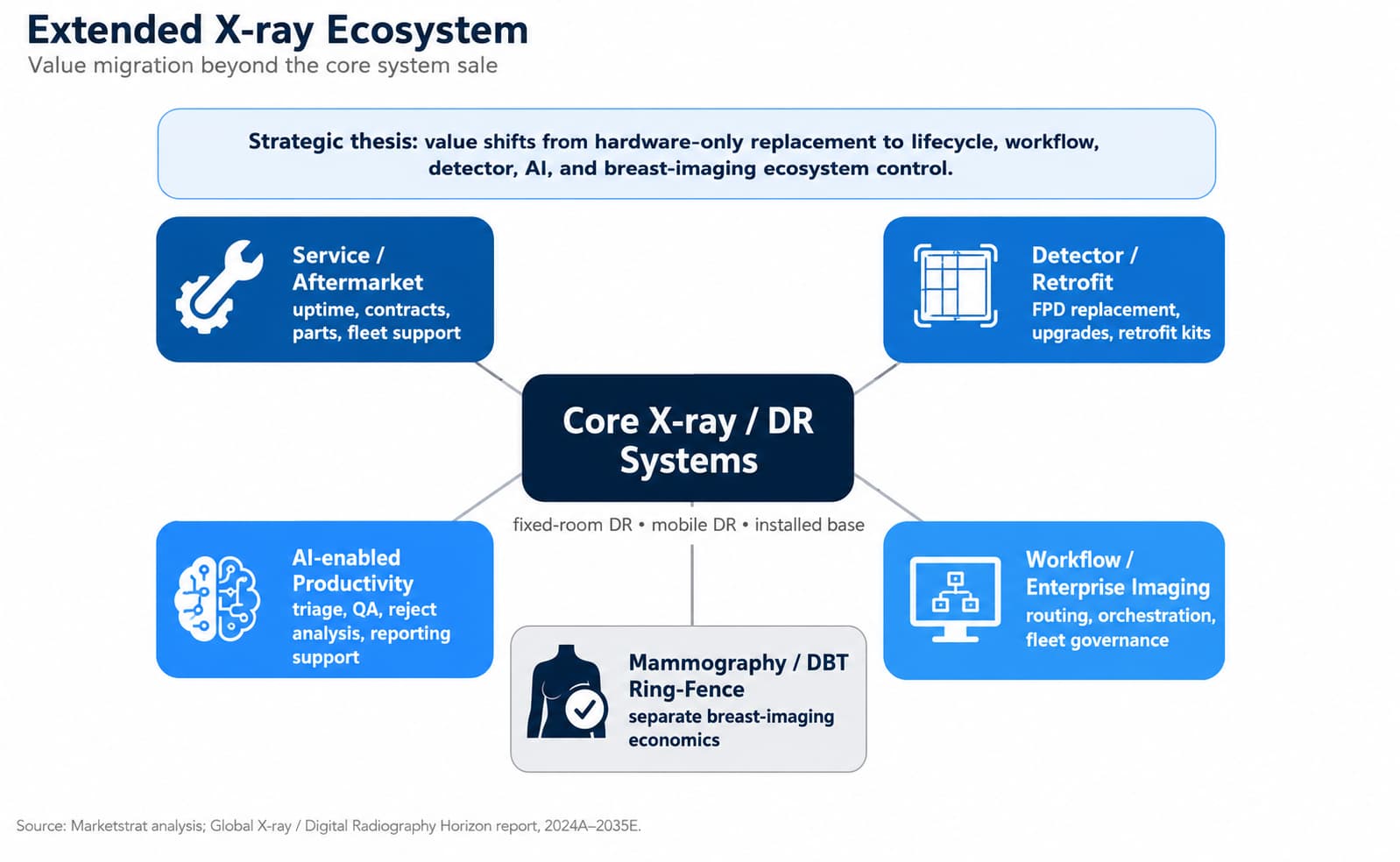
X-ray / Digital Radiography is one of medical imaging’s most widely deployed modalities, but it is no longer best understood as a simple hardware replacement market. Fixed-room and mobile DR systems remain essential, but the category’s profit pool is increasingly shaped by service attachment, detector replacement, retrofit economics, workflow software, AI-enabled automation, enterprise fleet control, China procurement pressure, and a ring-fenced mammography / DBT adjacency.


This Marketstrat® Horizon report answers the questions senior leaders are now asking: where does X-ray / DR still grow, where is hardware being commoditized, which segments remain defensible, how much value sits above the system sale, and which competitors are positioned to capture the next layer of revenue?


The report models core fixed-room and mobile DR systems, then layers in service / aftermarket revenue, recurring AI and workflow software, detector / retrofit overlays, and mammography / DBT ecosystem economics. The result is a structured view of the broader X-ray / DR value pool rather than a narrow equipment-shipment forecast.


This Horizon report is Marketstrat’s in-depth global analysis of the X-ray / Digital Radiography market and broader X-ray / DR ecosystem. It is built for medical imaging OEM executives, strategy and corporate development teams, service and aftermarket leaders, detector and component suppliers, AI and workflow vendors, enterprise imaging platforms, investors, private equity, and provider-side imaging leaders.


The report is designed to answer a practical commercial question: how does value get captured in a mature modality when the core hardware market is replacement-led and price pressure is rising?


The answer is not a single number. The report separates the market into layers:

  • core fixed-room and mobile DR systems,
  • service and aftermarket revenue tied to the installed base,
  • recurring AI and workflow software revenue,
  • detector replacement and retrofit economics,
  • mammography / DBT as a ring-fenced adjacent ecosystem,
  • and competitive control planes across hardware, service, workflow, AI, enterprise imaging, and China value channels.


The goal is not just to size the market. It is to explain which segments are defensible, where procurement pressure is highest, where installed-base monetization accumulates, how AI becomes paid software rather than an embedded feature, and which vendors are best positioned to capture value above the initial system sale.

Market Snapshot

The core X-ray / DR market remains essential, global, and installed-base-rich. World core unit shipments grow from approximately 79.2k in 2024A to 98.3k in 2035E, while the installed base expands from roughly 499.0k to 647.1k systems. Core systems revenue grows from approximately $5.0B to $6.4B, reflecting modest unit growth, premium-system resilience in mature markets, and continued ASP pressure in value segments and procurement-sensitive geographies.


The broader ecosystem is materially larger. Core total ecosystem revenue, including systems, service / aftermarket, and core AI recurring revenue, grows from approximately $6.0B in 2024A to $8.6B in 2035E. When detector / retrofit overlays and mammography / DBT total ecosystem revenue are included, extended ecosystem revenue rises from approximately $9.1B to $12.8B.


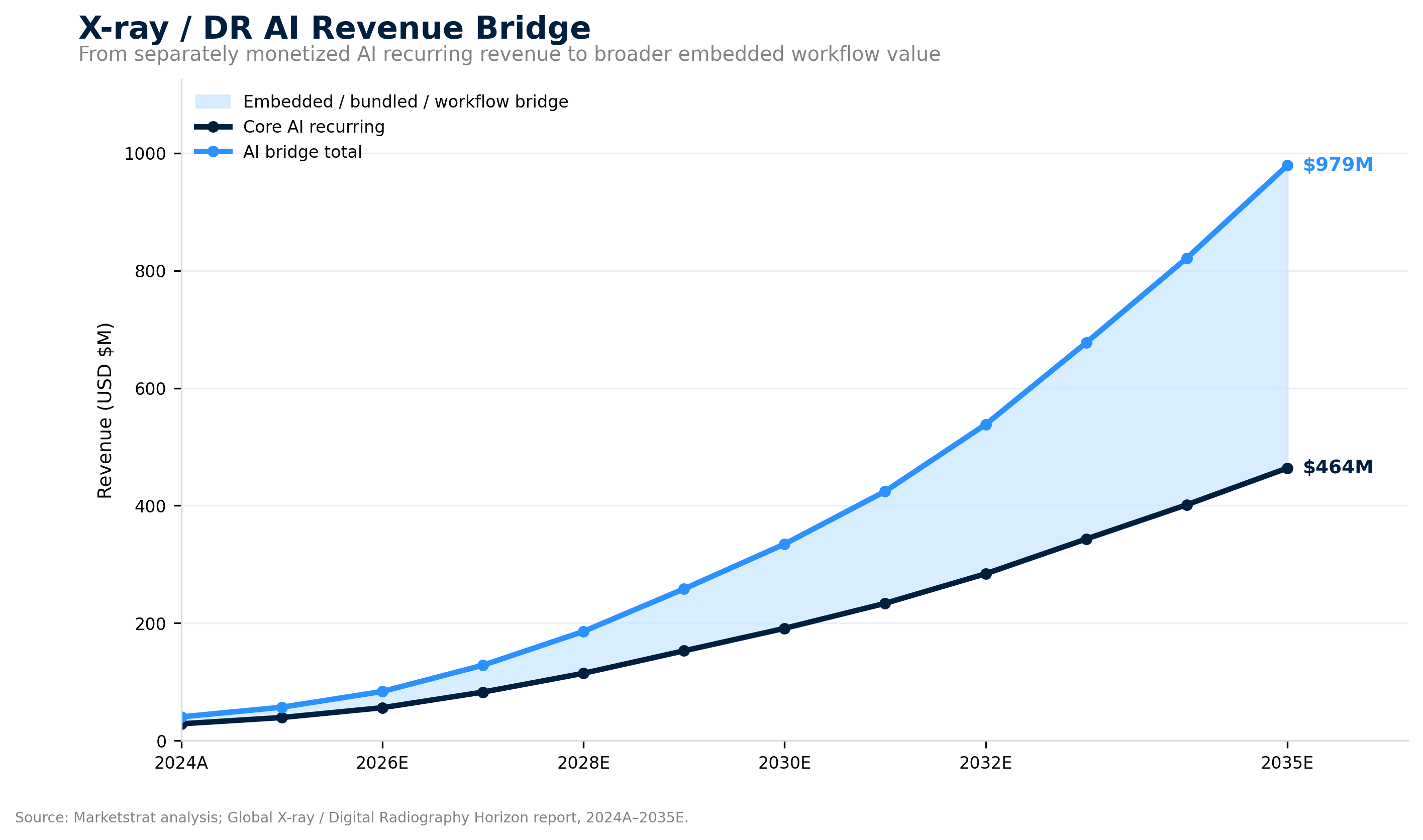
That gap between core systems revenue and extended ecosystem revenue is the central strategic insight: X-ray / DR is not only a system-shipment market. It is an installed-base, service, detector, retrofit, AI, workflow, and breast-imaging ecosystem.


Key Market Trends

  1. Hardware remains essential, but its share of monetization declines: Systems revenue remains the largest layer, but service / aftermarket and core AI recurring revenue grow faster than core system sales. The report models systems revenue at a 2.3% CAGR, service / aftermarket at 5.1%, and core AI recurring at 28.7% from 2024A to 2035E.
  2. Service and lifecycle economics become more important: X-ray / DR value is increasingly harvested after the initial system sale through maintenance, uptime, replacement parts, detector service, tube replacement, software support, and managed fleet models.
  3. China splits into premium and value channels: Premium / tier-1 hospitals remain more open to multinational systems and workflow propositions, while county / value procurement is more exposed to domestic suppliers, localization, and price compression.
  4. Detector economics outlast simple retrofit conversion: Detector-led upgrades can delay full-room replacement while still enabling digital workflow and image-quality improvement, especially in cost-constrained settings. In mature markets, detector replacement can be linked to uptime, productivity, wireless workflow, and installed-base monetization.
  5. AI monetization is use-case specific: The report avoids a generic AI attach assumption. Mammography AI, fracture / ED AI, chest AI, acquisition automation, reject analysis, dose optimization, reporting support, orchestration, and governance each have different commercialization paths.
  6. Competitive advantage moves toward control planes: The advantaged competitors are not simply those with the most hardware share. They are the companies that can combine hardware credibility, service reach, workflow software, detector strategy, procurement relevance, and AI / enterprise imaging control.


Competitive Landscape

Marketstrat structures the X-ray / DR ecosystem into competitive clusters because the market is increasingly shaped by ecosystem position rather than flat OEM ranking. The report analyzes:

  • systems OEMs / platform incumbents,
  • detector / subsystem suppliers,
  • mammography / DBT specialists,
  • AI detection / workflow vendors,
  • enterprise imaging / orchestration platforms,
  • service / aftermarket players,
  • and China domestic challengers.


The report evaluates each company across product footprint, regional strength, procurement position, installed base and service moat, detector / subsystem strategy, AI workflow role, enterprise imaging control, mammography / DBT exposure, China exposure, pricing posture, and recent strategic moves. This cluster-based approach helps clarify where value is captured: in hardware, service, detector economics, workflow software, AI, enterprise orchestration, procurement access, or installed-base control.


Companies Covered:

  • Systems / platform OEMs: GE HealthCare, Siemens Healthineers, Philips, Canon Medical, Fujifilm, Agfa, Carestream, Shimadzu, United Imaging, Wandong, Mindray, Neusoft.
  • Detector / subsystem suppliers: Varex, Trixell, Canon, iRay, Rayence, CareRay, Vieworks, Detection Technology.
  • Mammography / DBT and breast AI: Hologic, GE HealthCare, Siemens Healthineers, Fujifilm, RadNet / DeepHealth, Lunit, ScreenPoint Transpara, iCAD / ProFound AI.
  • AI / workflow: Qure.ai, Gleamer / RadNet, Annalise.ai, Aidoc, Lunit, AZmed, Milvue, DeepHealth, Agfa MUSICA, Siemens YSIO X.pree, GE Raymo, United Imaging AI workflow stack.

What’s Inside

Core model: 2024A–2035E

  • Unit shipments
  • Installed base
  • ASPs
  • Systems revenue
  • Service / aftermarket revenue
  • Core AI recurring revenue
  • Core total ecosystem revenue
  • Detector / retrofit overlay
  • Mammography / DBT ring-fenced ecosystem
  • Extended ecosystem revenue

Core system segmentation

  • Fixed DR — Premium
  • Fixed DR — Midrange
  • Fixed DR — Value
  • Mobile DR — Premium Motorized
  • Mobile DR — Value / Compact

Market-structure views

  • Care location
  • Clinical application / specialty
  • Purchase / monetization model
  • Operating model
  • Procurement model
  • AI capability mix

Geographic coverage

  • North America: United States, Canada
  • Europe: Germany, France, United Kingdom, Italy, Rest of Europe
  • APAC: China, Japan, India, Rest of APAC
  • LATAM
  • MEA

Strategic frameworks

The report applies Marketstrat’s Markintel® framework stack, including M³ Market Momentum Matrix, M-TEM, T-DIC, Solution Adoption & Growth Matrix, ARC-Index, Ecosystem Collaboration Matrix, and Upgrade & Package Ladder. These frameworks are used to translate model outputs into strategic interpretation: which segments deserve investment, where pricing risk is highest, where software can be monetized, which players control the customer relationship, and which technologies are commercially ready versus evidence- or reimbursement-gated

Why This Report

This Horizon report is Marketstrat’s in-depth global analysis of the X-ray / Digital Radiography market and broader X-ray / DR ecosystem. It is built for medical imaging OEM executives, strategy and corporate development teams, service and aftermarket leaders, detector and component suppliers, AI and workflow vendors, enterprise imaging platforms, investors, private equity, and provider-side imaging leaders.


The report is designed to answer a practical commercial question: how does value get captured in a mature modality when the core hardware market is replacement-led and price pressure is rising?


The answer is not a single number. The report separates the market into layers:

  • core fixed-room and mobile DR systems,
  • service and aftermarket revenue tied to the installed base,
  • recurring AI and workflow software revenue,
  • detector replacement and retrofit economics,
  • mammography / DBT as a ring-fenced adjacent ecosystem,
  • and competitive control planes across hardware, service, workflow, AI, enterprise imaging, and China value channels.


The goal is not just to size the market. It is to explain which segments are defensible, where procurement pressure is highest, where installed-base monetization accumulates, how AI becomes paid software rather than an embedded feature, and which vendors are best positioned to capture value above the initial system sale.
 

This report is designed for decision-makers with commercial, product, operational, or capital exposure to the X-ray / DR ecosystem, including:

  • X-ray / DR OEM strategy, product, commercial, and corporate development teams
  • Service, aftermarket, and managed fleet leaders
  • Detector, tube, and subsystem suppliers
  • AI detection, workflow, orchestration, and enterprise imaging vendors
  • Mammography / DBT and breast AI companies
  • Provider imaging operations, procurement, and radiology service-line leaders
  • Investors, banks, private equity, and strategic acquirers
  • China, emerging-market, and public-procurement strategy teams

Report Details

  • Title: Global X-ray / Digital Radiography Horizon: Market Structure, Forecasts, Installed-Base Economics, and AI Monetization Architecture, 2024A–2035E
  • Type: Markintel® Horizon Report
  • Publication: June 2026
  • Forecast Horizon: 2024A–2035E
  • Format: PDF digital delivery
  • Geographic Coverage: North America (US, Canada) | Europe (Germany, France, UK, Italy, ROE) | APAC (China, Japan, India, ROAPAC) | LATAM | MEA
  • Core Coverage: Fixed-room DR, mobile DR, service / aftermarket, AI recurring revenue, detector / retrofit overlay, mammography / DBT ring-fenced ecosystem
  • License Options: Individual ($4,950), Team ($5,450), Enterprise ($8,950)
By submitting this form, you agree to our Privacy Policy