
Stockholm’s expansion of AI-assisted mammography screening strengthens the case for further regional adoption across the Nordic markets. In PSMA PET, Marketstrat expects the initial uptake of PYLARIFY TruVu to come chiefly from converting existing PYLARIFY business. Those two developments establish different priorities for commercial teams: reproduce a validated clinical workflow and preserve a valuable customer franchise through a product transition.
The week ending October 2, 2026, also brought the first commercially available Butterfly Embedded partner product and completion of Jardine Matheson’s I-MED acquisition. Their significance will emerge through additional partner launches and the technology investments made across an established imaging network.
Stockholm strengthens the case for further regional AI adoption
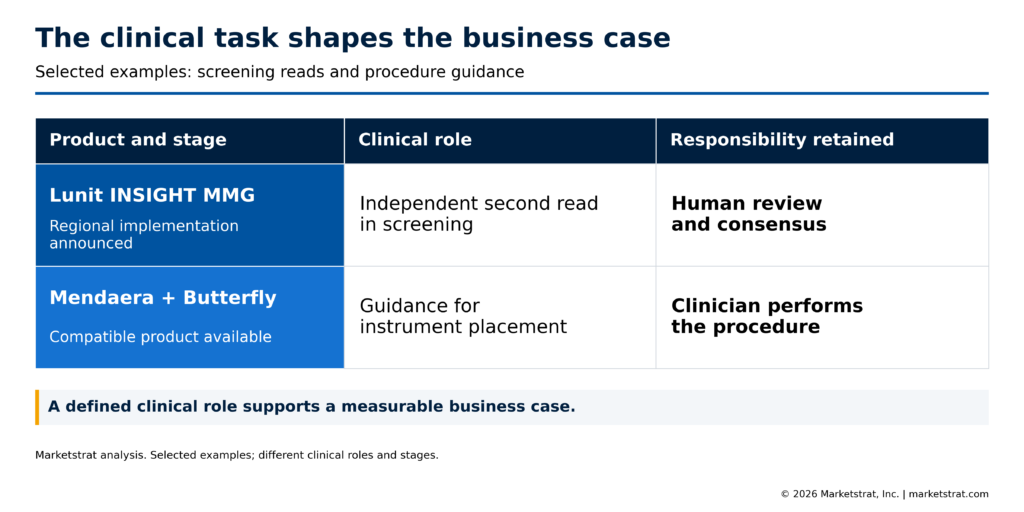
Lunit (328130: KOSDAQ) announced that INSIGHT MMG will serve as an independent second reader across Stockholm Region’s mammography screening program, working with Sectra. Regional implementation remains prospective.
The adoption sequence deserves attention. Region Stockholm helped fund ScreenTrustCAD, and the regional expansion follows three years of routine use at Capio S Göran. This connects clinical validation, operating experience and a public screening authority’s decision to extend the model across institutions.
Stockholm becomes a major reference case for AI in a formal reading position. Lunit identifies Dalarna as an earlier regional deployment, providing another part of the Swedish adoption history.
Marketstrat expects further Nordic regional commitments to AI reader replacement. The commercial opportunity should favor suppliers that can reproduce a validated workflow within established screening services. Enterprise-imaging partners matter because they help make that workflow deployable across institutions.
For buyers, the central operating question is how much reading capacity the arrangement releases while maintaining clinical quality. Initial reads transferred to AI, retained human review and consensus work belong in the same evaluation. A regional decision creates a stronger commercial reference when implementation produces repeatable results across participating institutions.
Butterfly’s next milestone is repeatable partner commercialization
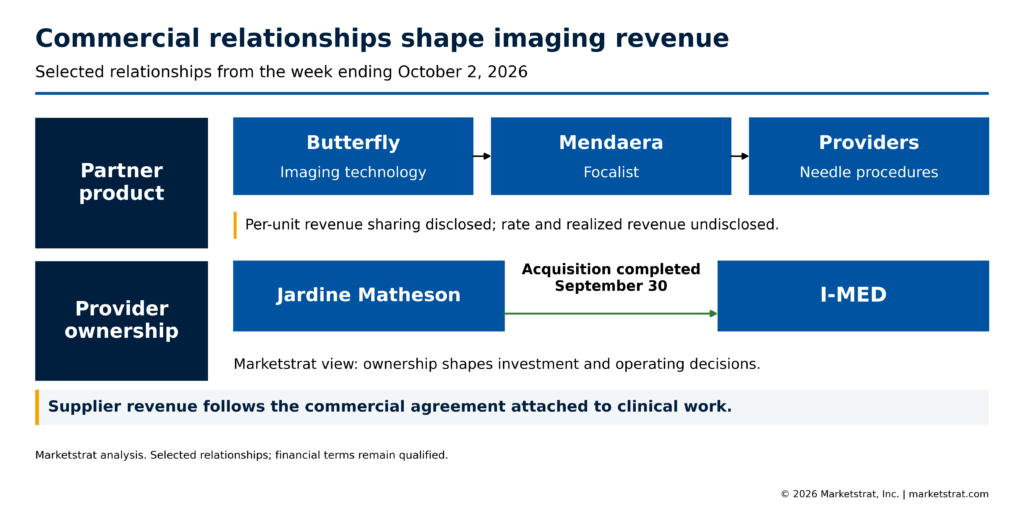
The Butterfly-compatible Mendaera Focalist system became commercially available on October 1, establishing the first Butterfly Embedded partner product to reach the market. Butterfly Network (BFLY: NYSE) supplies imaging technology within a system that combines ultrasound and robotic guidance for instrument placement during needle procedures.
The original 2023 agreement provided for revenue sharing on each unit sold. Current rates and realized partner revenue remain undisclosed. An installed system can support repeated procedures between purchasing decisions, linking continuing clinical value to retention, expansion and subsequent system demand.
Our base case is a gradual commercial revenue build from Focalist. The strategic value of this launch is the reference it creates for moving Butterfly’s technology through a partner’s development process into a finished product.
We expect further Embedded partner commercialization. Successive launches would strengthen the case for a repeatable business model, while shipments and repeat orders would establish its financial significance. For investors, these milestones provide a practical way to evaluate whether the partner pipeline is developing into sustained product demand.
TruVu’s early uptake should be dominated by conversion
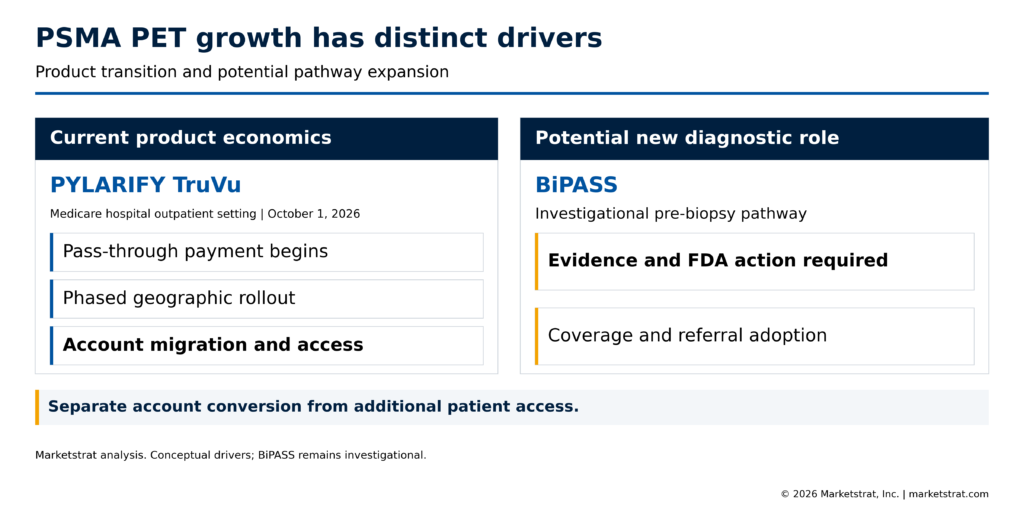
Lantheus (LNTH: Nasdaq) is rolling out PYLARIFY TruVu in geographic phases, with pass-through payment effective October 1 under Medicare’s hospital outpatient system. Gozellix had already entered pass-through payment in 2025. Original PYLARIFY continues to receive separate payment.
Marketstrat views TruVu primarily as a franchise lifecycle move. We expect migration of existing PYLARIFY business to generate most of TruVu’s uptake over the next 12 months. The formulation’s intended manufacturing and distribution improvements support the effort to retain customers and transition activity across the franchise.
TruVu’s share of franchise activity should rise rapidly. Combined dose volume and realized pricing will show the commercial gain. Providers will assess the delivered product, acquisition terms and actual reimbursement; sharing a payment category leaves room for different account economics.
For commercial planning, track converted accounts separately from additional patients, locations and competitive wins. This distinction will identify how much uptake protects existing sales and how much expands the business. Conversion execution becomes commercially significant through retained customers, dependable supply and the value of their continuing activity.
Telix Pharmaceuticals (TLX: ASX; TLX: Nasdaq) is pursuing another source of potential demand through BiPASS, its investigational pre-biopsy PSMA PET pathway alongside MRI. An earlier diagnostic role could expand the eligible population if clinical evidence, regulatory approval, coverage and referral adoption support it. That opportunity warrants its own growth assumptions and development timetable.
I-MED’s existing relationships will shape technology expansion
Jardine Matheson (JAR: London Stock Exchange) completed its I-MED acquisition on September 30. The network’s existing relationship with Harrison.ai is important to the next investment phase.
I-MED holds a minority interest in Harrison.ai. The two companies established annalise.ai as a joint venture in 2019, and I-MED announced Annalise CXR implementation in 2021. Shared development and clinical integration give the relationship an operating foundation under the new owner.
We expect expanded use of Harrison.ai within I-MED. Familiarity with the network’s workflows and an established deployment base give Harrison an advantage in renewal and expansion decisions.
Competing suppliers retain opportunities through additional clinical coverage, stronger operating value or integration with established platforms. Harrison’s open platform already includes external AI suppliers. For vendors pursuing I-MED, the business case should specify the service improvement and the implementation requirements across the intended sites.
Marketstrat POV: build the growth case around the next commercial decision
Stockholm raises the importance of reproducing validated screening workflows across regional services. Suppliers should bring evidence of the professional capacity released, the clinical responsibilities retained and the effort required to deploy successfully. That combination will shape the next regional purchasing decisions.
For Lantheus, protecting customer activity through conversion is the immediate commercial task. Growth assessment should follow combined franchise performance as TruVu’s mix increases. For Butterfly, another partner product reaching market would advance the commercialization case; repeat purchasing will determine its scale.
I-MED’s next technology commitments will show how an established AI relationship develops under new ownership. Vendors should evaluate each application’s contribution to the network and the strength of the incumbent position.
Regional adoption will deliver a stronger business case when clinical quality holds and total reading effort falls. For TruVu, customer losses, supply interruptions or pricing concessions would weaken the value of conversion. These operating outcomes should carry weight alongside product mix and deployment announcements.
Explore Marketstrat Pulse Insights and related imaging research at Marketstrat.com. Subscribe to the newsletter, or contact Marketstrat for research access and custom analysis.
Sources: Company and provider disclosures; regulatory and payment records; peer-reviewed clinical research; Marketstrat analysis.
Research process: Marketstrat uses a human-led, AI-enabled workflow. AI systems materially support synthesis, modeling, drafting, coding, and quality control. Marketstrat sets the methodology, evaluates the evidence, determines the conclusions, and approves all published content.
Related Marketstrat Research
Explore the wider market and company context.
Lunit Company Research
Examine Lunit’s cancer AI strategy across screening and treatment, including U.S. expansion. Provides company context for assessing the significance of regional adoption.
Request Lunit research: email us at research@marketstrat.com
World Market for Oncology Imaging AI
Explore market forecasts, clinical adoption and competition across the cancer imaging pathway. Assess how evidence, reimbursement and commercial models shape opportunities for AI suppliers.
Global Nuclear Medicine & PET Market Horizon
Assess radiopharmaceutical competition, manufacturing readiness, reimbursement and provider capacity. Provides the wider molecular-imaging context for evaluating Lantheus, PSMA PET and franchise growth.
Global Ultrasound Horizon
Examine systems, handheld adoption, AI revenue models and enabling technologies. Assess Butterfly’s strategy within the broader ultrasound market and its evolving commercial relationships.
For research access and licensing, contact research@marketstrat.com.
About Marketstrat
Marketstrat® is an independent market intelligence firm focused on MedTech, medical imaging, imaging AI, enterprise imaging, PACS, and adjacent healthcare technology markets. Through its Markintel® research methodology and publishing system, Marketstrat produces Horizon Reports, Focus Reports, Company Research, Market Signals, and weekly Pulse Insights. The firm’s research combines market sizing, forecasting, segmentation, competitive mapping, company intelligence, and event-driven analysis to help corporate strategy, product, commercial, investment, consulting, and industry media professionals interpret fast-moving healthcare markets with greater clarity.
Marketstrat® and Markintel® are registered service marks of Marketstrat, Inc.
Our Research
- Horizon Reports — Comprehensive market landscape assessments with sizing, segmentation, forecasting, and competitive mapping across multi-year time horizons.
- Focus Reports — Targeted market intelligence reports on specific segments, technologies, or competitive dynamics drawn from Marketstrat’s broader Horizon research program.
- Company Research — Decision-grade company intelligence covering strategy, competitive positioning, product portfolio, business model, financial structure, partnerships, and stakeholder impact.
- Market Signals — Event-driven analysis tied to specific catalysts, including regulatory actions, M&A, product launches, policy shifts, reimbursement changes, and earnings. Each signal is structured around strategic implications, not just news.
- Pulse Insights — Weekly market intelligence digest covering what moved, what it means, and what to watch across healthcare, MedTech, medical imaging, imaging AI, and adjacent life sciences markets.
