
The value of imaging’s latest acquisitions depends partly on customers that remain outside the combined businesses. Marketstrat expects retained customer activity, wider distribution and reliable delivery to support the earliest commercial gains. Integration must preserve the relationships that make the acquired networks useful.
An acquired network earns its value through the customers and partners that continue to use it.
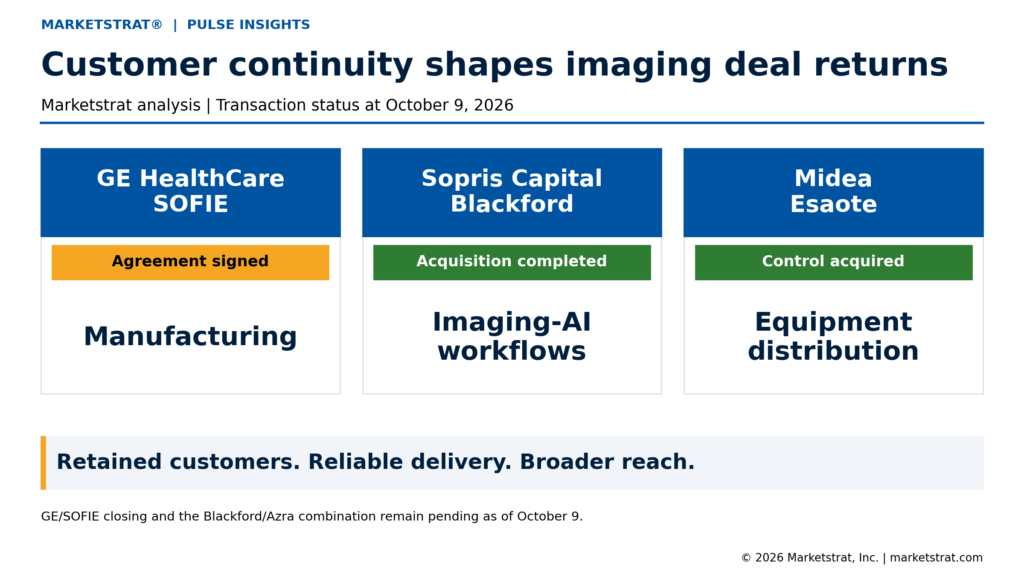
Announcements during October 3–9, 2026, put that expectation into focus. GE HealthCare agreed to acquire SOFIE Biosciences. Midea completed its acquisition of a controlling stake in Esaote. Sopris completed its acquisition of Blackford Analysis. Alongside those transactions, Jubilant committed capital to radiopharmaceutical manufacturing, and Telix reported the first commercial doses of Pixclara.
The economic consequences differ. Ownership can make investment and commercial priorities easier to coordinate. Its value also depends on the response of customers, distributors and technology partners whose participation supports the business.
GE HealthCare: Preserve the value of external manufacturing relationships
GE’s proposed $945 million SOFIE acquisition would add direct control over an established U.S. radiopharmaceutical manufacturing network. Closing is expected in the first half of 2027, subject to the stated conditions and approvals.
SOFIE already manufactures Flyrcado, and GE intends to continue supplying third-party customers while retaining other manufacturing partners. That makes external-customer confidence an important integration variable.
A tracer developer buying manufacturing services needs reliable production, acceptable allocation and protection of commercially sensitive information. GE’s broader product portfolio adds a reason to make those operating arrangements explicit.
Marketstrat expects established manufacturing to support the acquired business’s early revenue. The next useful evidence will be customer continuity and product-specific supply performance. Coordinated capital investment can strengthen delivery, provided the resulting capability serves demand at a workable operating cost.
Blackford: Align imaging findings with the work that follows
Sopris’s acquisition of Blackford creates an opportunity to coordinate imaging AI with Azra’s patient-navigation workflow. Their further corporate combination remained pending as of October 9.
The two companies announced their partnership in August. October’s ownership change gives them an additional mechanism for aligning implementation, development priorities and commercial execution.
The purchasing proposition can extend across radiology and care management when an imaging finding connects reliably with review and appropriate follow-up. That requires clear responsibility for the handoff and manageable effort when exceptions occur.
Existing OEM relationships and independent applications also remain relevant. Their continuing access helps determine the breadth of the platform’s offering. Marketstrat expects routine clinical deployments and the support burden they create to be important tests of the combined commercial proposition.
A wider workflow can support a larger customer relationship. Maintaining numerous customized implementations can also consume the value generated by that reach.
Midea and Esaote: Make the broader portfolio useful within an account
Midea’s completed acquisition adds Esaote’s ultrasound, dedicated MRI and medical IT capabilities to a wider equipment portfolio. Esaote will retain its Genoa headquarters and research and manufacturing operations in Italy and the Netherlands.
Marketstrat expects distribution and service coverage to provide the clearest early route to competitive gains. Existing accounts can create opportunities for additional products where the combined portfolio meets their procurement and clinical requirements.
The specialist capabilities matter to that strategy. Preserving product expertise, service quality and distributor confidence should support the commercial value of broader ownership.
For competing suppliers, the relevant exposure is account-specific: where does the combination gain access, become eligible for a broader tender or improve its service proposition? The announcement alone supplies insufficient evidence for a sector-wide price-compression forecast.
PET investment needs a path into recurring examinations
Jubilant’s Kirkland expansion targets additional RUBY-FILL production capacity. Telix’s first commercial Pixclara doses mark the beginning of a product’s commercial supply. Those developments create distinct starting points for assessing future activity.
The generator-capacity project still needs commissioning and sustained customer demand. Its announcement did not disclose a commissioning date. Planned output must become qualified supply that providers can use.
Pixclara addresses a defined glioma-assessment role. Marketstrat expects specialist referral networks to support its early use. Repeat ordering depends on eligible patients moving through referral, payment and examination scheduling. Initial commercial doses provide limited information about recurring volume, which remained undisclosed.
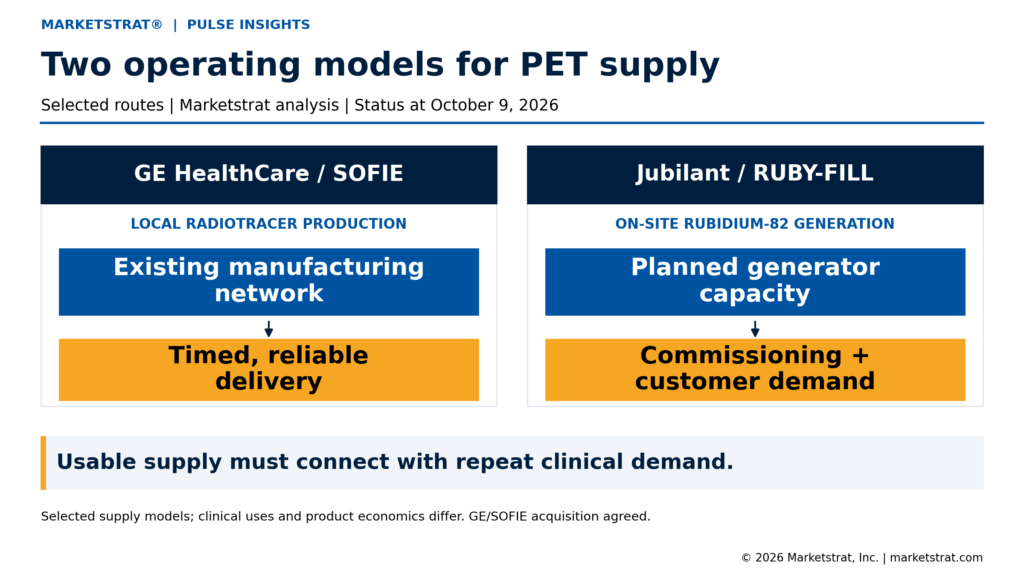
For commercial planning, separate usable supply from announced capacity and repeat customer activity from launch milestones. Each contributes different evidence about the likely timing and durability of revenue.
Revenue progress still needs an operating explanation
Hyperfine provides a separate example of the same discipline. Preliminary third-quarter revenue of approximately $6 million establishes a sales reference point. Its full-year outlook implies a further quarterly increase in revenue alongside continuing cash consumption.
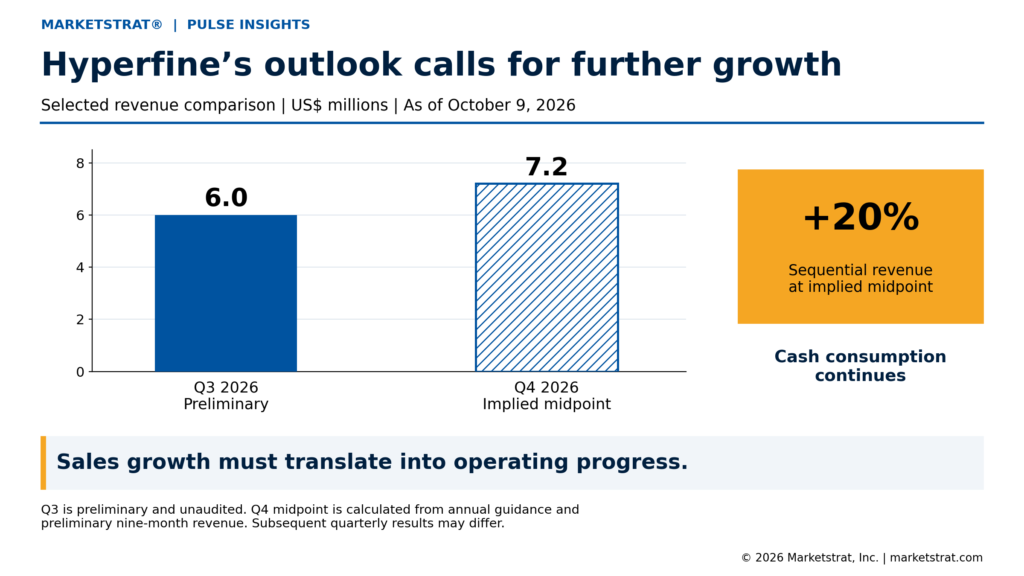
The commercial assessment should follow order quality, implementation obligations and subsequent cash use. Higher sales can strengthen the business while continuing to require funding. Preliminary figures and guidance-derived implications retain their stated qualifications.
For acquired businesses, the corresponding assessment separates retained-customer contribution, new account wins, integration expenditure and any lost channel business. This makes the sources of value visible as the integration proceeds.
What decision-makers should take from the week
Providers should examine service commitments, backup arrangements and responsibility for failures after a change of ownership. AI buyers should also understand how interfaces, technical support and customer data access will be maintained.
Strategy and commercial teams should identify which existing relationships can support additional business and where channel overlap requires careful coordination. The larger portfolio needs a workable account plan and sufficient support capability.
Investors and acquirers should follow the contribution generated by retained and newly won customers. Customer losses, persistent customization or deteriorating service would weaken the expected benefits. These are conditions to monitor; the announcements reviewed do not establish that such deterioration has occurred.
Marketstrat POV
The earliest gains should come from serving established customers more effectively and extending the business through credible distribution relationships. A larger network creates more opportunities for coordinated investment. Its commercial value will depend on recurring purchases, dependable execution and the contribution left after supporting the customer.
Explore related research themes
Nuclear medicine and PET: Radiopharmaceutical production, tracer commercialization and provider economics.
Ultrasound markets: Equipment portfolios, distribution, service coverage and portable-imaging adoption.
Enterprise imaging and AI: Platform access, workflow implementation and the economics of ongoing support.
Medical imaging M&A: Customer retention, channel integration and the realization of commercial value.
Explore Marketstrat Pulse and related Horizon research at Marketstrat.com. Subscribe to the newsletter for weekly analysis, or contact Marketstrat for research access and custom market assessments.
Sources: Company disclosures; government investment announcements; Marketstrat analysis. Event and transaction status as of October 9, 2026.
Research process: Marketstrat uses a human-led, AI-enabled workflow. AI systems materially support synthesis, modeling, drafting, coding, and quality control. Marketstrat sets the methodology, evaluates the evidence, determines the conclusions, and approves all published content.
About Marketstrat
Marketstrat® is an independent market intelligence firm focused on MedTech, medical imaging, imaging AI, enterprise imaging, PACS, and adjacent healthcare technology markets. Through its Markintel® research methodology and publishing system, Marketstrat produces Horizon Reports, Focus Reports, Company Research, Market Signals, and weekly Pulse Insights. The firm’s research combines market sizing, forecasting, segmentation, competitive mapping, company intelligence, and event-driven analysis to help corporate strategy, product, commercial, investment, consulting, and industry media professionals interpret fast-moving healthcare markets with greater clarity.
Marketstrat® and Markintel® are registered service marks of Marketstrat, Inc.
Our Research
- Horizon Reports — Comprehensive market landscape assessments with sizing, segmentation, forecasting, and competitive mapping across multi-year time horizons.
- Focus Reports — Targeted market intelligence reports on specific segments, technologies, or competitive dynamics drawn from Marketstrat’s broader Horizon research program.
- Company Research — Decision-grade company intelligence covering strategy, competitive positioning, product portfolio, business model, financial structure, partnerships, and stakeholder impact.
- Market Signals — Event-driven analysis tied to specific catalysts, including regulatory actions, M&A, product launches, policy shifts, reimbursement changes, and earnings. Each signal is structured around strategic implications, not just news.
- Pulse Insights — Weekly market intelligence digest covering what moved, what it means, and what to watch across healthcare, MedTech, medical imaging, imaging AI, and adjacent life sciences markets.
