
Azra AI’s completed Blackford acquisition combines imaging AI orchestration and patient navigation within the Azra group. That expands what the group can offer hospitals. Marketstrat expects the commercial return to depend on the cost and reliability of moving appropriate patients into completed care.
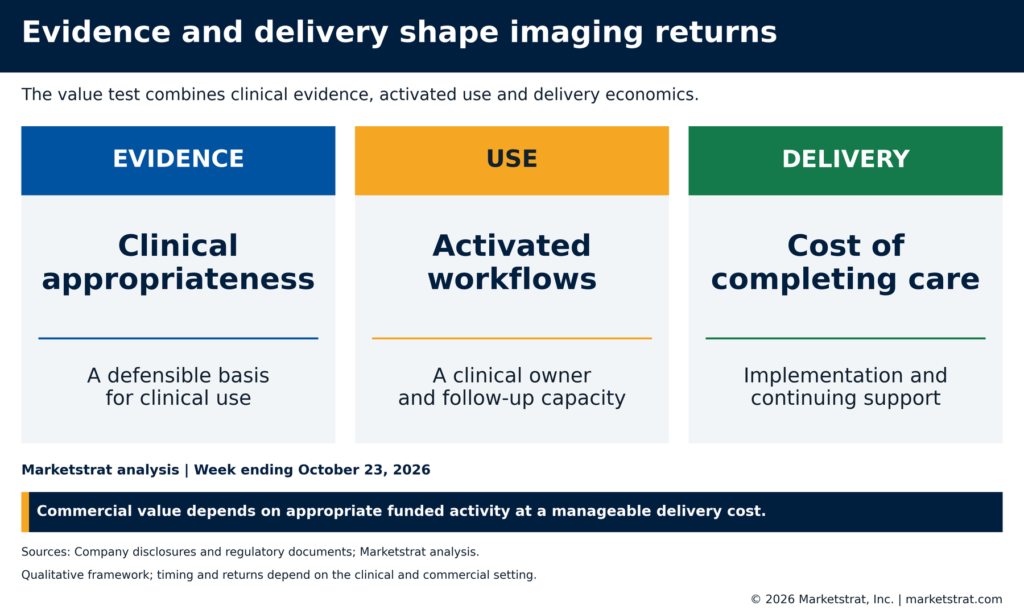
The developments reviewed for the week ending October 23, 2026 point to a shared commercial test. Suppliers are extending the functions they can provide, while hospitals and development programs must supply the people, evidence and operating capacity needed to use them. Broader capability creates an opportunity to earn more revenue and an obligation to deliver more work. The balance determines whether expansion improves the business.
Ownership changes the scope of responsibility
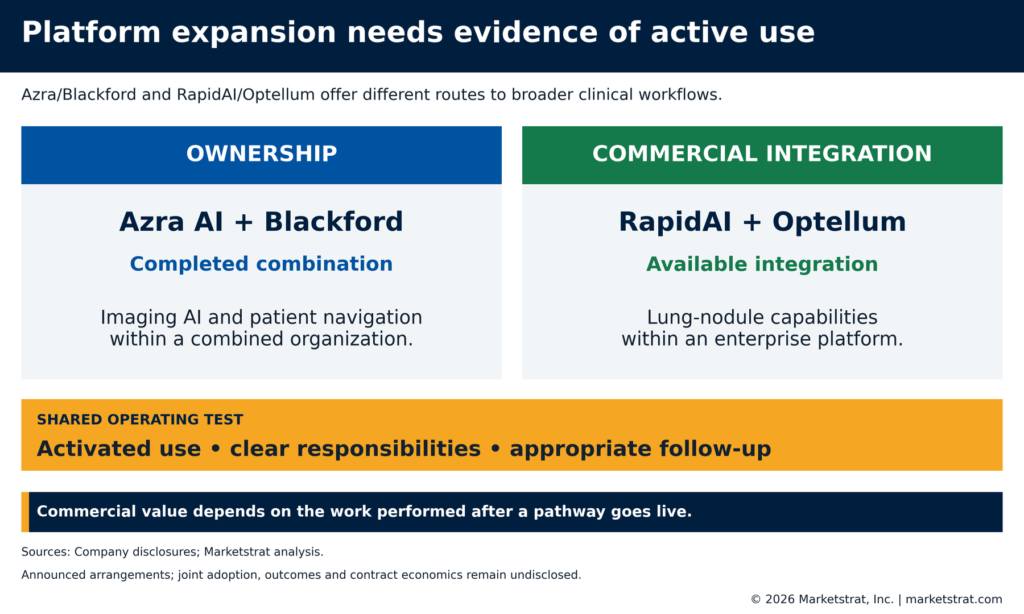
Azra announced completion of the Blackford acquisition on October 20 within the Sopris ownership structure. The combination gives management greater control over how imaging AI orchestration and patient navigation are sold, implemented and supported. A hospital could gain a clearer commercial relationship for connecting an imaging finding with the team responsible for subsequent care.
The disclosure leaves the joint operating result unproven. Measured improvements in combined deployment, follow-up or cross-selling were not established. Marketstrat expects existing customer relationships to provide an initial expansion route, provided the receiving clinical service can act on the findings. The relevant commercial question is whether a broader contract produces enough additional value to cover implementation and continuing support.
RapidAI and Optellum illustrate a partnership route to similar operational questions. Their announced integration brings lung-nodule management into Rapid Enterprise. That creates another way to introduce a clinical workflow through an established platform relationship. The commercial test is whether the integration leads to activated lung programs and appropriate follow-up. Availability within a platform leaves hospitals to define clinical responsibility and organize the service around it.
Evidence obligations enter the purchasing decision
NICE’s prostate MRI AI consultation makes the cost of evidence unusually explicit. The proposal would permit eligible use of five tools in England with core NHS funding during a two-year evidence-generation period. Companies would organize funding for evidence activities. The guidance remains draft, with local purchases uncommitted.
Marketstrat’s interpretation is that evidence capability becomes part of the commercial offering. Suppliers need to support clinical deployment and the information needed for a subsequent assessment. Those tasks consume resources alongside software delivery. An early license can therefore create obligations that continue well beyond installation.
For providers, the proposal makes an agreed evidence plan relevant to the initial purchasing discussion. For vendors, it puts attention on the cost of supporting a usable deployment and the likelihood of sustaining the customer relationship. The opportunity remains conditional on final guidance, implementation and local purchasing decisions. The draft does not establish a commercial ranking among the eligible products.
Telix provides a current revenue reference
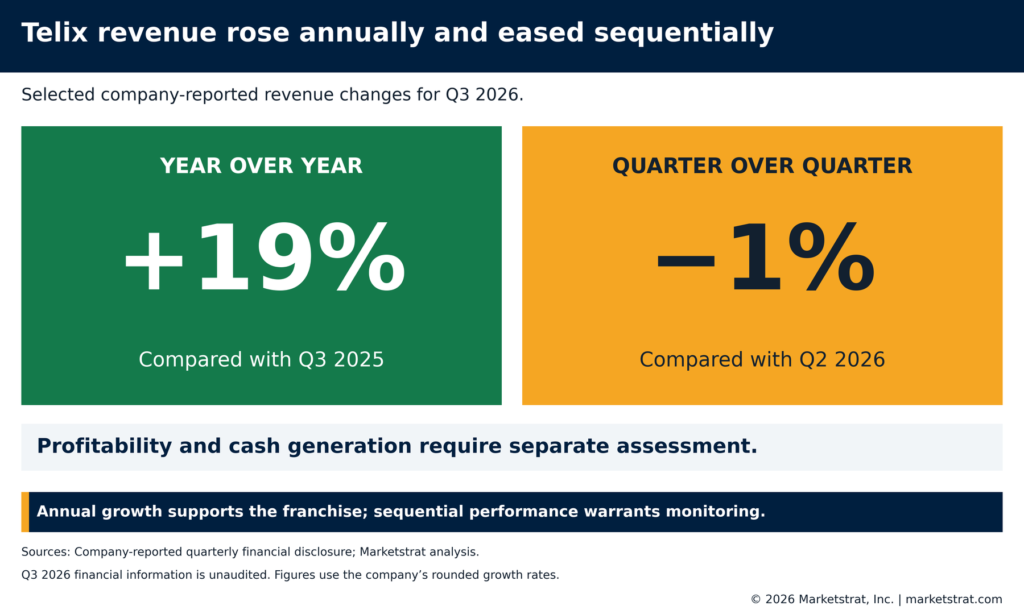
Telix Pharmaceuticals (TLX: ASX; TLX: Nasdaq) reported Q3 revenue growth of 19% year over year and a 1% sequential decline. The two comparisons describe different aspects of the same quarter. Annual growth supports the scale of the established diagnostic business. The sequential comparison calls for care when extending that growth rate into future periods.
Marketstrat expects the diagnostic franchise to remain the main near-term commercial foundation. New supply initiatives still require qualification, delivery and clinical use before their economic contribution can be assessed. Current revenue provides a reference for that expansion, while the capital requirements and eventual returns need separate evaluation.
The reported figures are unaudited and do not establish profitability or cash available for future investment. A broadly stable revenue quarter also leaves underlying demand, realized pricing and operating costs to be examined through further disclosures. This qualification matters when a supplier combines an established commercial business with development programs that operate on different timetables.
What the market may be underestimating
The common issue across these developments is the expense of taking responsibility for more of the clinical or operating process. A platform that adds navigation, evidence collection or supply coordination gains additional ways to serve a customer. Each function can also require people, interfaces, support and management attention.
Marketstrat’s view is that the cost of completing appropriate care will influence the value of broader imaging offerings. A finding creates a useful result when it supports a clinically justified action or a documented decision that further intervention is unnecessary. Counting every additional alert as incremental commercial opportunity would miss that distinction.
The same reasoning applies to capacity. Additional identified patients can increase demand on appointments and staff. A supplier’s technology can improve the information available while the receiving service remains unable to act promptly. Implementation quality therefore depends on how the expanded product fits the provider’s actual operating resources.
Why it matters for executive decisions
For providers, the practical implication is to establish who will act on a finding and whether that service has capacity before expanding enrollment. This connects the purchase to the work required after the software produces a result. It also makes the intended clinical benefit easier to evaluate.
For commercial and product leaders, account expansion should include an explicit view of implementation and continuing evidence costs. A larger contract can improve revenue while increasing service demands. The useful commercial evidence is sustained use that the customer can support and the supplier can deliver economically.
For investors and corporate strategy teams, current commercial performance and future operating milestones need distinct assessments. Customer access, completed deployment and recurring paid use describe different stages of progress. The same distinction applies to a supply agreement, qualified output and its eventual contribution to a clinical program.
The boundary condition
Broader responsibility can reduce duplicated work and improve coordination. Its value remains conditional on what happens after deployment. If added functions consistently increase support costs without improving appropriate follow-through or customer retention, the expansion thesis weakens. That uncertainty is particularly relevant where the announcements provide limited evidence of joint operating results.
Marketstrat POV
We expect suppliers that can document appropriate clinical follow-through and control its delivery cost to gain a stronger position in purchasing decisions. The next useful evidence will show how customers use the added capability, what resources it consumes and whether the relationship continues. That is where the commercial implications of this week’s announcements become observable.
Explore Marketstrat Pulse for the complete analysis, subscribe to the Marketstrat LinkedIn newsletter, and visit Marketstrat.com for related research and research-access inquiries.
Research process: Marketstrat uses a human-led, AI-enabled workflow. AI systems materially support evidence synthesis, modeling, drafting, coding, and quality control. Marketstrat defines the methodology, evaluates the evidence, determines the conclusions, and approves all published content.
Related Marketstrat Research
Explore Marketstrat’s market models, competitive assessments, and company research relevant to this week’s developments.
Global Enterprise Imaging IT & PACS Horizon
Horizon Report | October 2026
Examines enterprise imaging infrastructure, PACS market structure, competitive dynamics, implementation costs, and recurring software revenue through 2036. Provides the broader commercial framework for assessing Azra/Blackford’s integration strategy and Optellum’s distribution through RapidAI.
Heartflow: Reimbursement Proved the Model; Plaque Must Prove the Platform
Company Insight | September 2026
Analyzes Heartflow’s coronary CT AI strategy, product architecture, clinical evidence, reimbursement, commercialization, competitive positioning, and operating outlook. Provides company-level context for evaluating Elucid’s FFR-IQ launch and intensifying competition in coronary physiology and plaque analysis.
Global Nuclear Medicine & PET Market Horizon
Horizon Report | August 2026
Examines nuclear medicine, PET/CT, SPECT/CT, radiopharmaceuticals, and theranostics through 2036. Provides market and competitive context for Telix’s commercial performance, isotope-production partnerships, and the strategic implications of Curium’s proposed acquisition of Lantheus.
Global AI in Medical Imaging Horizon
Horizon Report | June 2026
Provides market forecasts, competitive architecture, and reimbursement-driven monetization analysis across major imaging modalities through 2035. Establishes the broader market framework for evaluating NICE’s proposed evidence-linked prostate MRI AI access and the economics of converting clinical authorization into sustained adoption.
Median Technologies: FDA-Cleared Lung Screening AI, Scaled via Tempus Pixel Distribution
Market Signal | February 2026
Examines the commercialization of lung screening AI through an established technology distribution channel. Offers a complementary perspective on Optellum/RapidAI’s integration strategy, particularly the role of platform access, implementation, and clinical workflow adoption in generating recurring revenue.
For research details and licensing, contact research@marketstrat.com.
About Marketstrat
Marketstrat® is an independent market intelligence firm focused on MedTech, medical imaging, imaging AI, enterprise imaging, PACS, and adjacent healthcare technology markets. Through its Markintel® research methodology and publishing system, Marketstrat produces Horizon Reports, Focus Reports, Company Research, Market Signals, and weekly Pulse Insights. The firm’s research combines market sizing, forecasting, segmentation, competitive mapping, company intelligence, and event-driven analysis to help corporate strategy, product, commercial, investment, consulting, and industry media professionals interpret fast-moving healthcare markets with greater clarity.
Marketstrat® and Markintel® are registered service marks of Marketstrat, Inc.
Our Research
- Horizon Reports — Comprehensive market landscape assessments with sizing, segmentation, forecasting, and competitive mapping across multi-year time horizons.
- Focus Reports — Targeted market intelligence reports on specific segments, technologies, or competitive dynamics drawn from Marketstrat’s broader Horizon research program.
- Company Research — Decision-grade company intelligence covering strategy, competitive positioning, product portfolio, business model, financial structure, partnerships, and stakeholder impact.
- Market Signals — Event-driven analysis tied to specific catalysts, including regulatory actions, M&A, product launches, policy shifts, reimbursement changes, and earnings. Each signal is structured around strategic implications, not just news.
- Pulse Insights — Weekly market intelligence digest covering what moved, what it means, and what to watch across healthcare, MedTech, medical imaging, imaging AI, and adjacent life sciences markets.
