
A growing imaging business can count examinations, analyses, activated contracts or completed reports. Each measure describes a different route to revenue. This edition examines how those distinctions affect commercial strategy and the assessment of reported growth.
Marketstrat’s assessment of developments disclosed October 31–November 13, 2026 points to expansion opportunities within established clinical workflows. Cardiac CT analysis suppliers can increase clinically appropriate product use within existing accounts. Enterprise platforms can extend their role into reporting and related services.
The economic value depends on the payment route, the activity actually delivered and the expense required to sustain it. A larger footprint creates opportunity; commercial performance emerges as providers activate the service and suppliers earn from its use.
Payment policy defines the service being purchased
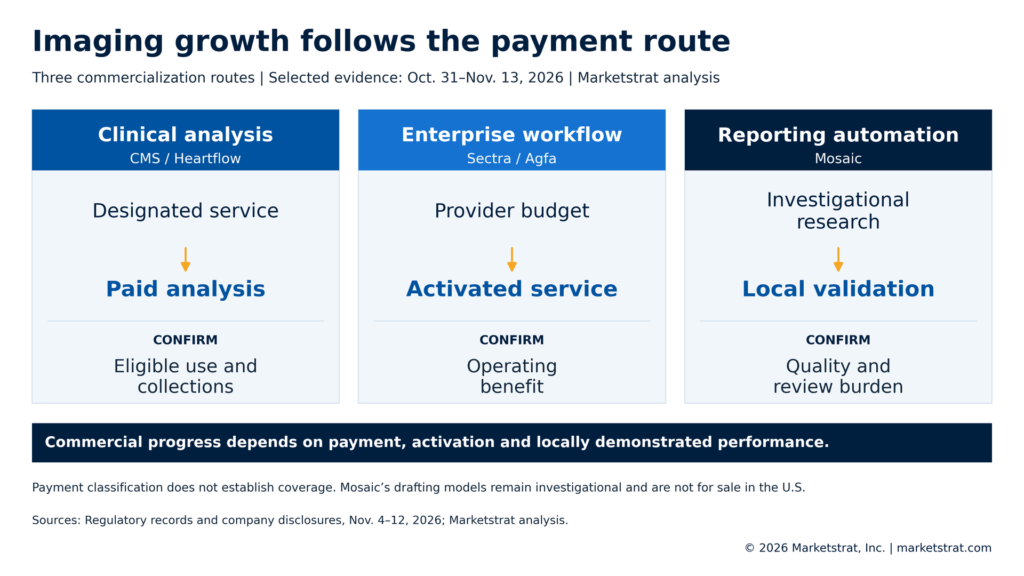
CMS’s final 2027 outpatient rule gives designated clinical analyses specific treatment under its Software as a Medical Service framework. FFRCT is among the affected services. Payment remains code-specific, and some services remain bundled into other payments.
This matters for product strategy because a defined clinical analysis can be associated with an order, a claim and an observable payment outcome. The supplier and provider can assess the route from eligible examination to collected revenue.
Reporting infrastructure and enterprise workflow have a different purchasing proposition. Their case rests on the provider’s operating needs, implementation effort and the value of the service delivered. Suppliers should establish the intended budget and the evidence required for that purchasing decision.
The policy also has a clear limit: classification alone does not establish coverage or medical necessity. These remain conditions of the commercial model. The 2027 rules provide a forward operating context and cannot explain the third-quarter results discussed here.
Heartflow illustrates growth within an existing examination
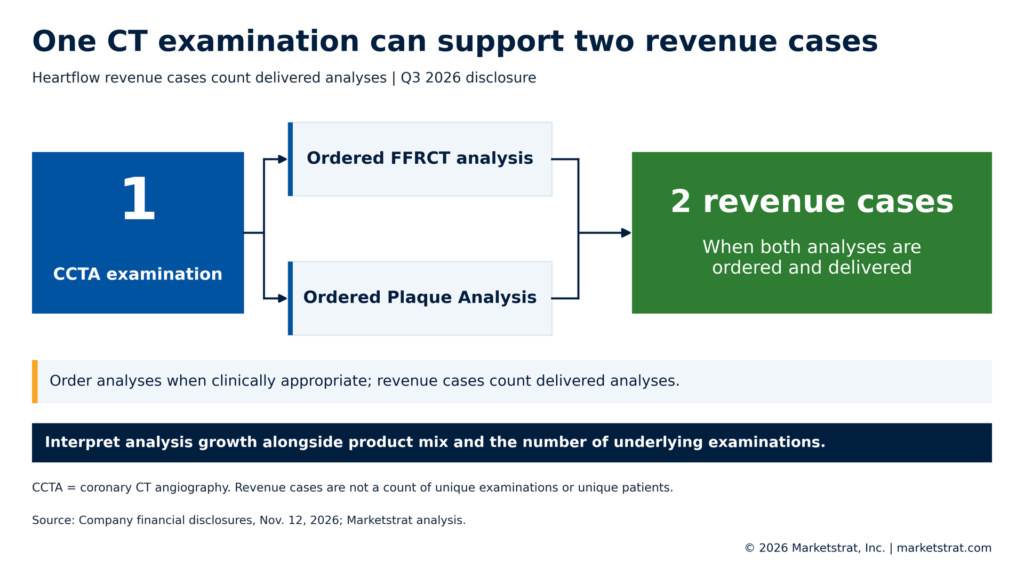
Heartflow (HTFL: Nasdaq) defines revenue cases at the analysis level. When FFRCT and Plaque Analysis are both ordered and delivered from one coronary CT angiography examination, the company records two revenue cases.
The definition has consequences for market assessment. Growth can reflect more underlying examinations, more analyses attached to each eligible examination, or a combination. Those mechanisms place different demands on clinical capacity, ordering behavior and payer acceptance.
For a supplier, adding a useful analysis within an established account can broaden the customer relationship. For an investor, the same mechanism makes the denominator important: an analysis count cannot by itself establish the number of unique patients reached.
Heartflow’s improving gross margin provides evidence of stronger blended gross economics. It leaves additional questions about product mix, realized revenue and the cost of serving different customers. Company-wide expenses and cash requirements also sit beyond the gross-margin measure.
The commercial assessment should connect the clinical reason for the additional analysis with its revenue and delivery burden. The current disclosure does not fully separate the contributions of additional examinations and product attachment.
Reporting places the platform inside a daily clinical task
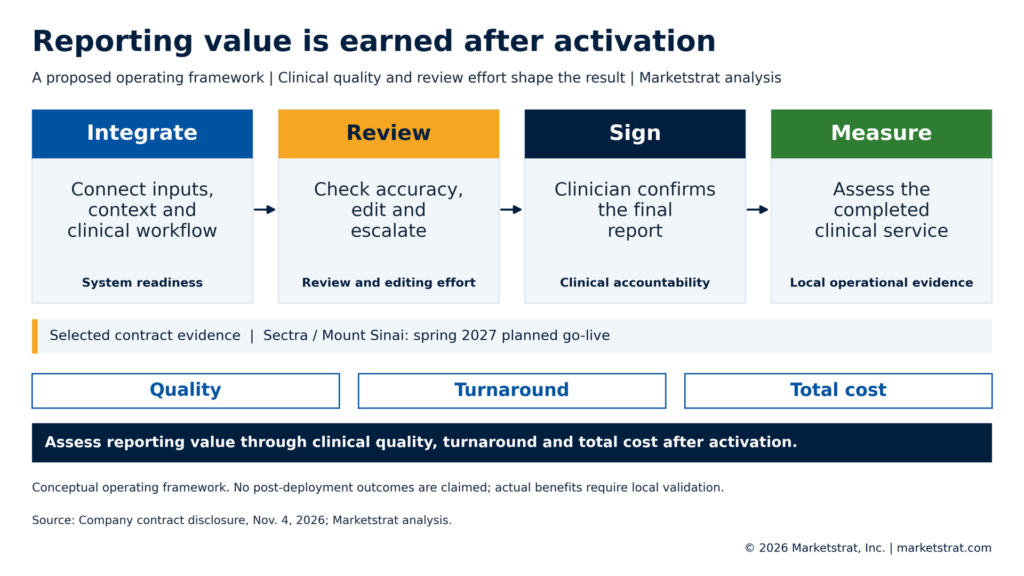
Sectra (SECT B: Nasdaq Stockholm) is extending its existing Mount Sinai enterprise-imaging relationship into reporting. The planned spring 2027 activation will begin the test of the new workflow’s operating value.
Report creation connects images, prior examinations, clinical context and the signed clinical output. Integrating those activities can increase the platform supplier’s influence over application selection and implementation. It also makes delivery quality more consequential for the customer.
The agreement demonstrates a purchasing commitment. Measured benefits from the new module remain prospective. Providers need an acceptance process that examines how the workflow performs after training and activation, including the work required to resolve exceptions.
Reporting automation introduces another evidence requirement. Mosaic’s newly disclosed drafting research remains investigational, and the models are not for sale in the United States. Its company-reported findings support evaluation, while a purchasing case still needs evidence about clinician review effort and the quality of completed reports.
Even a repeatable reading-efficiency gain must be connected to an operating benefit. Released time might shorten reporting queues, reduce overtime or support additional examinations. The relevant outcome depends on the provider’s existing constraints and how the time is used.
Cloud contracts create a continuing delivery obligation
Agfa-Gevaert (AGFB: Euronext Brussels) reported stronger HealthCare IT cloud orders and quarterly results, with recurring revenue representing a substantial share of the business. Its year-to-date results and full-year profitability outlook showed an unfinished financial transition.
The shift changes what management must execute. A signed cloud contract requires migration and implementation before it becomes a routine operating service. Hosting, support and renewal then shape the continuing cost base.
The order book is therefore one stage in the commercial process. Suppliers also need to activate contracts at a manageable cost and sustain the service over time. The reviewed disclosure does not isolate cloud-cohort margins or implementation payback.
This makes activation timing and ongoing service economics relevant to both sides of the contract. Buyers are committing to a recurring service. Suppliers need enough contribution to fulfill that commitment and support future development.
Decisions for providers, product leaders and investors
For providers, the immediate task is to define the operating benefit that justifies the purchase. A clinical analysis requires appropriate use and a workable payment route. A reporting platform requires measurable service performance and a clear account of implementation effort.
Product leaders should align the offering with the budget that funds it. The evidence supporting a paid analysis differs from the evidence supporting an enterprise operating expense. Commercial packaging, account ownership and implementation support should reflect that distinction.
Investors should ask how reported activity becomes external revenue and contribution. Additional examinations, additional analyses and newly activated contracts describe different growth mechanisms. Consistent definitions make the quality of expansion easier to assess.
Marketstrat POV
We expect expansion within active imaging accounts to remain commercially important over the next 12–24 months. Appropriate additional analyses and integrated reporting have identifiable routes to the customer and the purchasing budget.
The outlook would weaken if payment collection deteriorated, implementation remained costly or reporting benefits failed to reproduce in operating use. Supplier growth needs a continuing economic foundation in the work delivered and the revenue retained.
Related Marketstrat Research
Explore the market models and company analysis relevant to this edition’s developments.
Heartflow: Reimbursement Proved the Model; Plaque Must Prove the Platform
September 2026
Examines Heartflow’s reimbursement, installed-base productivity, Plaque Analysis commercialization, competitive position, financial performance and operating scenarios. It provides company-level context for assessing whether growth in cardiac CT analyses can translate into stronger platform economics as product mix, utilization, pricing and operating costs evolve.
Covers enterprise imaging IT and PACS market structure, forecasts, competitive positioning, pricing, implementation and recurring-revenue economics. Its treatment of workflow and reporting monetization provides broader market context for the Sectra and Agfa developments and the commercial questions surrounding expanding enterprise software contracts.
Maps medical imaging AI across modalities, applications, revenue models and competitive positions. Coverage includes reimbursed quantitative analytics, enterprise workflow, cloud and pay-per-use models, reporting and provider operating economics. It provides structural context for evaluating the different routes through which clinical AI can generate revenue.
Connects CT equipment demand with clinical applications, installed-base economics, service, software upgrades and vendor-net AI revenue. Coverage of cardiac CT, outpatient imaging, paid-use conversion and enterprise orchestration provides context for assessing how additional analysis revenue and workflow adoption interact with scanner utilization and provider economics.
Subscribe to The Marketstrat Pulse and explore Marketstrat.com for market and company research. Contact Marketstrat to discuss research access or the questions relevant to your commercial strategy.
Research process: Marketstrat uses a human-led, AI-enabled workflow. AI systems materially support evidence synthesis, modeling, drafting, coding, and quality control. Marketstrat defines the methodology, evaluates the evidence, determines the conclusions, and approves all published content.
About Marketstrat
Marketstrat® is an independent market intelligence firm focused on MedTech, medical imaging, imaging AI, enterprise imaging, PACS, and adjacent healthcare technology markets. Through its Markintel® research methodology and publishing system, Marketstrat produces Horizon Reports, Focus Reports, Company Research, Market Signals, and weekly Pulse Insights. The firm’s research combines market sizing, forecasting, segmentation, competitive mapping, company intelligence, and event-driven analysis to help corporate strategy, product, commercial, investment, consulting, and industry media professionals interpret fast-moving healthcare markets with greater clarity.
Marketstrat® and Markintel® are registered service marks of Marketstrat, Inc.
Our Research
- Horizon Reports — Comprehensive market landscape assessments with sizing, segmentation, forecasting, and competitive mapping across multi-year time horizons.
- Focus Reports — Targeted market intelligence reports on specific segments, technologies, or competitive dynamics drawn from Marketstrat’s broader Horizon research program.
- Company Research — Decision-grade company intelligence covering strategy, competitive positioning, product portfolio, business model, financial structure, partnerships, and stakeholder impact.
- Market Signals — Event-driven analysis tied to specific catalysts, including regulatory actions, M&A, product launches, policy shifts, reimbursement changes, and earnings. Each signal is structured around strategic implications, not just news.
- Pulse Insights — Weekly market intelligence digest covering what moved, what it means, and what to watch across healthcare, MedTech, medical imaging, imaging AI, and adjacent life sciences markets.
