Telix, Lantheus and Sectra: Where Imaging Capacity Creates Value – September 25, 2026
Telix, Lantheus and Sectra developments highlight supply and workflow constraints shaping imaging strategy, procurement and investment decisions.
Imaging procurement requires an assessment of the resources that sustain delivery: qualified production, available specialists and clear responsibility for completing clinical work. These dependencies influence service reliability, total cost and the ability to expand activity.
Developments disclosed September 19–25, 2026 bring those requirements into focus. Telix proposed an acquisition spanning isotope production and therapeutic development. Lantheus announced another radioligand product. Sectra described specialist collaboration and managed imaging operations, while UltraSight raised capital for AI-guided cardiac workflows.
Marketstrat sees a commercial opportunity in improving access to these resources. Realized value will depend on operating performance, including the specialist effort and coordination required across the complete service.
Radiopharmaceutical entry adds a procurement decision
Lantheus announced final FDA approval of Bravnetsa through the ANDA pathway for adults with somatostatin receptor-positive gastroenteropancreatic neuroendocrine tumors. It reports FDA determination of bioequivalence and therapeutic equivalence to Lutathera.
For buyers, this establishes a specific competitive proposition. Purchasing terms, dependable supply and treatment-center implementation require their own commercial assessment.
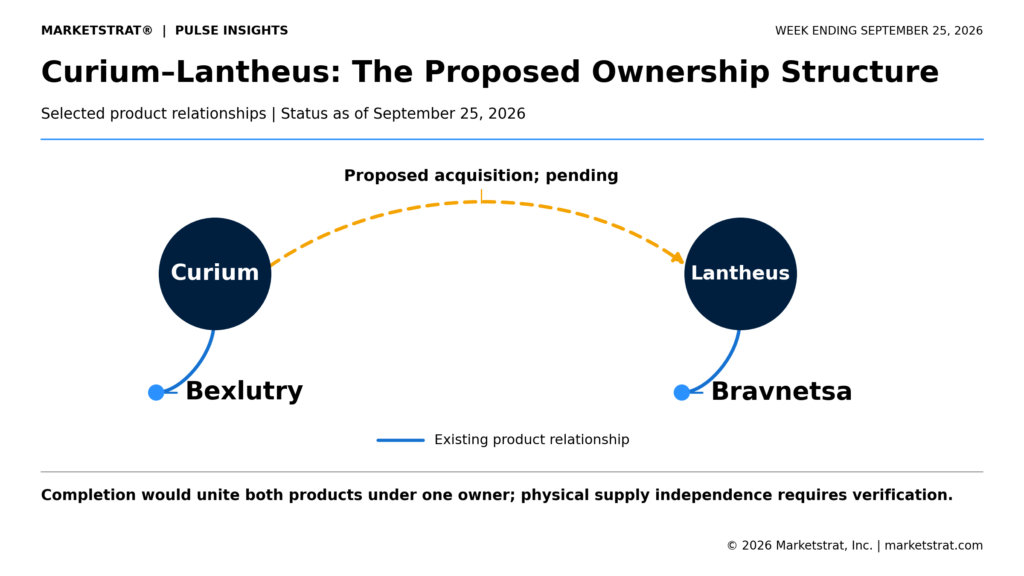
Curium’s previously announced agreement to acquire Lantheus remains pending. Completion would bring Bravnetsa and Curium’s Bexlutry under common ownership. The products have different regulatory routes, and the companies remain independent until closing.
An additional product may improve terms or service within existing treatment activity. Assessing that benefit requires separate measures for product choice, corporate ownership and physical supply redundancy. Specific shared manufacturing dependencies between these products remain unverified in the available evidence.
Purchasers should establish which alternatives could remain available during the same disruption. That assessment connects supplier diversification to the practical requirements of treatment continuity.
Telix’s acquisition proposal links supply and therapeutic development
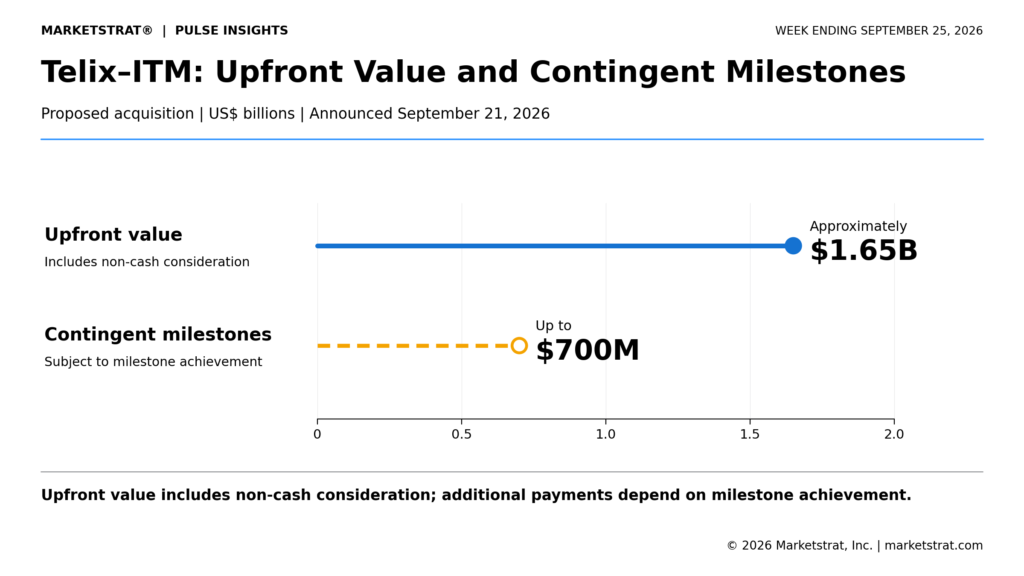
Telix’s proposed ITM acquisition carries approximately $1.65 billion of upfront value and up to $700 million in contingent milestones. The upfront figure includes non-cash consideration, and transaction completion remains conditional.
The existing isotope business serves customers whose demand depends on their own production requirements. Therapeutic development depends on the progress and commercial performance of individual products. These activities warrant separate assumptions about revenue, spending and operating risk.
Following completion, Telix would need to sustain the external supplier franchise alongside its internal development programs. Customer confidence in dependable supply remains part of the acquired business’s value.
ITM-11’s manufacturing-related FDA complete response letter, received in August, adds a specific execution risk. Its outstanding product-manufacturing and authorization requirements need resolution before commercialization. The acquisition would provide ownership of infrastructure alongside responsibility for the continuing development work.
Strategic buyers should evaluate the cost and reliability of available supply arrangements. Dependable contractual access could provide adequate security with a smaller capital commitment and operating burden. The case for ownership depends on the additional capability and control it can deliver economically.
Sectra makes the handoff part of the service
Sectra’s three-year Source BioScience agreement concerns pathology collaboration through its Image Exchange Portal. Work can be assigned to external specialists and completed reports returned to the originating workflow.
The full service spans acceptance, assignment, interpretation and report return. Its commercial value depends on reliable coordination across those steps and clear responsibility for resolving exceptions.
A separate September 24 disclosure described Northeast Georgia Medical Center’s earlier Sectra One Cloud go-live across radiology, breast imaging and cardiology. It supplies a named operating reference. The go-live occurred before September, and measured productivity gains remain unestablished in the disclosure.
Managing system operation and support can deepen a supplier’s role and create continuing service obligations. Providers should identify which tasks the supplier assumes, what remains local and how the arrangement affects total operating cost.
UltraSight changes the allocation of work
UltraSight announced $24 million in financing to support commercial expansion and further development of AI-guided cardiac workflows. Its proposition allows more clinicians to acquire focused examinations while physicians retain oversight.
Expanded acquisition could improve access to useful imaging. It can also increase review, repeat imaging and downstream referrals. Those demands belong in the economics of the workflow.
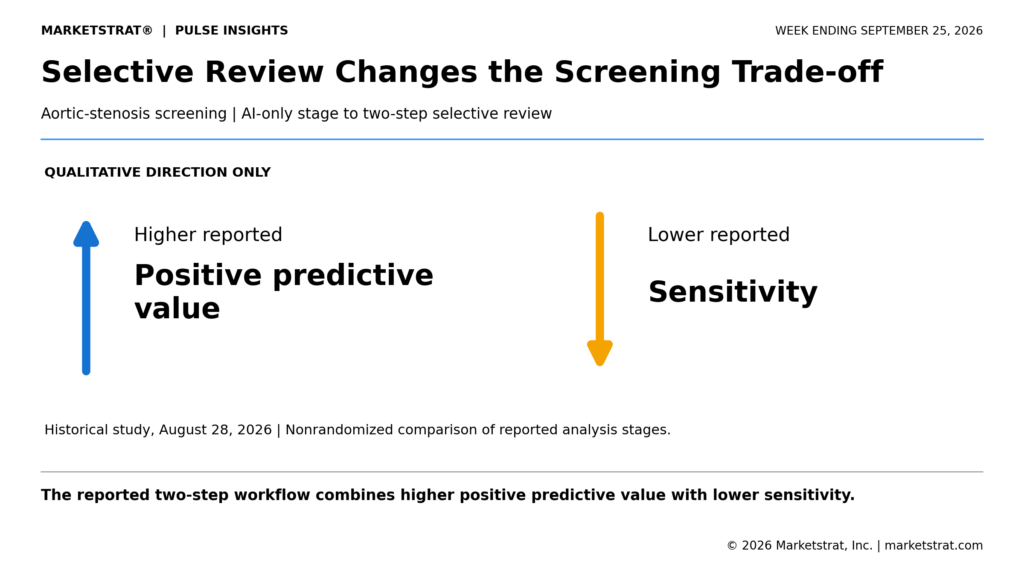
Historical aortic-stenosis screening evidence discussed in the research note makes the clinical qualification concrete. A two-step workflow with selective review reported higher positive predictive value and lower sensitivity than the AI-only stage. The comparison was nonrandomized and concerned reported analysis stages.
Specialist workload requires further evaluation. Review frequency and review effort can differ substantially: a small set of difficult cases may consume considerable clinical time. The evidence leaves staffing savings and performance across additional clinical settings unproven.
Providers should assess how many useful decisions the combined workflow supports after accounting for the remaining specialist work and downstream care requirements.
Capacity gains are credible only after the remaining specialist and operating work is counted.
What changes for commercial decision-makers
Purchasing teams should evaluate reliability and service responsibility alongside product specifications. The value of an alternative supplier depends on whether its delivery arrangements address the account’s actual constraint.
For strategic acquirers, existing operations and prospective product opportunities warrant separate assessment. A transaction can provide valuable capability while introducing customer-retention, utilization and quality obligations. Those commitments belong in the acquisition economics.
Platform and AI vendors need repeatable implementations and economically manageable support. Local customization, ongoing supervision and exception handling can increase the service burden as the customer base grows.
These considerations direct attention to completed clinical work, sustained use and the cost of supporting each account. Implementation evidence is needed to establish the benefits of the initiatives discussed here.
Where the capacity thesis could weaken
Dependable contractual supply could reduce the strategic value of owning production. Customer losses following integration would also challenge the supplier-acquisition case.
Distributed clinical workflows could increase coordination and review effort as quickly as they expand acquisition. Persistent downstream queues would limit the additional activity a provider can complete.
Marketstrat would evaluate these initiatives through reliable recurring activity and the cost of the complete service. A sustainable commercial advantage depends on implementing that operating model repeatedly.
Related research themes: Radiopharmaceutical competition and supply independence; isotope manufacturing and treatment-center capacity; enterprise imaging service responsibility and specialist access; AI-guided cardiac acquisition and complete-workflow economics.
Related Marketstrat Research
Global Nuclear Medicine & PET Market Horizon August 2026 | 2025A–2036E The broader assessment of diagnostic and therapeutic radiopharmaceuticals, theranostics, isotope supply, manufacturing, provider capacity and market forecasts.
Sources: Company disclosures, regulatory materials and peer-reviewed evidence; Marketstrat analysis.
Research process: Marketstrat uses a human-led, AI-enabled workflow. AI systems materially support synthesis, modeling, drafting, coding, and quality control. Marketstrat sets the methodology, evaluates the evidence, determines the conclusions, and approves all published content.
About Marketstrat
Marketstrat® is an independent market intelligence firm focused on MedTech, medical imaging, imaging AI, enterprise imaging, PACS, and adjacent healthcare technology markets. Through its Markintel® research methodology and publishing system, Marketstrat produces Horizon Reports, Focus Reports, Company Research, Market Signals, and weekly Pulse Insights. The firm’s research combines market sizing, forecasting, segmentation, competitive mapping, company intelligence, and event-driven analysis to help corporate strategy, product, commercial, investment, consulting, and industry media professionals interpret fast-moving healthcare markets with greater clarity.
Marketstrat® and Markintel® are registered service marks of Marketstrat, Inc.
Our Research
Horizon Reports — Comprehensive market landscape assessments with sizing, segmentation, forecasting, and competitive mapping across multi-year time horizons.
Focus Reports — Targeted market intelligence reports on specific segments, technologies, or competitive dynamics drawn from Marketstrat’s broader Horizon research program.
Company Research — Decision-grade company intelligence covering strategy, competitive positioning, product portfolio, business model, financial structure, partnerships, and stakeholder impact.
Market Signals — Event-driven analysis tied to specific catalysts, including regulatory actions, M&A, product launches, policy shifts, reimbursement changes, and earnings. Each signal is structured around strategic implications, not just news.
Pulse Insights — Weekly market intelligence digest covering what moved, what it means, and what to watch across healthcare, MedTech, medical imaging, imaging AI, and adjacent life sciences markets.